
India-Bangladesh trade meet ahead
Businesses urge removal of tariff, non-tariff barriers to boost export
Trade gap against Bangladesh remains a concern
JASIM UDDIN | Thursday, 14 May 2026
Bangladeshi businesses request that the government take initiative to enhance exports to India through land ports and remove roadblocks to trade with the largest neighbouring economy to bridge a yawning gap.
According to industry insiders, they made the requests in proposals submitted to the Ministry of Commerce ahead of the 16th meeting of the India-Bangladesh Joint Working Group on Trade, scheduled to be held in Delhi in June.
On their part, the Indian government may raise issues regarding the reopening of land ports for yarn exports to Bangladesh and addressing matters related to bilateral agreements signed during the Awami League-led government, according to sources concerned.
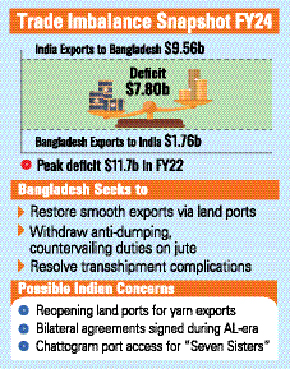
These issues came to light after the Ministry of Commerce sent separate letters to trade bodies, government organisations and ministries seeking their proposals, as well as updates on the implementation of decisions taken in the previous round of talks.
According to ministry sources, the Bangladesh government has already requested its Indian counterpart to fix a date in June for the Joint Working Group meeting to be held in Delhi.
Speaking to The Financial Express, Commerce Secretary in charge Abdur Rahim Khan said Bangladesh had proposed two dates in June, in line with diplomatic practice, and India would choose either.
President of BGMEA Mahmud Hasan Khan says the main challenge in Bangladesh-India trade at present lies in problems related to both import and export through land ports.
He also opines that there are complexities involving some of the online procedures previously in place. For example, BTMA has alleged that some firms are making "false declarations" on yarn imports.
To address these issues, all relevant stakeholders, including the government, BGMEA and BTMA, will have to work together.
"India, too, will need to adopt a cooperative stance on the matter. There should not be a situation where imports through land ports are completely halted," he told the FE.
He added that transshipment is also an issue and may receive importance on the meeting agenda.
"We will clearly raise these issues. They may say that the allegations have no basis. There are several other such matters as well," says the association chief of the largest export sector.
Mohammad Hatem, president of BKMEA, says Indian restrictions on export through land ports should be withdrawn to facilitate trade, which overwhelmingly remains in India's favour.
He also mentions that non-tariff barriers remain another major issue. "For example, in the case of laboratory tests or BSTI certification, Indian authorities often do not accept certificates issued here," he says.
"In some cases, exporters are forced to obtain certification from another Indian state, which is very difficult for us," he regrets.
Tapas Pramanik, chairman of Bangladesh Jute Spinners Association, expresses grave grievances over jute-export restrictions. Jute exporters have faced anti-dumping duties since 2017.
Furthermore, he says, India has initiated steps to impose countervailing duties on imports of jute goods from Bangladesh, which he describes as unreasonable.
He alleges that India has started the countervailing-duty investigation without following proper rules and procedures. "They are doing this, which is a form of coercion by the Indian government," he remarks, adding that the investigation has been conducted in a one-sided manner.
He urges that the government must take the matter seriously and respond appropriately, adding that the issue should be raised in the next round of bilateral talks.
"If they do not agree to withdraw it, Bangladesh should go to the WTO," he suggests.
"Exports through land ports have been suspended, increasing costs. Apart from that, there are tariff-and non-tariff barriers. If countervailing duties are imposed again, the business sector will face even greater losses," he laments.
Echoing the views of the business leaders, former member of Bangladesh Trade and Tariff Commission Dr Mostafa Abid Khan says Bangladesh should strongly raise the matter of removing restrictions on exports through land ports. "Otherwise, export would be severely affected and the trade gap would widen further."
This, in his view, should be a key agenda item for the Bangladesh side. In response, presumes, the Indian side might raise the issue of removing restrictions on yarn imports through land ports.
He also says the government should raise the issue of anti-dumping and countervailing duties on Bangladeshi jute exports to India.
Dr Mostafa Abid Khan also expresses concern over the upcoming negotiation being held when a BJP-led government has recently emerged in West Bengal.
He thinks they might raise questions about the effectiveness of all bilateral agreements signed with Bangladesh during the Awami League regime, especially regarding permission to use the Chattogram port for the "Seven Sisters" region.
According to data from the Export Promotion Bureau (EPB) and the Bangladesh Bank, the trade relationship between Bangladesh and India is marked by a significant and persistent trade deficit for Bangladesh.
newsmanjasi@gmail.com
Over the past five fiscal years (FY2019-20 to FY2024-25), Bangladesh's imports from India had consistently outweighed its exports, resulting in a substantial trade gap that peaked at US$ 11.70 billion in FY2021-22.
Although Bangladesh's exports reached $1.76 billion in FY2024-25, imports during the same period stood at $9.56 billion, leaving a trade deficit of $7.79 billion.
This imbalance highlights a long-term trend in which Bangladesh remains heavily reliant on Indian goods while maintaining a comparatively smaller export base.
Major export s to India include woven garments, knitwear, jute and jute goods, footwear and home textiles. India's major exports to Bangladesh include cotton, vegetable products, chemicals and allied industry products, and mineral products.