
PERCEIVED INCONGRUITIES IN LABOUR LAW AMENDMENT
Four major trade orgs to seek review of three amended provisos
They may seek legal remedy, if needed
JASIM UDDIN | Tuesday, 16 December 2025
Four major trade bodies in Bangladesh's industrial realm seek a rethink on three key amended sections of the labour law as they believe such new provisos could adversely affect employment and hike the cost of doing business.
As planned, the organisations will initially request the reigning interim government to scrap those sections of the law.
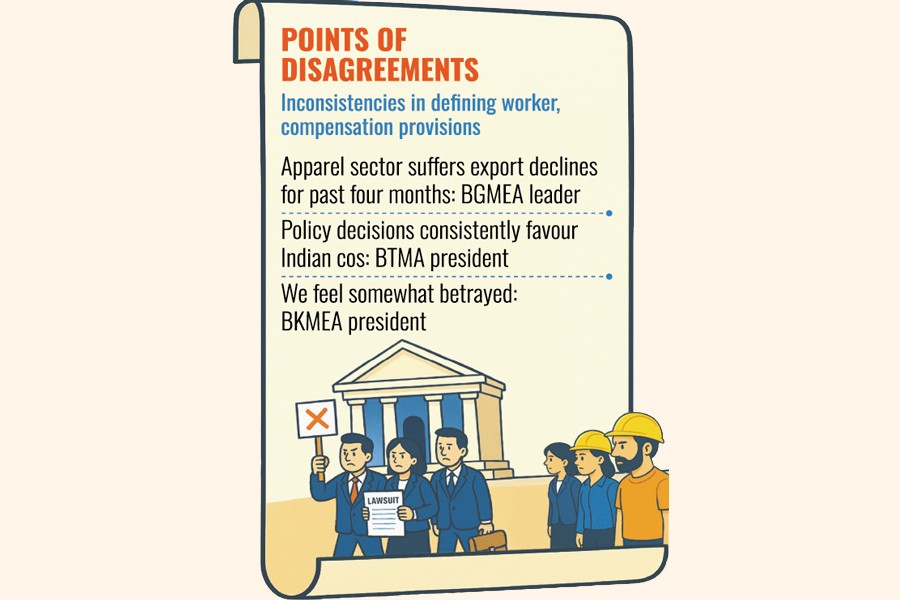
They claim there are gross anomalies in the wording of different parts of the legislation, including inconsistencies in defining worker, compensation provisions, and the incorporation of several "illogical" clauses in the law.
If their request is not addressed, the organisations will later file with the High Court a writ petition challenging the impugned sections. "We've already appointed legal counsel to plead for us," says a senior official of the associations.
The trade bodies gearing up for the legal challenge are Bangladesh Textile Mills Association (BTMA), Bangladesh Garment Manufacturers and Exporters Association (BGMEA), Bangladesh Knitwear Manufacturer and Exporters Association (BKMEA) and Bangladesh Employers' Federation (BEF).
According to the drafted writ petition, the petitioners plan to challenge the impugned provisions of Section 2(65), Section 27(4), Section 175, Section 179(1)(ta), and Section 179(2) of the Bangladesh Labour Act 2006, as amended by the Bangladesh Labour (Amendment) Ordinance 2025, published in gazette on November 17, 2025.
They argue these provisions are repugnant to and ultra vires of the petitioners' fundamental rights as guaranteed under Articles 26, 27, 31, 32, 40, and 42 of the Constitution of Bangladesh.
Talking to The Financial Express, Barrister Kazi Akhter Hossain says, "As per our discussions, we are making preparations to challenge these sections of the Bangladesh Labour (Amendment) Ordinance."
BGMEA Vice-president Rezwan Selim says several issues agreed upon with the government during consultations at the Tripartite Committee are missing from the Bangladesh Labour (Amendment) Ordinance 2025.
"This is not a healthy way to uphold agreements with the government," he adds.
He points out that the amended law defines "worker" in a way that includes top executives such as General Manager (GM), Production Manager (PM), and even CEO, which he describes as illogical.
The export-industry leader warns that if the amendment ordinance is not further amended, it will significantly increase business costs. "The law has now become completely contrary to the goal of creating new employment," he says.
On top of the 9.0-percent wage increment, the introduction of a provident fund (PF) would place an additional burden on many RMG exporters, especially as the Trump-era tariffs have already disrupted the global supply chain. As a result, Bangladesh's apparel sector has experienced consecutive export declines for the past four months.
"We are not against the provident fund, but this is not the right time," Rezwan argues.
President of BTMA Showkat Aziz Russell says the government move to amend the labour law appears to assume that the country has already achieved labour standards comparable to Singapore or European nations.
He adds: the authorities moved very quickly to amend the labour law, while paying little attention to job creation, which is "crucial for the economy and for rebuilding the country".
He claims nearly 250 garment factories and 50 textile mills have already closed, with investments in each ranging from Tk 5.0 billion to Tk 7.0 billion.
The BTMA president alleges that such bureaucratic moves suggest an intention to shift textile-and garment-industry capacity to India, claiming that policy decisions consistently favour Indian companies.
He further states that anyone who speaks out against Indian interests may face consequences, citing Sharif Osman Hadi as an example. "But I am ready for that."
The textile-sector leader also deplores that several think-tanks-such as the Centre for Policy Dialogue (CPD), Policy Research Institute (PRI), Research and Policy Integration for Development (RAPID), Policy Exchange of Bangladesh (PEB) and South Asian Network on Economic Modeling (SANEM)-regularly analyse the costs, benefits, losses, and profits of government incentives, but have recently appeared reluctant to do so.
Also, he has raised questions as to why the country's civil society remains silent on these issues related to national interests.
President of BKMEA Mohammad Hatem says after consultation at the Tripartite Committee they see the ordinance. "We feel somewhat betrayed."
He adds that although the industry accepted concessions in many areas, "we asked for safeguards in only three issues, yet even those have gone against the interests of the industry."
He says through the changes in labour laws for apparel sector, it appears, "the seeds of destruction have been sown-just as happened to the jute sector-which will become visible over time".
He sounds alarm that if the government does not take steps for further amendment, apparel industry may face a crisis similar to the consequences once seen in the jute sector.
However, Bangladesh Employers' Federation (BEF) President Fazlee Shamim Ehsan says they would initially request the government to further amend certain sections of the law.
He finds gross anomalies in the wording of different parts of the legislation, including inconsistencies in the definitions of worker, compensation provisions, and the inclusion of several "illogical" clauses.
"The labour law has made unionisation easier...there are no adequate provisions to ensure checks and balances in the democratic process," says the leading employer.
newsmanjasi@gmail.com