
Gold sales to face 15pc capital gain tax
FE REPORT | Monday, 15 June 2026
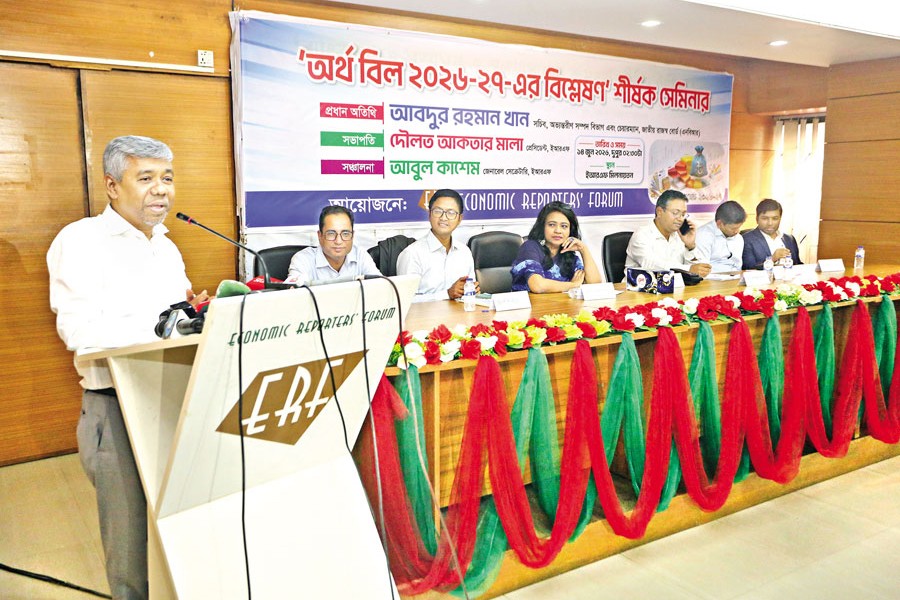
The National Board of Revenue (NBR) has classified personally owned gold jewellery as a capital asset rather than a personal asset, making gain from its sale subject to a 15 per cent capital gains tax.
Revenue officials say the measure, modelled on practices in several European countries, is aimed at curbing tax evasion.
The remarks were made at a seminar on the Finance Bill held at the Economic Reporters' Forum (ERF) office in Paltan on Sunday.
NBR Chairman Md Abdur Rahman Khan attended the seminal as the chief guest with ERF President Doulot Akter Mala in the chair.
Officials from the NBR's income tax, customs and VAT policy wings also addressed the seminar.
Tax consultant Snehasish Barua questioned the rationale for treating a personal asset such as gold jewellery as a capital asset.
In response, Md Jafar Imam, first secretary of the Income Tax Policy Wing, said the provision follows international standards and is already practised in many European countries.
"Many taxpayers declare gold in their tax returns but leave its value unspecified. This creates room for tax evasion, which the new provision seeks to address," he said.
The NBR chairman also clarified that the proposed budget neither raised taxes on savings certificates nor included any provision for whitening undisclosed income, commonly known as black money.
"No additional tax has been imposed on savings certificates. Rather, adjustments will be made under the new system, and in many cases we may have to refund advance tax. We are committed to doing so."
On the issue of black money, he said there had never been any plan to introduce such a provision. "Although there was pressure from the real estate sector, the government made it clear from the outset that there would be no opportunity to legalise undisclosed income through the budget."
Responding to questions about how the government intends to collect more than Tk 6.0 trillion in revenue, the NBR chairman said the budget provides extensive incentives to help revive economic activity.
"We have offered significant concessions to stimulate business growth. As businesses expand, revenue collection will naturally rise. At the same time, a substantial amount of revenue can be generated by curbing tax evasion," he said.
Mr Khan noted that the growing digitisation of tax administration has significantly improved the NBR's access to data.
"If we can strengthen audit selection and enforcement, revenue collection will increase considerably."
He also said the newly-proposed tax of Tk 2 per Tk 1,000 at the retail level would generate a meaningful amount of revenue without having a noticeable impact on prices.
To reduce tax evasion in the cigarette sector, the NBR plans to introduce a track-and-trace system using unique identification codes.
Mr Khan said the authority has set a revenue target of Tk 480 billion from tobacco products.
He added that this year's budget places greater emphasis on eliminating unjustified taxes than on imposing new tax burdens.
The chairman also highlighted measures aimed at boosting exports, including extending bonded warehouse facilities to all exporters and simplifying VAT registration procedures.
Speaking on income tax reforms, Mr Imam said the required deposit for filing tax appeals has been reduced, while a mechanism is being introduced to ensure tax refunds are processed within 120 days.
Md Tariq Hassan, first secretary of the Customs Policy Wing, outlined key customs-related changes in the proposed budget.
He said special attention should be paid to products receiving import-duty concessions. Significant incentives have been offered to electric vehicles and the pharmaceutical industry, while the semiconductor sector has been identified as a priority area.
newsmanjasi@gmail.com