
Govt drafting five-year strategic plan to spur economic growth
FE REPORT | Thursday, 16 April 2026
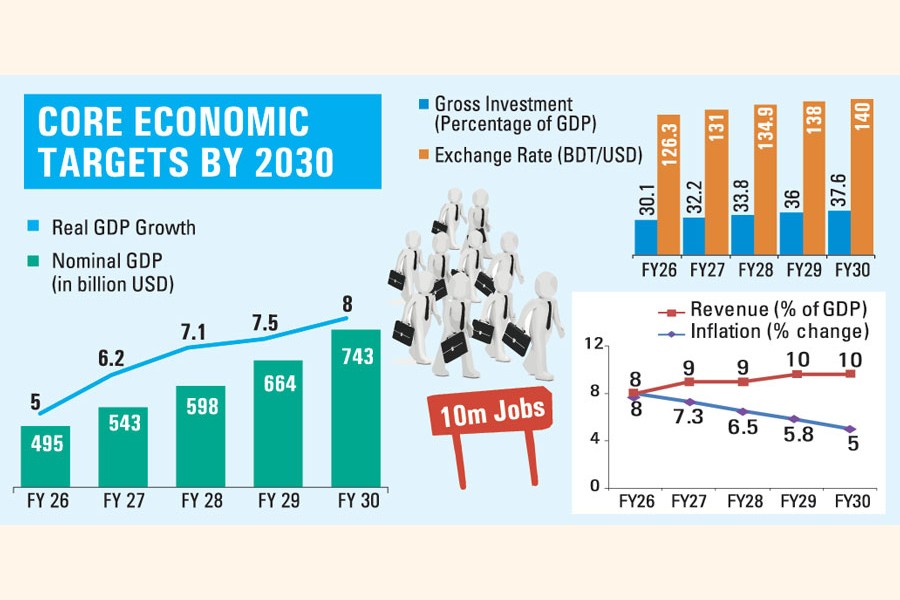
The government has begun formulating a new five-year strategic framework aimed at steering the economy from stabilisation to investment-led growth, setting ambitious targets for expansion and job creation.
The plan seeks to raise economic growth to 8.0 per cent by 2030 and increasing gross investment to 36.7 per cent of GDP, while addressing structural weaknesses and laying the groundwork for sustained long-term development.
Policymakers say the strategy will prioritise realistic, implementable reforms, marking a shift away from past planning approaches that often failed to align targets with ground realities.
"The initial measures of the plan, to be implemented up to 2030, will focus on recovery and stabilisation of the economy, with restoration efforts targeted within the next year," said Dr Rashed Al Mahmud Titumir, adviser to the Prime Minister on finance and planning, on Wednesday.
He made the remarks at a press briefing at the NEC Auditorium in the capital following the first meeting of the advisory committee formed to prepare the framework, chaired by Dr Wahiduddin Mahmud, former planning adviser to the interim government.
Zonayed Abdur Rahim Saki, State Minister for Planning, attended the programme, organised by the General Economics Division (GED) of the Planning Commission.
Documents presented at the meeting show that the proposed framework aims to create around 10 million jobs across diversified sectors by enhancing capital productivity, while raising revenue collection to 10 per cent of GDP.
The plan also targets increasing nominal GDP to $742.57 billion by 2030 from the current $495.17 billion, as part of efforts to achieve the election manifesto goal of building a $1.0 trillion economy by 2034.
Speaking at the briefing, Dr Titumir said the proposed framework would move away from "reality-disconnected and numbers-driven narratives" of the past and instead focus on a pragmatic, implementable strategy aligned with current economic conditions and future challenges.
He said ensuring accountability and a clear implementation roadmap would be a core feature of the new planning approach.
He noted that the government intends to introduce three fundamental shifts in economic planning, as earlier plans often showed significant mismatches between targets, statistics and ground realities.
These gaps are now under review, and future plans will be designed to be both realistic and responsive to public needs.
Referring to the "democratisation of the economy", he said economic planning must ensure participation of all stakeholders and reflect people's needs and aspirations. Aligning public expectations with economic realities will remain a key priority in the new framework.
On food and energy security, he said the government is considering building strategic reserves to cushion against future shocks, while also increasing domestic gas exploration and production and strengthening overall energy security.
He stressed that ensuring a stable power and energy supply would remain central to the development strategy.
He further said that economic strategies become effective only when grounded in present realities and designed with future risks in mind, noting that many past plans were detached from people's needs and overly dependent on abstract numerical projections.
On industrialisation and diversification, he said Bangladesh must rethink its industrial strategy with greater emphasis on competitiveness, productivity and diversification.
However, citing recent economic census data, he noted that industrial output has shown a downward trend, which is a matter of concern.
Planning Adviser Zonayed Abdur Rahim Saki said the country is currently facing a fragile economic situation and that the government has inherited a weakened macroeconomic structure.
He said the objective is to move from recovery towards a structured path of long-term prosperity.
He noted that past development planning often failed in implementation, with limited alignment between plans and outcomes. "That is why the Planning Ministry has begun reviewing the existing situation, evaluating past results and assessing ongoing projects," he said.
He added that continuity in development programmes should not mean uncritical continuation of all projects. Instead, ongoing initiatives must be restructured to align with the government's goals of economic democratisation and reducing inequality.
GED member Dr Monzur Ahmed said the initial idea was to adopt a two-year recovery strategy, but the formation of an elected government with a clear mandate has led to a broader approach.
He said the new framework will combine recovery, restoration and reconstruction into a comprehensive five-year strategic plan. The advisory committee has already started work, and several background studies have been completed.
He added that a draft strategic framework is expected within two months, followed by wider consultations with stakeholders. The final document is expected within the next two to three months for subsequent implementation planning.
Key targets of the strategy
The plan sets ambitious macroeconomic targets, including achieving a $1.0 trillion economy by 2034, raising foreign direct investment to 2.5 per cent of GDP, and increasing the tax-to-GDP ratio to 15 per cent by 2035.
Key growth drivers have been identified in sectors such as information and communication technology (ICT), the blue economy and renewable energy, with a target of generating at least 20 per cent of electricity from renewable sources by 2030.
Employment generation remains a central focus, with the framework aiming to create around 10 million jobs through structural reforms and sectoral expansion, alongside the recruitment of 500,000 government employees through merit-based processes.
On the social front, the plan proposes the introduction of a "family card" for around 40 million vulnerable households and a gradual increase in public expenditure on health and education to 5 per cent of GDP each.
The framework also outlines a range of governance and institutional reforms, including a 10-year term limit for the prime minister, the introduction of a bicameral legislature with a 100-member upper chamber, and the reintroduction of a neutral caretaker government system.
According to projections, real GDP growth is expected to reach 8.0 per cent by 2030, while inflation is projected to decline to 5.0 per cent over the same period.
jahid.rn@gmail.com