
Govt looks to shift from rent-seeking economy
FE Report | Sunday, 19 April 2026
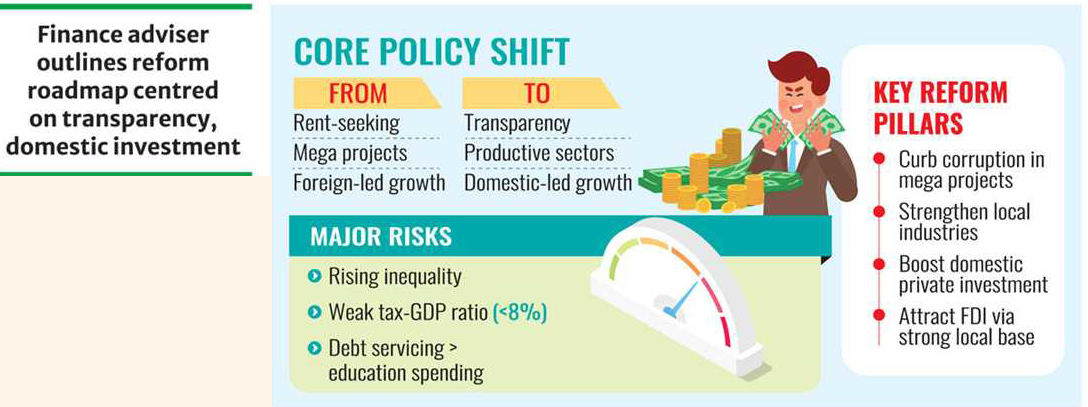
The government has signalled a decisive shift in economic strategy, aiming to move Bangladesh away from entrenched rent-seeking practices towards a more transparent, productivity-driven growth model.
Speaking at a policy seminar on Saturday, Prime Minister's Finance and Planning Adviser Rashed Al Mahmud Titumir outlined a wide-ranging reform agenda focused on curbing corruption, strengthening domestic industries and laying the groundwork for sustainable, investment-led expansion.
The seminar titled "Contemporary Economic Stability, Financial Resilience and the Government's 180-Day Action Plan" was held at the Economic Reporters' Forum (ERF) auditorium in the city.
The adviser unveiled a broad reform roadmap focused on curbing corruption in mega projects, strengthening key productive sectors, and prioritising domestic investment as a driver for attracting foreign direct investment (FDI).
Dr Mustafizur Rahman, Distinguished Fellow of the Centre for Policy Dialogue (CPD), attended as honoured guest.
Special guests included Mahmud Hasan Khan, President of BGMEA; Mohammad Hatem, President of BKMEA; and MdRafiqul Islam, Secretary General of the Footwear, Leather Goods & Accessories Exporters Association (FLAXA). ERF President DoulotAkter Mala chaired the event, while General Secretary AbulKasem moderated it.
In a strong critique of past development practices, Mr Titumir said large infrastructure projects had often been driven by vested interests.
"The mountain of debt accumulated in the past was not realistic; rather, it reflected a culture of crony patronage. Projects were undertaken with the intent of plunder. While a few may have succeeded, the overall economy has suffered," he said.
He emphasised that future growth must be rooted in domestic capacity, arguing that foreign investment would not materialise without a strong local private sector.
"Without investment in the local private sector, no foreign company will come forward. Our priority is to create an enabling environment for domestic entrepreneurs," he added.
Highlighting northern Bangladesh, the adviser said the region already produces surpluses in maize, potatoes, mangoes, lychees and dairy products, indicating strong untapped potential.
He also pointed to emerging export opportunities, including mozzarella cheese production in Thakurgaon and off-season tulip cultivation targeting European markets.
Outlining sector-specific reforms, he stressed strict compliance with Leather Working Group (LWG) standards and full operation of the Central Effluent Treatment Plant (CETP) to boost leather exports.
The adviser also indicated scope for improving efficiency through private management of selected state-owned enterprises, citing Sonargaon Hotel as an example.
In the pharmaceutical sector, he said upgrading the Directorate General of Drug Administration (DGDA) to World Health Organization (WHO) standards was essential for export diversification.
He further highlighted Dholaikhal's light engineering cluster as a national asset requiring modernisation, and called for addressing inequalities in agriculture, noting disparities in fertiliser and subsidy access between small tea growers in Panchagarh and large estates in Sylhet.
While the government has set ambitious GDP growth targets of 10 per cent by 2030 and 15 per cent by 2035, Mr Titumir criticised unrealistic revenue projections by the National Board of Revenue (NBR).
"Setting targets based on fiction undermines institutional credibility. We believe in realistic goal-setting," he said.
He also stressed the need to elevate local practices into globally recognised standards while safeguarding national interests and respecting international norms.
Referring to global fuel price adjustments, he acknowledged potential domestic impacts.
"An increase in prices could impose an additional burden of around Tk 150 on middle- and lower-income groups. We are trying to keep this burden as manageable as possible. We are accountable to the people and cannot fuel inflation," he said.
He added that Bangladesh Bank would soon introduce a comprehensive package to restore discipline in the banking sector, including liquidity support and stronger regulatory measures.
Restoring financial accountability and ensuring a people-friendly governance framework, he said, remain key priorities.
Dr Mustafizur Rahman said the current government faces an "acid test" from the outset, starting from a more difficult position than in 2009 due to high inflation, weak investment and instability in the banking sector.
He noted a dual challenge of LDC graduation by 2026 or 2029 and achieving SDG targets by 2030.
He identified three key challenges: managing inherited vulnerabilities, maintaining policy autonomy amid IMF conditionalities and geopolitical pressures, and ensuring inclusive growth. Despite economic expansion, he said inequality has worsened, with the income gap between rich and poor rising from 32 times in 2010 to 81 times in 2022.
He called for higher allocations to education and social protection but warned that fiscal space is limited.
He also pointed to weak revenue mobilisation, with the tax-to-GDP ratio still below 8 per cent against a 16 per cent target, suggesting politically difficult reforms such as inheritance and wealth taxes.
He warned that Bangladesh risks both a "middle-income trap" and a "debt trap", noting that debt servicing costs have already exceeded education spending.
BGMEA President Mahmud Hasan Khan said frequent policy shifts undermine industrial stability and urged the government to adopt at least five-year policy frameworks.
He announced reduced BGMEA service charges to promote rooftop solar adoption and proposed converting 1.2 million diesel irrigation pumps to solar, which could generate around 900,000 jobs.
He also called for the release of blocked funds in five merged banks and the expansion of the Green Transformation Fund (GTF) and Technology Development Fund (TDF). He stressed the need for a second man-made fibre refinery and suggested prioritising the Dhaka-Chattogram Expressway over a second Padma Bridge for efficiency gains.
BKMEA President Mohammad Hatem welcomed the deferment of LDC graduation, calling it a crucial decision, and thanked the Prime Minister for preventing what he termed a "self-defeating outcome".
He flagged unresolved issues in labour law, particularly Section 27 on resignation benefits.
He said tax and regulatory barriers are limiting solar energy adoption and noted declining exports since the Covid-19 pandemic. Weak banking cooperation and central bank policies, he added, are affecting factories and employment. He also criticised global trade practices, arguing that while compliance pressures exist, there is no mechanism ensuring fair pricing from foreign buyers.
He described the EU's due diligence law as "flawed" due to the absence of provisions for monitoring ethical pricing.
MdRafiqul Islam said Bangladesh is the world's seventh-largest footwear producer and 15th-largest exporter, contributing 3.45 per cent of national exports and employing around one million people.
He called for upgrading the CETP at the Savar Leather Industrial Park to full capacity and achieving LWG certification to strengthen export competitiveness.
He also urged the inclusion of footwear and leather goods in trade agreements with Japan, Korea and the EU for duty-free access, alongside maintaining cash incentives, improving port efficiency and ensuring rational energy pricing.
newsmanjasi@gmail.com