
Where research meets reckoning
How young scholars are learning to defend their ideas
Tasnimul Islam | Sunday, 17 May 2026
There is a particular kind of pressure that comes not from an examination hall but from standing beside your own work while someone with a doctorate tries to find the cracks in it. No multiple-choice questions, no partial credit, no retreating behind vague answers. Just you, your research poster, and seven minutes to convince a panel of academics that what you have spent weeks producing is methodologically sound, intellectually honest, and actually worth anyone's attention.
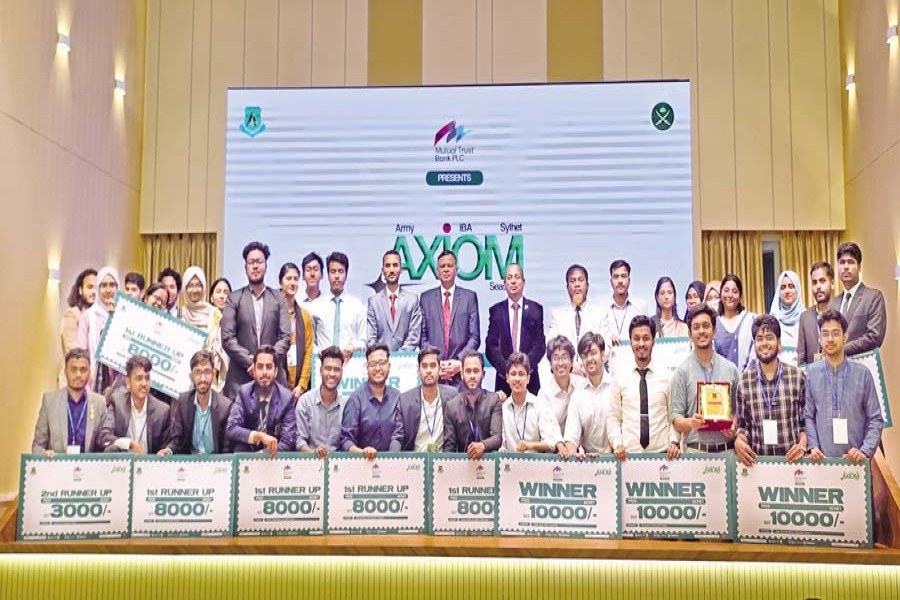
This is, more or less, what 70 undergraduate research teams faced on the morning of at the Army Institute of Business Administration (Army IBA), Sylhet, recently when the institution hosted its National Research Poster Competition-2026. It is also, educators would argue, precisely the kind of experience that transforms a student who has learnt to study into one who has learnt to think.
Bangladesh produces hundreds of thousands of university graduates each year. Far fewer emerge with the ability to frame a research question with precision, select an appropriate methodology, interpret findings without overstating them, and then defend all of those choices under scrutiny. The gap between these two groups is not merely academic; it shapes who contributes meaningfully to policy, to industry, and to public knowledge. Events such as this one are, in that context, less a celebration than a corrective.
The competition was sponsored by Mutual Trust Bank PLC and co-sponsored by Al-Haramine Hospital Pvt. Ltd. A spokesperson for MTB remarked that the methodological sophistication on display, from instrumental variable regressions to field-collected biospecimen data, exceeded what one would ordinarily expect at undergraduate level, and the bank indicated it would seek to incorporate selected working papers into an internal policy brief series. Al-Haramine Hospital noted that several posters addressing antimicrobial resistance and maternal health indicators offered actionable insights for Sylhet's clinical protocols, framing its co-sponsorship as consistent with the organisation's goal of promoting community-engaged health research.
The seventy posters had been shortlisted through a blind pre-review process conducted by the Army IBA Research Cell and were presented across five parallel thematic tracks, each assessed by a panel of two doctoral-level academics. Evaluation was weighted heavily towards research content, methodology, and significance, approximating the standards of a peer-reviewed academic conference rather than a conventional student competition.
In the Finance, FinTech, Artificial Intelligence and Digital Transformation in Business category, the champion award went to team Bellwether from Army IBA Sylhet for research examining the effect of geopolitical risk and inflation on small industry lending rates in Bangladesh. Fact Finders of Shahjalal University of Science and Technology became first runner-up for a panel data analysis comparing Islamic and conventional banks across efficiency, liquidity risk, and asset quality metrics. Behavioral AI Lab from North East University Bangladesh became second runner-up for a behavioural and cost-aware framework for churn prediction in mobile financial services, which they titled Churnomics.
The Business Strategy, Entrepreneurship, Marketing and Consumer Behaviour track was won by team NutriSafe from Sylhet Agricultural University, whose research examined consumer concern, practices, and purchasing behaviour around food safety in Sylhet City. Team EcoWeave of Shahjalal University of Science and Technology followed in first runner-up position for a study evaluating the commercial viability and environmental impact of agro-waste-based bio-paper in Bangladesh's ready-made garment packaging sector. TriVision of North East University Bangladesh secured second runner-up for a qualitative study on the experiences of local business owners within Sylhet's tourism economy, focused on the metropolitan area.
In the Economics and Development Studies category, Sajid Al-Sadek from Sylhet Agricultural University claimed the championship for work on agro-tourism as a mechanism for sustainable economic growth in the Sylhet district. Team BUBT Gaming and Content Creation and Economic Development from Bangladesh University of Business and Technology became first runner-up for research on the content creation and gaming industry as a source of youth employment opportunity and economic development. A second team from the same institution, Team BUBT Controlling Inflation, secured second runner-up for a study on controlling inflation through market dynamics and government policy.
The Supply Chain, Operations, Human Resource Management and Leadership category was won by team 7x7, a collaboration between Bangladesh University of Professionals and Army IBA Sylhet, for research on the integration of artificial intelligence, digital twin technology, and blockchain for sustainable business operations. The Curiosity Council, a cross-institutional team drawing from Army IBA Sylhet, the Bangladesh University of Engineering and Technology, and Shahjalal University of Science and Technology, became first runner-up for a study on structural barriers to female leadership progression in Bangladesh's ready-made garment sector. Army IBA's own team Catalyst secured second runner-up for a multi-criteria assessment of challenges facing waste-to-energy adoption in Bangladesh, employing an integrated Bayesian BWM-Fuzzy DEMATEL approach.
The Open and Interdisciplinary category was won by FarmNexa from Habiganj Agricultural University for research on an IoT-enabled smart fertiliser recommendation system designed to reduce costs in boro rice cultivation. Army IBA's Snowball became first runner-up for a study on the impact of excessive screen time on attention span and cognitive performance among university students. Green Guardians of Shahjalal University of Science and Technology secured second runner-up for research using structure-based virtual screening of phytochemicals to assess multi-target insecticidal potential against key insect proteins.
The competition also welcomed international participation, with all three awards in that category going to researchers from UniversitiTeknologi MARA (UiTM) in Malaysia. The international champion, Nor Zubaidah Binti NorAlbashri, presented a bibliometric assessment of evolving scholarly narratives on Gaza, mapping humanitarian and geopolitical research trends across the academic literature. Muhammad Nor Azwar Bin Nor'Izam became first runner-up for a conceptual framework proposing a borderless and resilient global classroom model for education in Gaza. Nabilah Binti Aswan secured second runner-up for a study drawing on user satisfaction patterns in Malaysian government-linked companies to examine what drives effective e-learning outcomes.
Major General Dr Monirul Islam Akhand who addressed participants, noted that the finalist posters exhibited methodological pluralism, including panel econometrics with fixed-effects estimation, mixed-methods triangulation through sequential explanatory designs, and GIS-based geospatial analysis. The winning entry in its category, he observed, demonstrated robust diagnostic testing for heteroscedasticity and multicollinearity. These are not phrases one typically associates with undergraduate coursework in Bangladesh, and their appearance in a competitive setting suggests that at least some institutions are producing students capable of working at a genuinely rigorous standard.
Brigadier General Kazi Mohammad Kaiser Hossain, director of Army IBA Sylhet, framed the event in terms that went beyond the immediate results. A research culture, he said, cannot be legislated; it must be practised. The competition was designed to make peer critique, replication-worthy methodology, and public defence of findings into habits rather than occasional requirements.
The day ended not with an awards dinner but with a closed-door workshop on research integrity, covering ethical authorship, data reproducibility, and the hazards of predatory journals. It was a deliberate choice, and a revealing one. The organisers appear to understand that producing one good poster is considerably easier than producing a researcher, and that the habits formed early, around attribution, transparency, and rigour, tend to persist.
For the students who stood beside their work and fielded difficult questions from people who had spent careers finding flaws in other people's arguments, the event offered something that no lecture theatre straightforwardly provides: the experience of being taken seriously. Whether that experience finds its way into refereed journals, into policy briefs, or simply into a more rigorous way of approaching problems in whichever field they eventually enter, it is the kind of formation that Bangladesh's knowledge economy can ill afford to leave to chance.
Dr Tasnimul Islam is assistant professor and head, Center for Research and Development at Army Institute of Business Administration, Sylhet.
drtasnim@aibasylhet.edu.bd