
Petrobangla struggles to recover Tk 2.1b stuck in seven troubled banks
Fund crunch raises concerns over gas projects, IOC payments
FE REPORT | Tuesday, 17 February 2026
State-owned energy corporation Bangladesh Oil, Gas and Mineral Corporation (Petrobangla) is facing mounting challenges in recovering Tk 2.10 billion placed as fixed deposits in seven troubled private and scheduled banks, raising concerns over funding for key gas-development projects.
Despite the maturity of the fixed deposit receipts (FDRs), the banks have reportedly failed to release the funds, sparking fears over delays in critical energy sector activities, sources said.
According to an official letter from Petrobangla, the funds belong to two crucial accounts - the Gas Development Fund (GDF) and the International Oil Companies (IOC) payment fund.
The liquidity strain appears to be most acute among Shariah-based lenders.
A total of 44 FDRs remain stuck across seven commercial banks: First Security Islami Bank PLC, Global Islami Bank PLC, Padma Bank PLC, Union Bank PLC, EXIM Bank PLC, Social Islami Bank PLC and Bangladesh Commerce Bank.
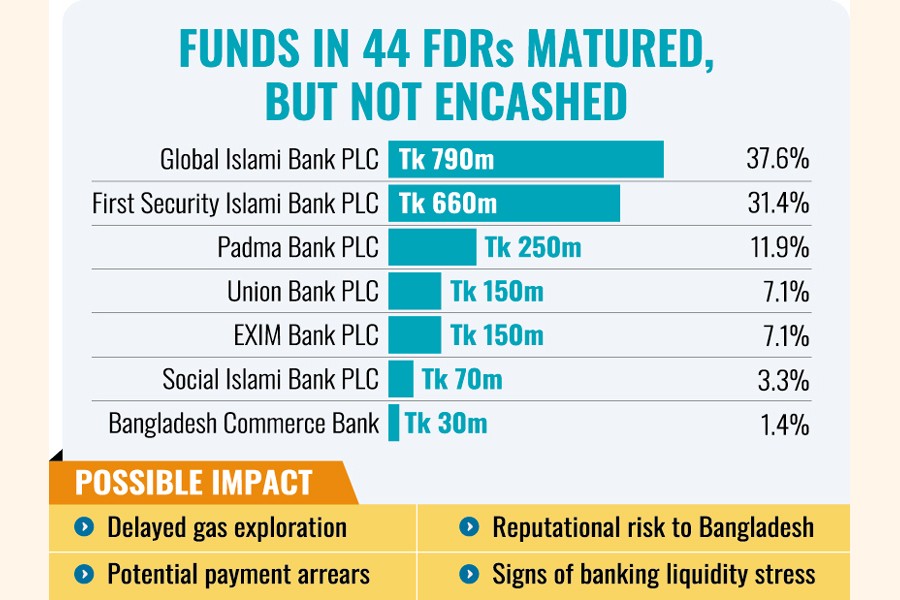
Global Islami Bank PLC holds the largest share of the blocked funds, amounting to Tk 790 million or 37.6 per cent, followed by First Security Islami Bank PLC with Tk 660 million or 31.4 per cent.
The remaining FDRs are distributed among five institutions. Padma Bank PLC holds Tk 250 million (11.9 per cent), while Union Bank PLC and EXIM Bank PLC each hold Tk 150 million (7.1 per cent). The balance is held by Social Islami Bank PLC (Tk 70 million or 3.3 per cent) and Bangladesh Commerce Bank (Tk 30 million or 1.4 per cent).
Petrobangla officials have expressed serious concern that the delay in encashment is hampering domestic gas exploration and production. The GDF is intended to finance new well drilling, boost output and expand gas transmission infrastructure to strengthen the country's energy security.
Financial experts suggest that the failure of multiple banks to honour matured deposits points to deeper systemic liquidity stress.
Beyond the immediate financial impact, Petrobangla has also highlighted potential reputational risks for Bangladesh, particularly regarding its commitments to foreign oil companies.
The IOC fund is used to settle invoices submitted by international oil companies for cost recovery and profit gas.
Failure to make timely payments to these partners could result in additional financial liabilities for the government and damage Bangladesh's standing as an investment-friendly destination for global energy companies, a confidential source said.
"We have requested the Energy and Mineral Resources Division to determine the next course of action regarding the stuck FDRs," the source added.
The state-run corporation has formally requested the managing directors of the concerned banks to cooperate and release the funds without delay. Officials view the prolonged impasse as a significant threat to ongoing and planned energy sector operations.
Contacted for comment, an official of the Financial Division said: "We have received a letter from the Energy and Mineral Resources Division and forwarded it to the relevant offices for necessary action."
rezamumu@gmail.com