
RMG slump drags down Nov exports 5.58pc
FE REPORT | Friday, 5 December 2025
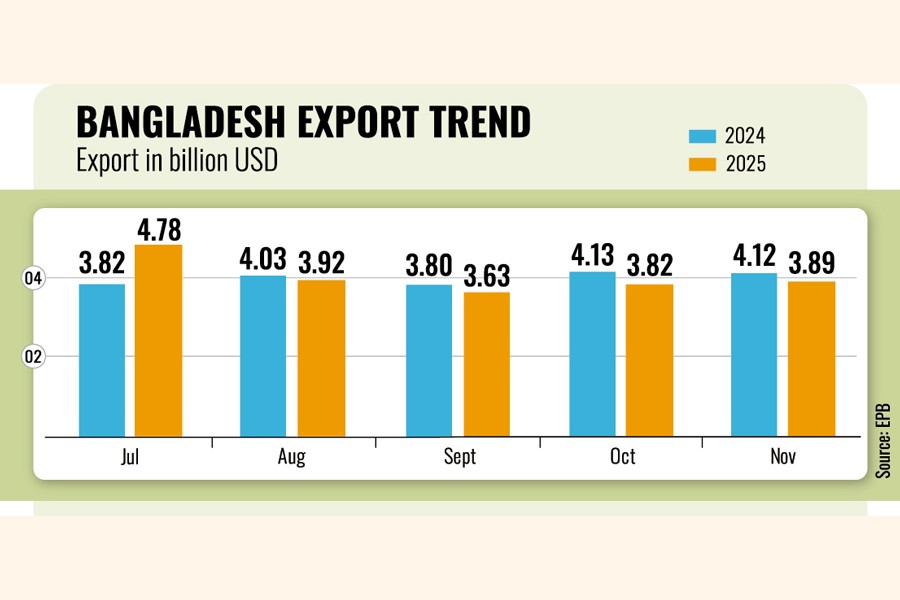
Bangladesh's single-month merchandise export earnings in November 2025 declined for the fourth consecutive month on a year-on-year basis, registering a 5.58 per cent fall compared to the same month in 2024.
The fall was caused by a negative growth of readymade garment (RMG) exports, the country's largest foreign currency earner.
Bangladesh fetched $3.89 billion last month, which was $4.11 billion in November 2024, according to the Export Promotion Bureau (EPB) data released on Thursday.
Exports started witnessing year-on-year negative growth in August 2025, when the country recorded a 2.93 per cent fall.
This was followed by a decline of 4.61 per cent and 7.43 per cent in September and October, respectively.
Of the total November earnings, RMG fetched $3.14 billion, logging a 5.0 per cent negative growth compared to that in the same month of 2024, the EPB data revealed.
The overall exports, however, stood at $20.02 billion during the July-November period of FY26, reflecting a meagre 0.62 per cent year-on-year growth.
Bangladesh earned $19.90 billion in the same period of the last fiscal year.
As usual, RMG maintained its leading position, contributing $16.13 billion - a 0.09 per cent growth - to the total export earnings during the first five months of the current fiscal year.
Within this segment, knitwear exports fell by 1.0 per cent to $8.85 billion, while that of woven garments increased by 1.44 per cent to $7.27 billion.
Sources say while the strong performance in July reflects resilience, the slowdown since August highlights challenges for Bangladesh's export sector amid fluctuating global demand and evolving market dynamics.
Fazlee Shamim Ehsan, executive president of the Bangladesh Knitwear Manufacturers and Exporters Association (BKMEA), tells The Financial Express buyers are "a little bit" worried due to some internal issues, including mismanagement and "some wrong messages".
Explaining those, he says the ratification of the International Labour Organisation (ILO) Convention 190 and some measures taken in the amended labour law have made buyers concerned, while the absence of an elected government has also played a role.
"Buyers will not regain confidence until there is an elected government," he says.
Last year, the sector experienced a crisis for two to two and a half months due to labour unrest in major industrial belts, he also says.
Ehsan attributes the decline in export earnings to the fall in global demand due to US tariff hikes.
During the July-November period of FY26, home textile exports rose 5.68 per cent year-on-year to $345.40 million.
Leather and leather products earned $512.49 million, up 9.88 per cent.
The agricultural sector saw a 6.81 per cent negative growth to $461.63 million.
Jute and jute goods exports rose by 1.36 per cent to $346.34 million, while that of frozen and live fish jumped 6.97 per cent to $211.89 million.
Pharmaceutical exports grew by 2.95 per cent to $95.31 million.
In FY25, Bangladesh fetched $48.28 billion, riding on $39.34 billion earnings from RMG.
Munni_fe@yahoo.com