
Tobacco cultivation rising worryingly in Manikganj
Driven by corporate incentives and high profitability, farmers are shifting towards the crop despite knowing about the risk factors
Wednesday, 6 May 2026
OUR CORRESPONDENT
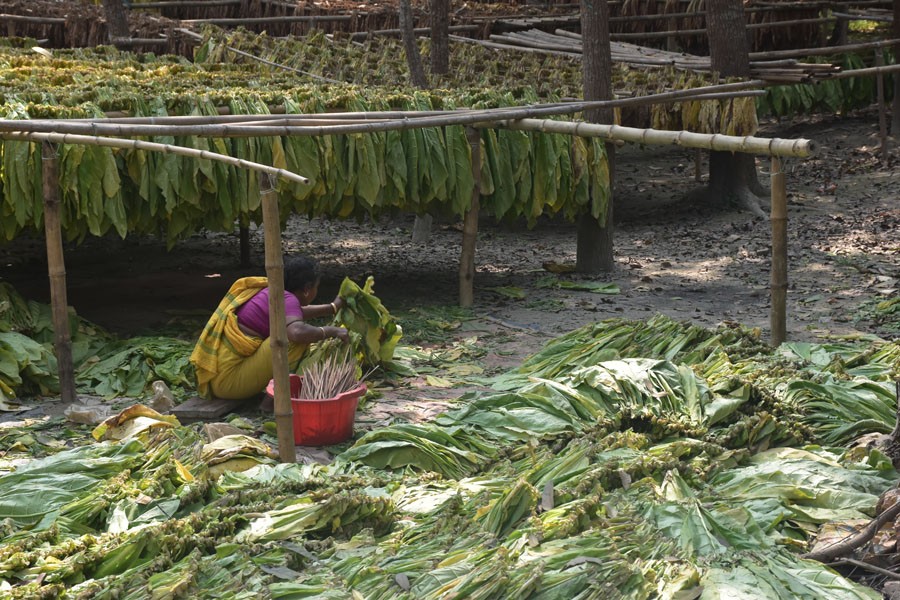
MANIKGANJ, May 05: Tobacco cultivation is expanding rapidly in Manikganj, particularly within Sadar, Ghior, Saturia and Daulatpur upazilas, as farmers are shifting towards the crop despite being aware of the severe environmental and health consequences.
In the four above-mentioned upazilas, several thousand farmers are now involved in tobacco farming, driven by attractive incentives offered by tobacco companies, including easy loans, free seeds and fertilisers, and guaranteed purchase of the harvested crop.
According to the Department of Agricultural Extension (DAE), tobacco has been cultivated on approximately 355 hectares of land in the district this season. Abdul Kalam, a farmer from South Uthli village under Garpara union in Sadar upazila, has been growing tobacco for nearly two decades. This year, he has cultivated tobacco on 12 bighas of land.
"We know tobacco is harmful to health," he said. "But the reality is that we earn more profit from it compared to other crops. Company representatives provide us with money, seeds, and fertilisers at the beginning. After harvest, they buy the produce on a fixed date, so we don't have to worry about finding a market. That's why we cannot leave tobacco farming, despite the risks."
Another farmer from the same area, Abdul Malek, said he cultivated tobacco on a total of 10 bighas of land this season, including both owned and leased land. "The cost per bigha is around Tk 35,000 to Tk 40,000, but after expenses, we can earn a profit of Tk 50,000 to Tk 60,000 per bigha," he explained. "Several companies have registered us and issued cards. We dry the tobacco leaves and sell them to the company buyers at a fixed time, based on quality." In the Tilli area of Saturia, farmer Shahid said tobacco farming has been practiced in their locality for generations. "Almost every farmer here is involved in tobacco cultivation, regardless of land size. Even those with small plots grow tobacco because it brings nearly double the profit compared to other crops," he said.
He added that contract farming with tobacco companies has made the process easier. "Company representatives regularly visit the fields and guide us on cultivation methods. We don't get this level of support for other crops. That's why many farmers are turning to tobacco." However, workers involved in tobacco farming are facing serious health issues. Rashid Mia, a seasonal labourer in Saturia, said he often experiences physical discomfort while working. "We work from morning to evening picking tobacco leaves. After that, we tie and load them onto vehicles. Often, we experience burning sensations in our hands and feet, weakness, and dizziness. Still, we continue because there are no regular job opportunities."
Another worker, Sadeq Mia, said protective gear is difficult to use in the heat. "At first, we used gloves and masks, but it's hard to wear them for long hours in hot weather. So we take the risk to earn a living."
Female worker Muntaz Begum shared similar concerns.
"When we collect tobacco leaves, a sticky substance gets on our bodies. It often causes nausea and sickness. But we have no choice, this is how we support our families."
Environmentalists warn that tobacco farming is not only damaging agricultural land but also harming the environment in the long run.
Environment activist Bimal Chandra Roy said, "Tobacco cultivation reduces soil fertility quickly, making it difficult to grow other crops on the same land. Moreover, the strong smell from drying tobacco leaves pollutes the surrounding air. Farmers need incentives and support to shift to alternative crops."
Doctors are also raising concerns about health risks. Dr. ABM Touhiduzzaman Sumon, resident medical officer at Manikganj 250-bed General Hospital, said, "Farmers and workers involved in tobacco cultivation face significant health hazards. The gaseous elements of tobacco affect the respiratory system and can increase the risk of lung cancer over time. Direct contact with tobacco leaves can also cause dizziness, nausea, and weakness."
Meanwhile, the DAE, Manikganj claims it has taken steps to reduce tobacco farming in the district. DAE Deputy Director Shahjahan Siraj said, "Compared to last year, tobacco cultivation has slightly decreased from 360 hectares to 355 hectares in Manikganj. We are conducting training sessions and awareness programmes to highlight the harmful effects of tobacco."
asadlimon@gmail.com