
Where is our Alan Greenspan?
Central bank's governor's role is serious business
N N Tarun Chakravorty | Tuesday, 10 March 2026
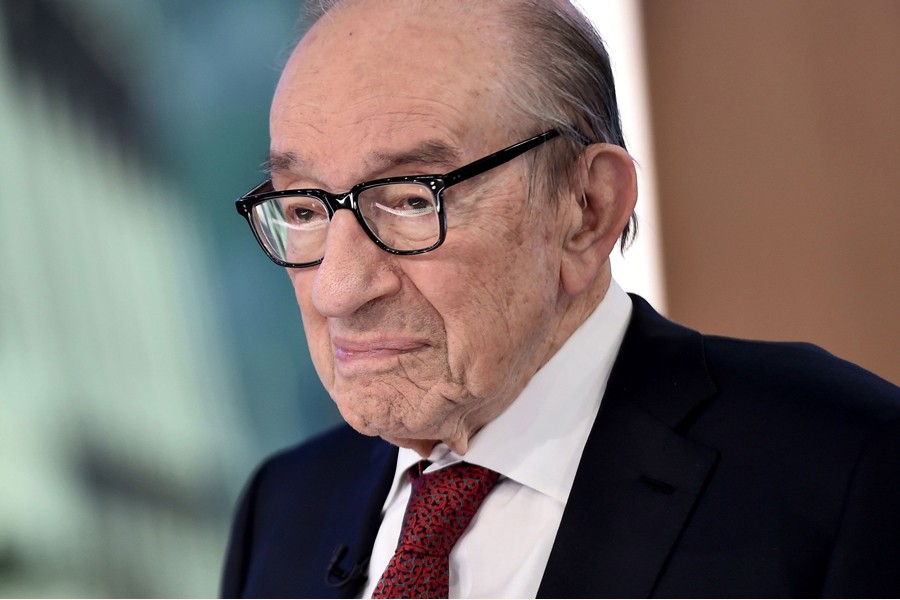
The current government appointed a new governor at Bangladesh Bank, 'force-releasing' the previous one. The move has faced sharp criticism. In this context let's try to understand what qualifications, qualities and personal attributes a governor of a central bank should possess. To do so, we will review the academic background and achievements of some distinguished central bank governors.
Among all, American economist, Alan Greenspan is the longest-serving and most influential governor (chairman of the Federal Reserve) in modern history. Known as 'the Maestro' for his leadership during the 1990s economic boom, his tenure covered multiple crises, rapid globalisation, and the rise of modern financial markets.
Greenspan earned his bachelor, masters, and doctorate degrees in economics from New York University. He served as the 13th chairman of the Federal Reserve from 1987 to 2006. Appointed by President Ronald Reagan, he served an unprecedented five terms under four different presidents: Ronald Reagan (1981-1989); George H. W. Bush (1989-1993); Bill Clinton (1993-2001); and George W. Bush (2001-2009).
On October 19, 1987, known as 'Black Monday', the US stock market crashed dramatically, industrial average fell about 22per cent in a single day, the largest one-day percentage decline in history. It created fear of a financial panic similar to the Great Depression. Immediately Greenspan directed the Fed to inject liquidity into financial markets and publicly announced readiness to support banks and credit markets. It encouraged banks to continue lending. As a result, confidence returned quickly because people believed the Fed would prevent systemic collapse. Thus, Greenspan averted a banking crisis.
In 1990-1992 when symptoms of recession appeared in the forms of rising unemployment, weak investment, credit tightening after Gradual interest rate cuts, Greenspan quickly realised interest rates have been too low which made borrowing cheaper leading to higher investment and consumption. Soon after, he decided to maintain an accommodative monetary policy longer than many expected. The policy worked and not only sustained economic recovery but also led to a prolonged period of economic expansion.
In 1994 (following long expansion) quite reasonably, Greenspan sensed a rise of inflation. To avert it, he took no time to undertake pre-emptive measures. What he did is raising interest rates earlier than inflation actually soared. The economy avoided overheating. Taking actions before the mishap takes place i.e., taking pre-emptive measures is only possible for a far-sighted economist. Interestingly, Robert Lucas received Nobel Prize on his theory of Rational Expectation in 1996, and Greenspan applied his tool earlier. It made Greenspan exceptional. In fact, it should be the case with every governor, but unfortunately, Bangladesh never got someone like this.
The USA experienced productivity surge owing to technology boom in late1990s. Quite naturally, rapid growth is supposed to cause inflation and wage pressure. But Greenspan argued that technology and productivity improvements allowed faster growth without inflation. Accordingly, he resisted aggressive rate hikes, for which he was criticised. He recognised structural change caused by IT revolution even earlier than many famous economists. Greenspan proved right. The economy experienced strong growth, low inflation and falling unemployment without runaway prices. This period remains one of the strongest US expansions in history.
During Asian Financial Crisis and nearly collapse of Hedge fund Long-Term Capital Management in 1997-1998 almost triggered a global financial crisis. To tackle this, Greenspan eased monetary policy, encouraged private sector expansion. Thus, he managed to avert global financial panic and US recession.
In 2000-2003 the USA encountered a massive stock market collapse known as 'dot-com crash' triggered by the bursting of technology stock bubble and internet speculative bubble. Investment collapsed and recession began. Greenspan responded to the emergency by rapid interest rate cuts (from about 6.5 per cent to 1 per cent) and strong monetary stimulus with a view to preventing deflation and deep recession. The policy proved effective and the economy began to recover pretty quickly, and the financial system regained stability after the shock
During Alan Greenspan's tenure, monetary stability was reinforced by the fiscally disciplined environment under President Bill Clinton, when sustained budget surpluses strengthened macroeconomic confidence. This monetary-fiscal coordination produced a period characterised by low inflation, robust private investment, rising productivity, and declining unemployment-an era many economists regard as an example of effective policy complementarity in modern macroeconomic management.
Economists often regard Alan Greenspan as a successful chairman of the Federal Reserve because of his strong crisis management, his ability to anchor inflation expectations, and his flexible, data-driven approach rather than strict adherence to rigid policy rules. He also strengthened the credibility of modern central banking and helped sustain the long economic expansion from 1991 to 2001, a period of steady growth, low inflation, and falling unemployment.
Dr Manmohan Singh, a Cambridge and Oxford graduate, served as Governor of the Reserve Bank of India (RBI) from 1982 to 1985. Facing fiscal, external, and inflationary challenges, Singh emphasised monetary stability, disciplined financial management, and policy coordination. His pragmatic leadership modernised India's financial sector and laid the groundwork for the liberalisation reforms he later enacted as Finance Minister in 1991, earning him acclaim as the architect of modern India.
Raghuram Rajan, former IMF Chief Economist and University of Chicago professor, became the 23rd governor of the RBI in 2013, later appointed as chief economic adviser by Prime Minister Singh. He succeeded Kaushik Basu, a Cornell professor and ex-Chief Economist of the World Bank.
Another prominent figure is Joseph Schumpeter, a Harvard professor renowned for introducing the concept of 'Creative Destruction'. As Finance Minister of Austria, he applied Rudolf Goldscheid's fiscal sociology to analyse how state finances influence society.
In Bangladesh, central bank governors are sometimes chosen for their political loyalty instead of their skills or experience. The most recent appointment demonstrates a troubling lack of concern for the bank's reputation and institutional disregard, as competence is ignored in favour of rewarding party men. It undermines public trust in the central bank, the highest monetary authority and the country's economic leadership, sending the message that politics matter more than protecting the economy.
Dr N N Tarun Chakravorty is professor of economics, IUB, and Editor-At-Large, South Asia Journal. nntarun@gmail.com