
World Cup 2026 to generate $10.9 billion for FIFA
Monday, 15 June 2026
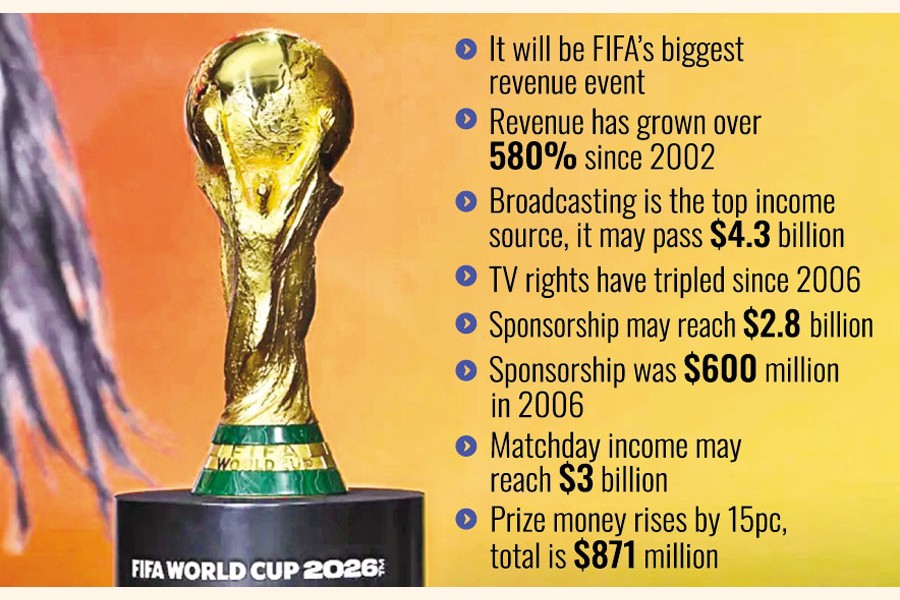
The 2026 FIFA World Cup, which has kicked off across the United States, Canada and Mexico, is emerging not only as the biggest event in world football but also as a major economic powerhouse. FIFA expects the expanded 48-team tournament to generate a record $10.9 billion in revenue, report agencies.
The 2026 World Cup, which kicks off in the United States, Canada and Mexico, is set to become the biggest financial success in FIFA's history, confirming the ever-increasing commercial value of the world's premier football event. The expansion of the tournament to 48 teams and 104 matches, combined with hosting in three countries, is set to generate record revenues of $10.9 billion.
Sports Value projects total World Cup revenue to exceed US$10.9 billion, with broadcasting rights alone expected to pass US$4.2 billion for the first time. Sponsorship revenue is forecast to exceed US$2.8 billion, while matchday and hospitality revenue could reach as much as US$3 billion.
This is a 45 per cent increase on the 2022 World Cup in Qatar, which brought in $7.5 billion, and is another leap in FIFA's steady rise in revenue from the tournament. The 2002 World Cup in South Korea and Japan brought in just $1.6 billion, while four years later in Germany, revenue rose to $2.6 billion, a 62.5per cent increase. The next big leap came in 2010 in South Africa, when total revenue reached $4.2 billion, a further 61.5 per cent increase.
Growth has continued at a slower but steady pace in subsequent tournaments. The 2014 Brazil tournament brought in $4.8 billion, up 14.3per cent from 2010, while the 2018 Russia World Cup brought in $5.3 billion, up 10.4per cent. Qatar 2022 was another turning point, with revenues soaring to $7.5 billion, up 32% from 2018. If the 2026 projections are confirmed, total revenues will have increased by more than 580per cent since 2002, clearly demonstrating the enormous economic scale of the World Cup.
In this context, FIFA increased the amounts to be distributed to the 48 teams by 15%, with the total amount reaching $871 million.
The decisive role of television rights
Television rights continue to play a key role in this growth. This year, for the first time in the history of the event, broadcasting revenues are expected to exceed $4 billion. The evolution of this particular source of revenue is impressive, since in 2006 FIFA collected $1.3 billion from television rights, with the amount soaring to $2.4 billion in 2010, an increase of almost 85 per cent. In 2014, a smaller increase was recorded, to $2.5 billion, while in 2018 revenues reached $3.1 billion, showing an increase of 24 per cent. Qatar in 2022 brought a new increase to $3.4 billion and the forecast for 2026 places the amount at $4.3 billion, i.e. approximately 26.5per cent higher than the previous World Cup. Overall, revenue from television rights will be more than triple compared to 2006.
The contribution of sponsorships
Equally important is the contribution of sponsorships, which continue to strengthen their position as a key pillar of FIFA's finances. From $600 million in 2006, sponsorship revenue increased to $1.1 billion in 2010, recording an increase of 83.3per cent. In 2014, it reached $1.6 billion, showing an increase of 45.5per cent, while in 2018 it reached $1.7 billion and in 2022 it reached $1.8 billion, showing a period of more moderate growth. However, the forecast for 2026 speaks of a spectacular increase to $2.8 billion, an amount increased by 55.6 per cent compared to Qatar and the highest FIFA has ever recorded from commercial partnerships and sponsors. The above figures confirm that the commercial value of the World Cup continues to grow rapidly, with this year's event expected to create new financial records for FIFA, recording historical highs in both total revenue and the two main sources of funding, television rights and sponsorships.