
Young voters shape BD's democratic moment
Nearly 5.0m first-time voters head to the polls amid hopes, doubts and a parallel referendum
FE REPORT | Thursday, 12 February 2026
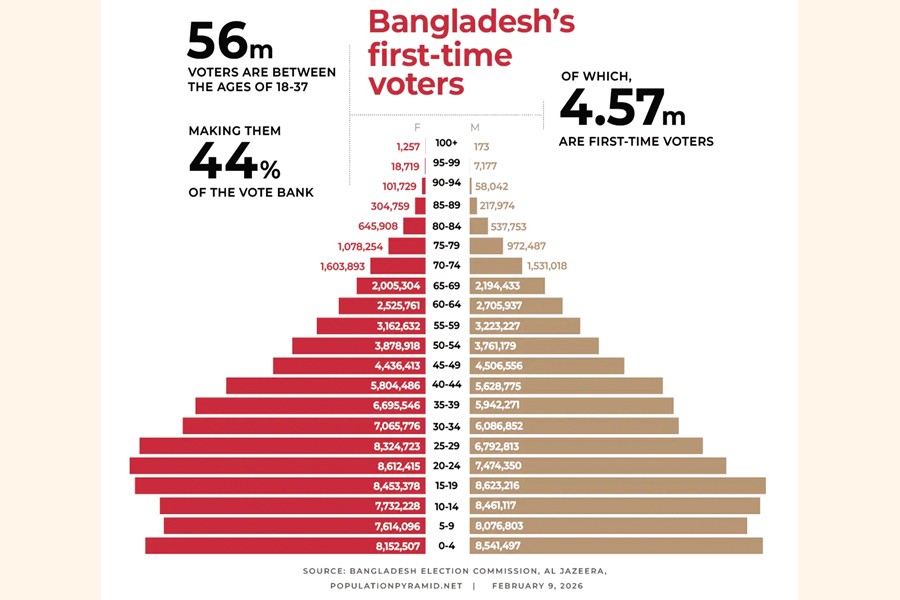
Bangladesh goes to the polls today (Thursday) in what many see as a defining moment in its post-uprising transition towards democratic normalcy.
With nearly 5.0 million newly enlisted voters casting ballots for the first time, the 13th national election carries an added generational weight.
For these young citizens, voting is not merely a constitutional right but a civic responsibility -- one that could influence the country's political direction, economic prospects and institutional future.
The new voters, having just reached or crossed the age of 18, are eligible to cast their ballots for the first time. In a country with one of the world's youngest populations, where a significant share is under 30, their participation could prove decisive.
Alongside the parliamentary vote, a referendum will also be held today. While widely discussed, many young voters admit they are still navigating its details, even as they express hope that it could strengthen democratic structures and human rights protections.
The Financial Express spoke to several first-time voters to gauge their expectations and concerns ahead of polling day.
For Shad Jaman Uschas (23) and Wakiya Sultana Nafi (23), both students of the Department of Economics at Shahjalal University of Science and Technology (SUST), the election marks a personal milestone -- "a proud step into citizenship".
"As economics students, we often discuss policy, governance and development in our classrooms," said Uschas. "This time, I feel I am directly participating in that process."
He believes voting is not only a right but also a responsibility that shapes the country's economic and social direction.
Nafi, a third-year student, said she feels excited and empowered to finally have a voice in choosing national leadership. "For years we watched elections as observers. Now we are part of it," she said.
She added that young voters are increasingly aware of economic challenges, employment prospects and the need for education reform.
Both students believe stronger youth participation can enhance democratic accountability and influence future policy priorities.
Not all first-time voters, however, will be able to cast their ballots.
Mohammad Saikat (21), who moved to Dhaka a year and a half ago in search of work, now earns his livelihood by operating a battery-run rickshaw purchased for Tk 151,000.
A registered voter in Barisal, he cannot afford to travel home to vote as he needs to continue working in the capital. While he expressed little visible frustration, his absence from the polling station reflects the economic realities faced by many young migrants.
Similarly, a young security worker stationed at a metro rail entrance in Dhaka said he was saddened by his inability to vote in his home constituency outside the capital. His job does not permit leave on election day.
Sirajul Islam (22), a student at United International University and a voter in Narsingdi-05, said the younger generation seeks change in governance and wants to move beyond traditional political practices.
"We want a corruption-free, democratic country," he said, adding that new leadership deserves an opportunity to be tested.
On the referendum, he noted widespread campaigning in favour of a "Yes" vote, creating a perception that it could bring meaningful change. However, he admitted he was not fully familiar with all its provisions.
A 19-year-old Higher Secondary Certificate graduate from Bangladesh International School and College, who preferred not to be named, said he feels conflicted. Observing the conduct of political leaders over the past year and a half has left him disillusioned.
"I don't see leaders from existing parties admitting their mistakes," he said. "Even some of the young leaders I supported during the July movement have been linked to questionable activities. That frustrates me."
Despite his disappointment, he hopes the next government will prioritise justice and accountability.
Mashiat Khaled Prapti (24), a student at North South University, said she and her friends have been researching candidates in their constituency, seeking leaders with clean reputations.
"We will decide at the last minute and vote accordingly," she said.
Although she intends to vote "Yes" in the referendum, she acknowledged that she has not examined all the clauses in detail.
Noore Basarat Islam Faizah (23), a civil engineering student at the Military Institute of Science and Technology, said she will not support any party or candidate perceived as opposing women's development. She also favours a "Yes" vote in the referendum and hopes the next government will establish a more efficient system across state institutions to accelerate national development.
Maiesoon Ateefah Hosen (22), a third-year honours student at Habibullah Bahar College, expressed support for candidates backed by student movements, believing they could reshape the country's political landscape.
At the same time, she stressed that whoever comes to power must focus on eliminating corruption, tackling pollution and strengthening social security to improve Bangladesh's global standing.
As millions of young voters approach polling stations, some with optimism, others with hesitation, their collective voice may not only influence the electoral outcome but also signal the direction of Bangladesh's evolving democratic journey.