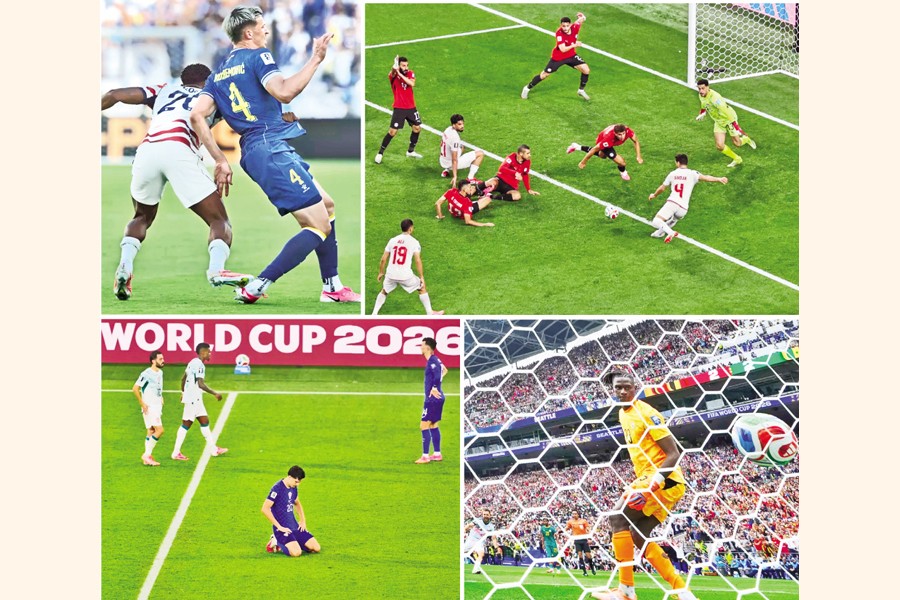
 Clock-wise: A VAR review led a referee to overturn a Croatia goal during its 2-1 loss to Portugal in Toronto, eliminating Croatia from the tournament, USA forward Folarin Balogun steps on Bosnia-Herzegovina defender Tarik Muharemovic's foot and received a red card, Iran's Shoja Khalilzadeh shoots past Egypt's Mostafa Shobeir, but the goal was overturned after VAR review and Belgium's Youri Tielemans on a penalty kick that sails by Senegal goalkeeper Mory Diaw during a round of 32 match in Seattle on July 1 as the game-deciding penalty kick was awarded after VAR review —AP
 Croatia's World Cup was seconds away from being over and Portugal was seconds away from the round of 16 when Ivan Perisic sent a long, desperate cross into the penalty area. The ball bounced off bodies like a pinball before magically, unbelievably, caroming into the net. They scored a goal. Fate had given Croatia a reprieve.
But as pandemonium broke out in the stands and on the pitch, Norwegian referee Espen Eskas stood in the middle of the celebration in Toronto, hand to his ear, listening to a voice half a continent away in Dallas. The voice recommended a review, via the video assistant referee, or VAR.
So Eskas trotted over to a TV monitor, watched a video replay over and over again, and more than 2½ minutes after the goal was recorded, he took it off the board. Perisic's cross had brushed the hair of teammate Igor Matanovic, leaving Mario Pasalic in an offside position when the ball reached him near the far post. The contact was imperceptible to the naked eye, but a space-age sensor in the ball had confirmed it.
Croatia's World Cup was over, another victim of VAR, which has had an outsized influence on this summer's tournament, according to American daily newspaper The Los Angeles Times.
It wasn't supposed to be this way. When VAR was introduced to soccer nine years ago, its mission was clear: to alert the head referee to potential clear and obvious errors or serious missed incidents. At least that's what Major League Soccer, one of the first leagues to use the system, wrote in the news release introducing it.
"It was really to stop the headlines," said Mark Geiger, who helped implement VAR as an MLS referee. "These super-egregious errors in a game that impact the outcome. The mantra for VAR was always minimum interference but maximum benefit." Under the VAR system, officials sitting before a bank of monitors in a centralized control room review match footage in real time and advise the on-field referee of potential errors. If the video assistant referees believe a mistake has been made, they communicate that through an earpiece the match referee is wearing. If the match official agrees, they will stop play, signal a review by motioning their hands in the shape of a rectangular TV screen, then watch the play themselves on a pitch-side monitor before either confirming or reversing the original decision.
It is comparable to the Automated Ball-Strike review added this year in Major League Baseball, tennis' Hawk-Eye line-calling system and long-standing centralized instant replay review in the National Football League and National Basketball Assn., systems that have both corrected errors and stoked debate.
But VAR has morphed into something far greater. In this World Cup, there have been more than 100 VAR interventions, encompassing both confirmed on-field calls and overturned decisions, through the end of the round of 16, according to Antonio Vuksanovic, a publication relations and communications professional at Sofascore, a Croatian technology company and sports statistics website.
"When it comes to actual overturned decisions, we're looking at roughly 0.5 per match, which is higher than the last World Cup and higher than what we saw across the most recently completed club season," Vuksanovic said.
Even though the officials have gotten most of those calls right, many of the infractions reviewed have been so imperceptible yet so consequential, it has raised a question: if human error on the part of players and coaches is part of the sport, is allowing a game to be decided by electronic evidence of a touch detectable only through NASA-level technology violating the spirit of the game?
Christina Unkel, a former FIFA referee, state referee administrator in Florida and a rules of the game analyst for multiple TV networks, believes it does.
"Football is an art. And that's why we love it," she said.
© 2026 - All Rights with The Financial Express

