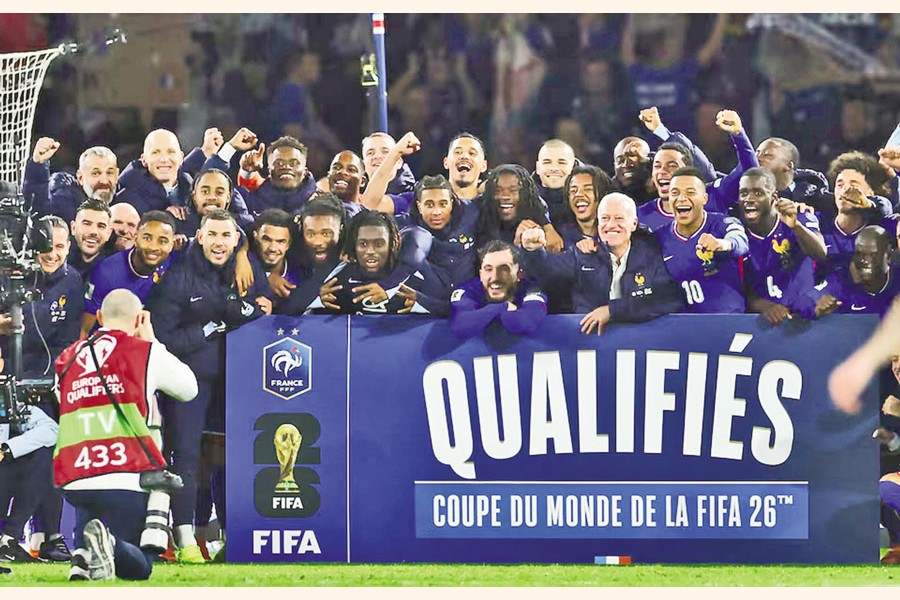
PARIS, June 4 (Reuters): For France's Didier Deschamps, the 2026 World Cup is not just another tournament, it is the closing chapter of one of international football's most successful managerial reigns.
The France coach with the Midas touch has already confirmed that he will step down after the finals in the United States, Canada and Mexico, ending a tenure that began in 2012.
It has seen Les Bleus become world champions in 2018, win the Nations League in 2021 and reach a second straight World Cup final in 2022. He also captained them to a first global crown in 1998, making his place in French football history secure.
France start this year's finals with Kylian Mbappe at the centre of the project and a squad to make most rivals envious.
Players such as Ballon d'Or winner Ousmane Dembele and Paris St Germain teammates Desire Doue and Bradley Barcola give France the unpredictability that has defined the Deschamps years.
Mike Maignan has authority in goal, William Saliba, Ibrahima Konate and Dayot Upamecano provide elite defensive options, while Aurelien Tchouameni and Adrien Rabiot offer power and control in midfield.
But this campaign carries a different emotional charge as Zinedine Zidane's name already hangs over the managerial succession, a reminder that even before a ball is kicked France are preparing for life after Deschamps.
The draw has also given his final mission an edge.
France are in Group I with Senegal, Norway and Iraq, a lineup with awkward history and real danger.
Senegal's 1-0 win over champions France in the opening match of the 2002 World Cup remains one of the tournament's great shocks, while Norway arrive with Erling Haaland and a qualification campaign that restored them as a serious threat.
France forward Michael Olise arrived at Bayern Munich a year ago as one of Europe's most gifted dribblers. Heading towards the World Cup, he increasingly looks like a player capable of becoming one of the tournament's defining figures.
At Crystal Palace, the London-born Olise was admired for elegance and unpredictability, a left-footed winger capable of producing moments others could barely imagine.
However, at Bayern, he has learned to dominate elite matches regularly, under pressure that can suffocate less mature attacking players.
A craftsman who plays at his own tempo, capable of slowing the pace at chaotic moments before suddenly accelerating it again with a disguised pass, a feint or a change of direction, Olise has what it takes to be the star of the World Cup.
He no longer looks like a luxury winger drifting through games on inspiration alone but has become one of Bayern's focal points - a player through whom attacks increasingly breath.
Where Kylian Mbappe overwhelms opponents with strength and directness and Ousmane Dembele with trickery and acceleration, Olise manipulates games more subtly, drawing defenders into spaces they realise too late they should never have entered.
© 2026 - All Rights with The Financial Express

