The 2026 FIFA World Cup has not only expanded in size but has also become one of the highest-scoring editions in history, with teams increasingly finding success from outside the penalty area, reports aqgencies.
With only Sunday's final between Argentina and Spain remaining, the tournament has produced 307 goals in 103 matches, averaging 2.98 goals per game. That is well above the 2.69 goals per game recorded at the 2022 World Cup in Qatar, where 172 goals were scored in 64 matches.
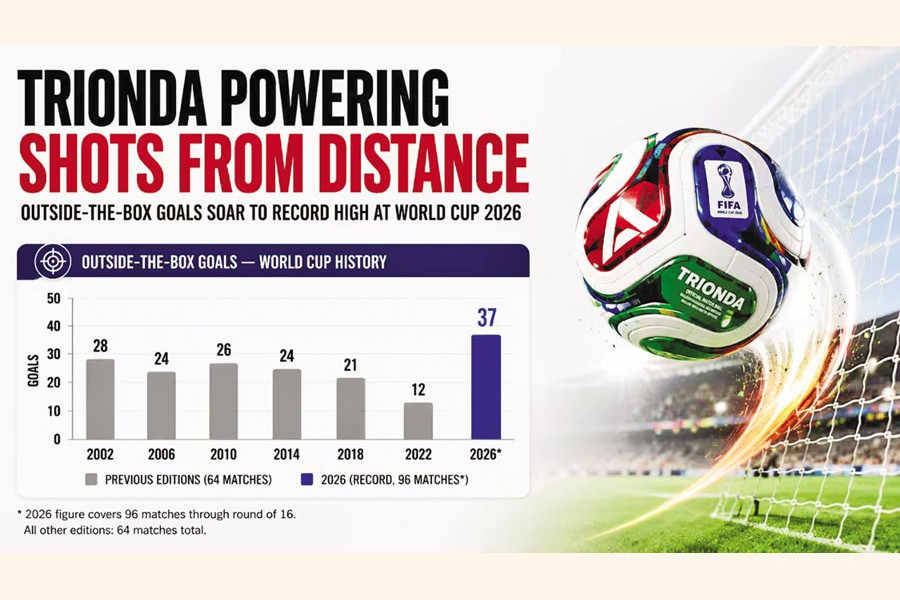
 Long-range strikes have played a major role in that increase. According to FIFA's Technical Study Group (TSG), 16 per cent of all goals at this World Cup have come from outside the penalty area, double the 8 per cent recorded in Qatar four years ago.In 2026, something unprecedented is happening. Thirty-seven goals have been scored from outside the penalty area through the end of the Round of 16, which is more than the entirety of any previous 64-match World Cup. Qatar 2022, played entirely at sea level, produced only 12 such goals. The 2010 South Africa tournament produced 26, at a rate of 17.93 per cent of total output. This record was broken in 2026 before the group stage had even concluded. And the explanation lies in two main factors working in tandem: the most altitude-diverse venue network in World Cup history, and a match ball whose aerodynamic nature says no single number can accurately describe it.
Messi's six outside-the-box goals break Rivellino's 60-year record. Two of Mbappé's last three World Cup goals came from outside the area, after only one of his first 13 ever did. Croatia's Petar Sucic struck from 27.4 metres, the second-farthest goal of the tournament. Austria's Romano Schmid scored from 23.3 metres, the first Austrian long-range World Cup goal since Ivica Vastic in 1998. Mbappé's opener against Iraq, from 29 metres, was the farthest of his 14 World Cup goals.
Former Germany and United States coach Jurgen Klinsmann, a member of FIFA's Technical Study Group, said the rise is largely due to teams defending with a deep, low block and crowding the penalty area.
"There's no space. Eight, nine players are in the box or outside the box, so it is definitely a recipe for shots from the outside," Klinsmann said.
He added that the congestion also makes life more difficult for goalkeepers, who often struggle to see the ball through a crowd of players.
"More goals are happening from shots from distance, 20-22 yards outside the box through a lot of people, which makes it very difficult for goalkeepers," he said. "It's something fun for us coaches to watch. We saw some beautiful goals that way." FIFA's chief of football development, Arsene Wenger, also praised the quality of long-range efforts throughout the tournament.
"The balls look fast. They delivered rockets from outside the box. The quality of the shots was great in this tournament," Wenger said.
No team has embraced the trend more effectively than Argentina. Lionel Scaloni's side has scored **five goals from outside the penalty area through Lionel Messi (two), Giovani Lo Celso, Julian Alvarez and Enzo Fernandez, equalling the highest tally by any team at a single World Cup since such records have been kept in 1966.
Among the standout strikes were Fernandez's late equaliser against England in the semifinal and Alvarez's spectacular 22-yard curler in extra time against Switzerland that helped send Argentina into the last four.
The trend continued in Saturday's third-place playoff, where England midfielder Declan Rice scored from outside the box in the third minute, although France eventually lost 6-4 in one of the tournament's most entertaining matches.
In a World Cup averaging nearly three goals per game, some of the most decisive moments have come from the least expected distance.
Meanwhile, the conversation starts with the Jabulani. Adidas's eight-panel creation for South Africa 2010 was widely condemned as a nightmare for goalkeepers. Brazil's Júlio César called it "a supermarket ball" while legendary Buffon termed it "shameful".NASA aerospace engineer Dr Rabi Mehta identified the problem precisely: its eight smooth panels pushed the drag crisis and the speed at which airflow transitions from smooth to turbulent which was 49-60 mph, exactly the range of a driven shot. At that speed, struck flat without spin, the ball knuckled, swerved, and dipped unpredictably. When speed exceeded 70 km/h, Mehta's team found, the trajectory became erratic. South Africa's mid-altitude venues also amplified the effect. The result: 143 goals in 64 matches, a scoring rate of 2.27 per match, and five of the world's greatest strikers - Messi, Ronaldo, Kaká, Rooney, Torres, combining for one goal between them. While some long-range goals were absolutely unpredictable for the stoppers.
The Trionda, Adidas insists, is its antithesis. Its drag crisis triggers at just 27 mph, well below shooting velocity, meaning the ball should stabilise early and arrive on a readable path. It does not knuckle. It does not visibly swerve. And yet 37 long-range goals have been scored through the Round of 16, outpacing every previous 64-match total, and recorded before the group stage had even ended. A peer-reviewed study published in the journal Fluids three weeks before the start of the World Cup has explained why. Jabulani's problem was visible and audible. The Trionda's is hidden in its seams.
© 2026 - All Rights with The Financial Express

