FE Report
ADN Telecom is set to form joint ventures with South Korean companies to assemble and supply electric three-wheelers in Bangladesh, amid the growing popularity of electric vehicles.
The publicly traded IT and telecommunication services provider has signed memorandums of understanding (MoUs) with South Korea's CND Motors Co Ltd and PBS Co Ltd to provide "smart mobility solutions" in the country.
The agreements have three key targets - assembling and supplying electric three-wheelers, introducing intelligent traffic management and AI-based traffic signal solutions, and implementing a solar streetlight installation project, the company said in a stock exchange filing on Sunday.
Under the deals, the South Korean partners will provide advanced technology, equipment, and technical expertise, while ADN Telecom will focus on facilitating project execution and market development.
"By combining international expertise with local capabilities, we are paving the way for smarter cities, cleaner energy, and modernized mobility," said Asif Mahmood, chairman of ADN Group, at the signing ceremony.
The collaborations will take place through joint ventures to be established in Bangladesh, aimed at technology transfer, local employment, and long-term operational sustainability, he added.
Initially, ADN Telecom plans to set up a three-wheeler assembling plant at one of the high-tech parks - in Sylhet or Kaliakoir of Gazipur - to leverage infrastructure and strategic advantages for production.
With the country's telecommunications business stagnating, the company management has decided to diversify its operations, it said.
Company secretary Md Monir Hossain told The FE that ADN had been developing assembling facilities at a hi-tech park and hoped to launch an electric three-wheeler in Bangladesh by next year in collaboration with the South Korean companies.
The company's profitability will increase once it starts assembling and supplying electric three-wheelers, he said, adding that the "partnership aims to generate better returns."
The adoption of electric vehicles has been on a steady rise globally, as governments and corporations push diverse initiatives to achieve net-zero carbon emissions by 2050.
As a result, global automobile manufacturers are shifting their focus to producing fully electric vehicles. In Bangladesh too, consumer demand for electric vehicles has grown significantly in recent years.
The government aims to cut carbon emissions in the transportation sector by 3.4 million tonnes by 2030, a goal that requires at least 30 per cent adoption of electric vehicles.
Meanwhile, despite the disclosure by ADN Telecom, its stock fell 1.51 per cent to Tk 78.5 per share on Sunday on the Dhaka Stock Exchange. Over the past year, the share traded between Tk 60.4 and Tk 115.1.
Latest investments
Since its stock market debut in 2020 - when it raised Tk 570 million through an IPO under the book-building method - ADN Telecom has continued diversifying its business.
In February this year, the company invested Tk 99.82 million to acquire 37 per cent shares in Senior Citizen Healthcare, which operates specialised hospitals for the elderly. The entity currently operates in Dhaka but has plans to expand into rural areas, seeing strong growth prospects.
In June 2023, ADN Telecom invested Tk 120 million to acquire a 10 per cent stake in Shohoz, an online ticketing platform, as part of its expansion strategy.
That same year, it acquired 60 per cent shares of SOS Developments, a fire security service provider, for Tk 20 million under a 10-year arrangement.
The company has also invested in ADN EduServices, MY TEL Ltd, ADN Media, and ADN International Gateway over the past four years to broaden its portfolio.
Financial performance
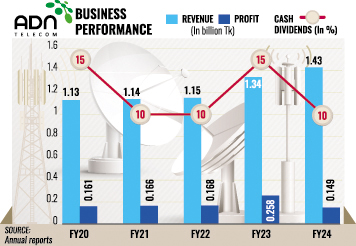
Despite its expansion efforts, ADN Telecom's profit tumbled 42 per cent year-on-year to Tk 149 million in FY24 due to rising business expenses and high borrowing costs amid increased interest rates.
As a result of lower earnings, the company declared a 10 per cent cash dividend for FY24, compared with 15 per cent in FY23.
However, profit for the nine months through March this year rose 16 per cent year-on-year to Tk 135 million, while revenue grew 29 per cent to Tk 1.33 billion.
The company attributed the profit growth to higher revenue from subsidiaries, expansion of its business-to-consumer (B2C) segment, and cost control through operational efficiency.
babulfexpress@gmail.com
© 2026 - All Rights with The Financial Express

