Global fund manager Asia Frontier Capital (AFC) anticipates that Bangladesh's capital market will turn around in 2026 after another gloomy year, aided by political stability and macroeconomic recovery.
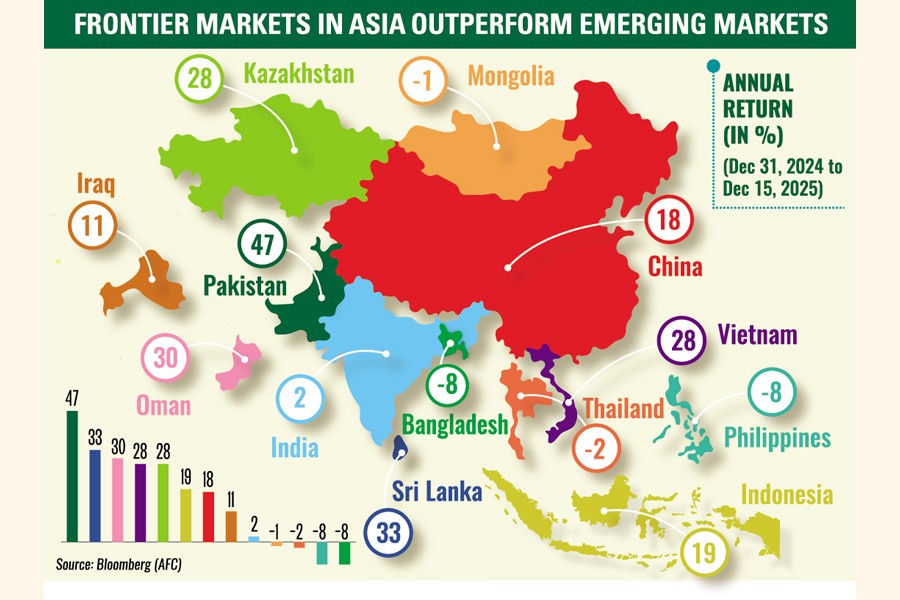
Although Asian frontier markets have significantly outperformed the region for a third consecutive year in 2025, the Bangladesh market posted another year of negative returns due to political uncertainties and regulatory developments.
In its latest report with market forecasts, Hong Kong-based AFC expressed optimism, saying that with parliamentary elections set for February 12 next year, improved political stability and policymaking could be a major positive driver for Bangladesh's economy and overall investor sentiment.
"On the macroeconomic front, lower inflation in 2026 should lead to benchmark interest rates declining, which will be very positive for Bangladesh stock market sentiment," reads the AFC outlook.
Moreover, Bangladesh's capital market stands at an attractive valuation compared with regional peers, offering a compelling entry point for investors.
Overall, the Bangladeshi capital market's price-to-earnings (PE) ratio currently stands at 8.7, while India's is 24.5, Indonesia's 21.4, Vietnam's 16.5, Sri Lanka's 10.7, the Philippines' 10 and Pakistan's 9.1, according to EBL Securities.
Present status
Asia Frontier Capital considers countries with the least developed or developing economies as frontier markets.
Bangladesh's stock market has been ranked the worst among Asian frontier markets for two consecutive years through 2025, while Pakistan and Sri Lanka delivered another strong year, supported by ongoing economic recovery, lower interest rates, rising domestic consumption and private-sector credit growth.
AFC expects investor sentiment to recover towards the second half of 2025. "We have seen some level of stability in the market after June 2025, with the Dhaka Stock Exchange (DSE) prime index securing a small gain of 2.6 per cent compared to a loss of 7.3 per cent in the first half."
Among Asian frontier stock markets, Pakistan is once again the best performer with a 47 per cent return in 2025, followed by Sri Lanka with a 33 per cent return, Oman with 30 per cent and Vietnam with 28 per cent. These markets are well ahead of most Asian emerging markets as well.
"We remain positive on Sri Lanka, not just in 2026 but also over the next three to five years, as the country now has both economic and political stability after a long time," reads the AFC newsletter prepared for investors.
Though recent floods will have a short-term negative impact on the economy, AFC said it is not extremely concerned, as Sri Lanka is now in a much stronger macroeconomic position compared to a few years ago.
Asia Frontier Capital is a pioneering fund management company that specialises in investing in high-growth Asian frontier economies.
The fund estimated its 2025 return at 17.5 per cent, marking the third consecutive year of double-digit gains. "Such performance underlines not only strong economic momentum across our investment universe but also the meaningful diversification benefits the fund provides to investors."
After three consecutive years of strong performance, the fund remains well positioned for further gains. "We continue to believe that Asian frontier markets have entered a sustained multi-year upcycle driven by lower interest rates, supportive fiscal policy, stable currencies and improved governance."
Fund performance this year has remained diversified across various markets, with Pakistan and Sri Lanka leading in terms of returns, while Mongolia, Georgia, Kazakhstan, Iraq and Uzbekistan also contributed meaningfully.
What to expect in 2026
The Bangladesh market posted a negative return of 8 per cent between December 31, 2024 and December 15 this year, according to AFC. In 2024, the stock index performed the worst globally, shedding 16.5 per cent.
"The overall market performance of 2025 was lower than promised, owing to various political uncertainties and regulatory reforms," said Salim Afzal Shawon, head of research at BRAC EPL Stock Brokerage.
Following the political changeover, Bangladesh's interim government took a number of reform measures across the economy, including in the capital market, to boost investor confidence.
The newly formed Bangladesh Securities and Exchange Commission (BSEC) approved new margin rules tightening lending to strengthen market discipline, while the merger of five Islamic banks and the nullification of their share values weighed on investor sentiment.
However, Mr Shawon remains optimistic about 2026 despite recent regulatory changes, some of which may slow market progress.
"While inflation, interest rates, political change and other positives would help in 2026, new issues and a more accommodating market structure would be needed to boost both the market and the economy," said Mr Shawon.
"We have a weak banking sector and there will be pent-up demand for funding from businesses that the capital market can accommodate given the right infrastructure," he added.
"We expect Bangladesh to turn the corner in 2026 after a few difficult years, both economically and politically," reads the AFC newsletter.
Meanwhile, Bangladeshi stocks are trading at attractive
price levels, with blue-chip companies at a large discount to their historical averages. More importantly, improvements
in political stability and policymaking could be major drivers for Bangladesh's economy and overall investor sentiment, AFC said.
babulfexpress@gmail.com
© 2026 - All Rights with The Financial Express

