The securities regulator has moved to amend the Debt Securities Rules 2021 to make bond issuance easier, with a focus on social impact and environmental sustainability.
The amendments appear urgent at a time when higher US tariffs on exports from competing countries such as India have boosted demand for Bangladeshi products, while donor agencies and foreign buyers are increasingly leaning toward responsible financing and business practices.
In addition, global development partners are insisting on the adoption of environmental, social, and governance (ESG) standards as they prefer to finance responsible companies to ensure green and inclusive growth, reduce poverty, and improve prosperity in developing countries like Bangladesh.
"With rising export demand, major global development partners such as the World Bank and IMF are seeking bonds aligned with the Sustainable Development Goals (SDGs)," said Md Abul Kalam, director and spokesperson of the Bangladesh Securities and Exchange Commission (BSEC).
Foreign buyers also want to source products from factories that comply with certain sustainability standards, prompting many issuers to invest in green infrastructure and production processes.
The existing regulatory framework lacks specific definitions and guidelines for issuing different types of bonds - green bonds, orange bonds, social impact bonds, etc., said Mr. Kalam.
"Now, we have set specific criteria, such as which bonds to call green bonds and which to call gender bonds, aiming to support the surge in export demand driven by shifting international trade preferences," Mr. Kalam said.
Recently, the USA increased tariffs on Indian goods to 50 per cent from the existing 25 per cent, in what is seen as a retaliatory move against India's continued purchase of Russian oil.
The higher tariff is feared to affect export-oriented industries, including textiles, jewelry, footwear, chemicals, seafood, furniture, and sporting goods.
Because Bangladeshi products face lower tariffs in the U.S. (typically about 20 per cent) compared to India's 50 per cent under the new regime, Bangladesh becomes more price-competitive in sectors like garments, leather goods, footwear, and accessories.
Even with favorable tariffs, Bangladesh still faces challenges: it must maintain product quality and supply chain reliability, and meet regulatory standards. Infrastructure, logistics, and trade facilitation - such as transit routes, ports, and customs - will also need to improve to take advantage of the shifting global trade landscape.
The securities regulator is looking to extend support to exporters with guidelines on the use of bond proceeds and project design.
At a meeting on Wednesday, the commission decided to publish the draft amendments for public opinion. It will finalize the changes after considering stakeholder feedback.
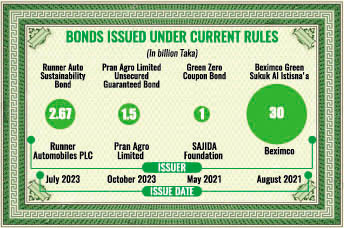
The spokesperson said several green bonds and a Sukuk had already been issued in Bangladesh under the existing framework, but issuers and investors need specific guidelines on sustainable debt instruments.
The BSEC is also working on developing a sustainable bond market. It is maintaining minimum issuance and consent fees for green, blue, and sustainable bonds, said Mr. Kalam. The watchdog has also been pushing for tax reductions and other incentives for such bonds.
For instance, the BSEC promotes orange bonds to support women entrepreneurs, particularly those in rural areas, by providing easy financing solutions and reducing gender bias. The initiative is expected to improve women's living standards.
Orange bonds are a crosscutting asset class designed for investments in gender equity and climate action, offering a transformative, impact-driven solution to advance development priorities and harness the potential of capital markets.
Potential sectors for orange bonds include readymade garments (RMG), women-led SMEs, agriculture and agri-business, green infrastructure and renewable energy, education, and health.
RMG companies can issue orange bonds to improve women's working conditions - for example, by providing daycare, medical care, and green buildings. Universities can also raise funds to support gender-responsive education and green campus initiatives.
Currently, the issuance of such a bond requires approvals from the BSEC, a no-objection certificate from the primary regulator, a credit rating from a recognized agency, and the appointment of an issue manager, trustee, and other intermediaries, if needed.
The issuer must also make clear disclosures in its prospectus on the use of proceeds, reporting, and impact assessment.
farhan.fardaus@gmail.com
© 2026 - All Rights with The Financial Express

