Investors have grown restless nearly a year after the Anti-Corruption Commission (ACC) took up the case of Moshihor Securities Limited, as little progress has been made in recovering the laundered funds.
According to the latest data from the Dhaka Stock Exchange (DSE), not a single taka has been returned to more than 7,000 clients of the brokerage firm, raising serious concerns about enforcement gaps in Bangladesh's capital market.
The ACC claims it has taken steps to trace the assets of Moshihor Securities and its related parties, but no visible progress has yet been made. "We have found clear evidence of fraudulent activities," said Hafizur Rahman, additional director of the ACC, who led the investigation against the broker.
Following the filing of a case, further investigation is ongoing at the ACC under the supervision of another additional director. "We are not in a position to disclose details at this stage," he said. He requested for anonymity saying he is not the authorised person to talk to the media.
Meanwhile, victims of the scam have been knocking on the doors of the securities regulator, the DSE, and the ACC in desperation to recover their investments.
With no success, they held a press conference at the Capital Market Journalists Forum (CMJF), urging authorities to ensure the recovery of their funds and punish those responsible.
Dr. M. Sadiqul Islam, professor of finance at the University of Dhaka, told The FE that the recovery process needs to be swift. He noted that while the BSEC and the DSE have already improved certain regulations, further upgrades are necessary to prevent such incidents in the future, as they negatively affect investor sentiment.
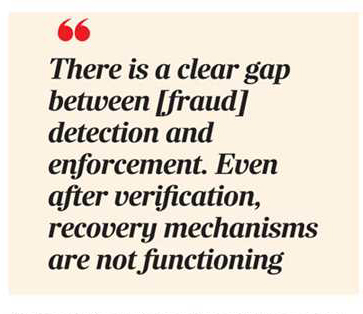
Market insiders say the delay in recovery reflects broader structural weaknesses. "There is a clear gap between [fraud] detection and enforcement. Even after verification, recovery mechanisms are not functioning," said Moniruzzaman, managing director and CEO of Prime Bank Securities Ltd.
The Bangladesh Securities and Exchange Commission (BSEC) in April last year urged the ACC to take legal action against the broker under the Money Laundering Prevention Act.
Moshihor Securities is accused of embezzling around Tk 1.61 billion-one of the largest scams in the country's capital market history. Of the total, Tk 685.8 million was allegedly misappropriated from the consolidated customer account (CCA), while Tk 923.5 million was siphoned off through the unauthorized sale of clients' shares.
Frustrated, one of the victims, speaking to The Financial Express, said his life savings had been taken away through deception.
He had opened his BO (beneficiary owner's) account with the brokerage firm in the early 2000s and gradually built a portfolio of blue-chip shares, including Square Pharmaceuticals and LafargeHolcim Bangladesh. "I was not a trader. I treated my investments like a fixed deposit for my old age," he said, requesting anonymity.
"I never received any SMS or email alerts [following the sale of my holdings]. Later, I came to know they used software to suppress notifications.
"I used to get dividends, but only after calling them. That made me believe everything was normal," the investor said, adding that the deception went unnoticed for three to four years.
He became aware of the unauthorized sale of his assets in 2025 when he tried to transfer his account. "They refused to accept my application and gave me a statement showing all my shares were intact."
The DSE later detected the fraud. "They told me the shares had been sold years ago. But even now, the brokerage firm provides statements showing the shares are still there," the client said.
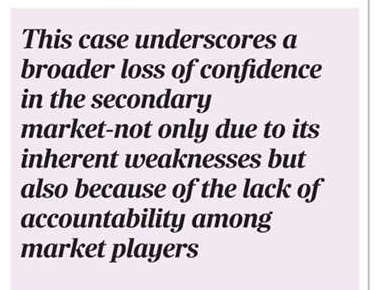
This case underscores a broader loss of confidence in the secondary market-not only due to its inherent weaknesses but also because of the lack of accountability among market players.
Irregularities at Moshihor Securities were first detected during a DSE inspection in August 2024. A subsequent probe committee-comprising officials from the BSEC, DSE, and the Central Depository Bangladesh Limited-uncovered deeper systemic manipulation.
Investigators found that the brokerage used back-office software to generate fake portfolio statements, sent fabricated reports to clients showing non-existent holdings, altered clients' phone numbers to intercept CDBL confirmation messages, and suppressed transaction alerts to conceal unauthorized trades.
Despite these findings and the involvement of multiple agencies, enforcement action remains slow.
The Moshihor Securities scandal has now become a benchmark case for Bangladesh's capital market. It highlights how even conservative investors-those who avoid speculation and invest in fundamentally strong companies-can suffer devastating losses due to manipulation by market intermediaries.
Prof M. A. Baqui Khalily of economics at the University of Asia Pacific (UAP) described the situation as "a disaster." He stressed the need for a faster recovery process and more robust detection systems to prevent such incidents from recurring.
In the meantime, clients of Moshihor Securities continue searching for the right authority to approach for a remedy. The investor, who talked toThe FE, said, "It feels like there is no authority that can actually ensure fund recovery."
farhan.fardaus@gmail.com
© 2026 - All Rights with The Financial Express

