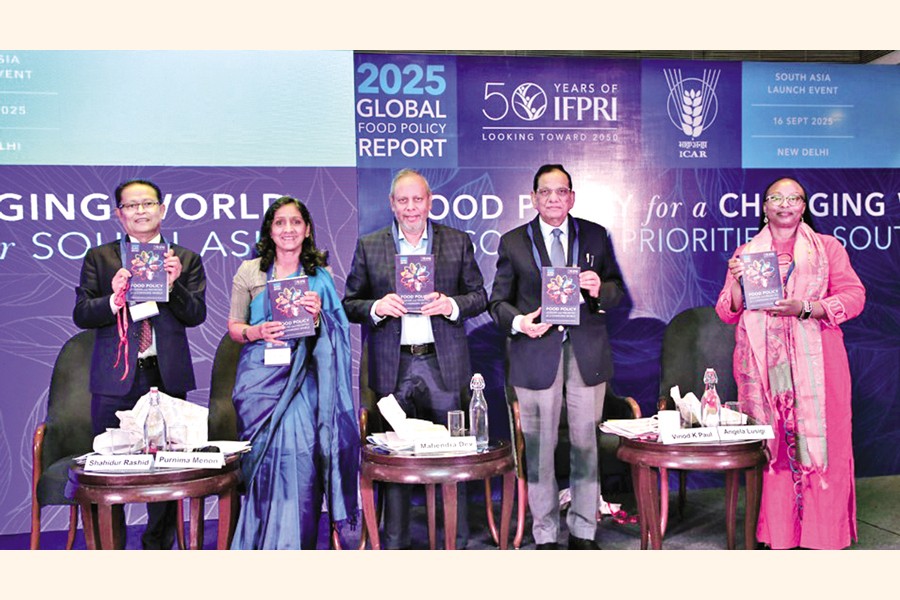
 South Asia launch of IFPRI's Global Food Policy Report (GFPR) was held in New Delhi, India, recently. — Photo: IFPRI
 The International Food Policy Research Institute (IFPRI), in partnership with the Indian Council of Agricultural Research (ICAR), convened a high-level regional policy dialogue on 'Food Policy for a Changing World: Lessons and Priorities for South Asia' in New Delhi, India, recently.
The event also marked the South Asia launch of IFPRI's 2025 Global Food Policy Report (GFPR), says a press statement.
Speaking as the chief guest, Prof. S. Mahendra Dev, Chairman, Economic Advisory Council to the Prime Minister of India (EAC-PM), said the food systems agenda cannot lose sight of traditional priorities.
"While we are focusing on newer challenges like food systems, environment, and nutrition, we should not forget that earlier priorities like agriculture growth linkages and rural investments remain critical. Governments and the private sector must work together to reshape food systems that deliver affordable, healthy, and diversified diets," he said.
Nutrition was another central theme of the dialogue. Dr. Vinod K. Paul, Member, NITI Aayog, emphasised early interventions, saying: "If we truly want to break the intergenerational cycle of malnutrition, we must act before pregnancy. Preconception health and nutrition for women can reduce growth restriction by up to 25 per cent, and when coupled with later interventions, can cut childhood stunting by nearly half."
The dialogue brought together senior policymakers, researchers, and development partners to reflect on how South Asia can secure resilient, inclusive, and sustainable food systems amid mounting pressures of climate change, malnutrition, and demographic transitions.
The South Asia Dialogue, co-hosted by IFPRI and ICAR, also underscored the region's shared responsibility and opportunity to lead.
Anchored in evidence, enriched by experience, and committed to collaborative solutions, the discussions set the stage for food systems transformation that prioritises resilience, equity, and nutrition for all.
tonmoy.wardad@gmail.com
© 2026 - All Rights with The Financial Express

