Foreign portfolio investors (FPIs) are steadily pulling out funds from Bangladesh's equity market as they have been moving assets to developed markets amid persistent macroeconomic challenges stemming from geopolitical tensions.
Net investment by overseas investors in the 12 months to May this year stood at negative Tk 4.30 billion, meaning they sold more shares than they bought. Foreign investors purchased shares worth Tk 21.12 billion, while selling shares worth Tk 25.42 billion during the period, according to market data.
Market analysts said the sustained outflow reflects a cautious stance among foreign investors as uncertainty over global economic growth, geopolitical conflicts and relatively attractive returns in developed markets continue to weigh on investment decisions.
Md Akramul Alam, head of research at Royal Capital, said multiple factors, including persistent macroeconomic challenges and global factors, have driven the prolonged foreign fund outflow.
"The overall economic activity remained sluggish, while profitability of major listed companies, including multinational firms, stayed subdued due to high input costs," he said.
The private sector credit growth remained low at 4.98 per cent in May this year, reflecting weak business confidence and tighter lending conditions.
The prospect of a sharp recovery in private sector credit demand looked slim, and that discouraged fresh investments, said Mr Alam.
Moreover, the US-Israel war on Iran has already triggered volatility in global oil prices, raising concerns about inflation and broader economic spillovers in Bangladesh.
Inflation hovered around 9 per cent during the time, and analysts warned that price pressures may persist in the coming months due to continuing global uncertainties, supply disruptions and elevated import costs.
The trend is not unique to Bangladesh. Global fund managers withdrew a record US$137.36 billion from major Asian equity markets during the first half of 2026, marking the fastest six-month capital outflow from the region since at least 2010 after strong gains over the previous two years, according to international media reports.
The outflows reflect concerns over slowing global growth, geopolitical tensions across regions and volatile crude oil prices, reducing investors' appetite for frontier and emerging markets.
Countries including India, South Korea, Taiwan, Thailand, Indonesia, Malaysia, the Philippines and Vietnam have also witnessed foreign fund withdrawals, although the scale has varied across markets.
Analysts said one of the key drivers behind the shift is the relatively higher return available in the United States. Elevated US Treasury yields have encouraged many global investors to move funds into American government securities, which offer attractive returns with lower risk.
The strength of the US dollar has further reinforced the trend by making developed markets more attractive than emerging economies.
Mr Alam also pointed to a global transition in investment towards artificial intelligence-focused companies, reducing portfolio allocations to markets such as Bangladesh and India, which are perceived to be lagging in the AI-driven investment cycle.
"This trend could reverse once the AI trade, which appears to be in bubble territory, eventually cools off," he said.
Mir Ariful Islam, managing director and chief executive officer of Sandhani Asset Management, attributed the foreign fund outflow to weak investor confidence, a strong US dollar and instability in the financial sector.
When the local currency weakens, foreign investors incur losses as the value of their assets falls even when share prices remain unchanged.
Moreover, foreign investors typically seek a stable, predictable, and long-term policy environment to ensure the safety of their investments, he said.
The newly elected government has yet to present a clear economic roadmap, while the Middle East conflict has further increased global uncertainty.
"Foreign investors are likely to look for greater policy clarity and consistency before increasing their exposure to Bangladesh's equity market," Mr Islam told The FE over the phone.
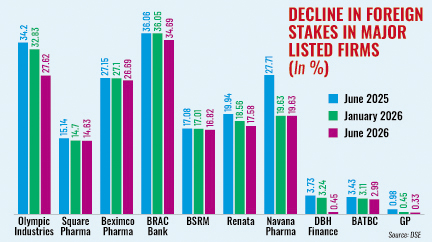
When it comes to investing in stocks in Bangladesh, foreigners usually prefer multinational companies. Currently, they are not interested in putting their money into these companies either, owing to lower-than-expected earnings in recent quarters.
After a significant decline in annual profit in 2025, the aggregate profits of the 11 multinational companies fell 6 per cent year-on-year to Tk 12.20 billion in January-March this year, according to company disclosures.
BAT Bangladesh's profit nosedived to Tk 5.84 billion in 2025, the lowest since its listing, due to lower sales, higher excise duty, and one-off costs for its Dhaka factory closure.
The tobacco leader's first quarter profit also dropped 34 per cent year-on-year to Tk 2.10 billion through March this year.
As a result, BAT's foreign stake dropped from 3.73 per cent to 2.99 per cent between June last year and June this year.
Grameenphone, the largest stock in terms of market capitalisation, reported its lowest annual profit in 2025 in eight years. However, its first quarter profit grew 4.4 per cent through March this year.
In the meantime, foreign stakes in GP fell to 0.33 per cent in June this year from 0.98 per cent in June last year.
Among the local firms, Olympic Industries experienced a similar trend. Its foreign stake fell to 27.62 per cent in June this year from 34.2 per cent in June last year.
Despite persistent selling of foreign holdings, Mr Islam said the domestic stock market has remained resilient in recent months, supported by strong participation of local institutional and retail investors amid falling Treasury bond yields.
However, he said foreign investors are closely monitoring Bangladesh. "Portfolio investment may pick up again if macroeconomic indicators improve and geopolitical tensions ease."
babulfexpress@gmail.com
© 2026 - All Rights with The Financial Express

