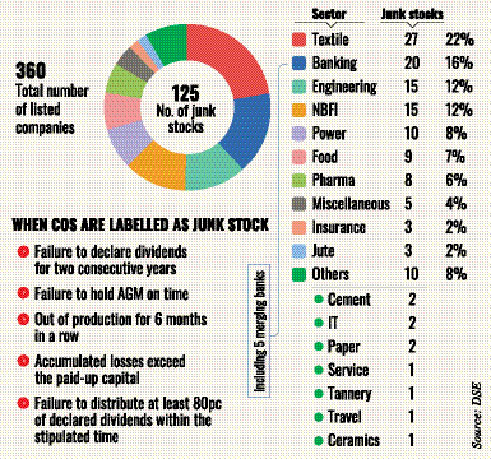
The number of junk stocks on the Dhaka Stock Exchange (DSE) has surged to a record high of 125, accounting for 35 per cent of all listed companies, signalling mounting stress in the capital market and deepening investor concerns.
The sharp rise follows the downgrade of 10 more banks to the Z category on Sunday after they failed to declare dividends for two consecutive years-2024 and 2025-amid rising non-performing loans (NPLs) and significant provisioning shortfalls.
These bank stocks turned into junk securities in the wake of a stricter dividend policy introduced by the Bangladesh Bank in March last year.
Under the policy, banks availing themselves of provision deferrals were barred from declaring dividends from 2024 onwards. From 2025, lenders with bad loans exceeding 10 per cent of total loans are also disqualified, regardless of profitability.
According to securities regulations, a stock is classified as 'junk' or placed in the Z category if the company it represents fails to declare dividends for two consecutive years, suspends commercial operations for at least six months, or fails to hold annual general meetings (AGMs) on time.
Firms may also be downgraded if retained losses exceed paid-up capital or if they are unable to distribute at least 80 per cent of declared dividends within the stipulated period.
The newly relegated banks are AB Bank, IFIC Bank, One Bank, Premier Bank, Rupali Bank, NRB Bank, Mercantile Bank, United Commercial Bank (UCB), Al-Arafah Islami Bank, and NRBC Bank.
They joined previously listed Z-category banks-ICB Islamic Bank, Islami Bank, National Bank, SBAC Bank, and Standard Bank-bringing the total number of bank stocks in this category to 15.
In addition, the stocks of five severely distressed banks-EXIM Bank, First Security Islami Bank, Global Islami Bank, Social Islami Bank, and Union Bank-remain suspended from trading after the central bank declared their share values nil. These banks are currently undergoing merger processes.
Altogether, 20 out of the 36 listed banks are now classified as weak or junk, representing approximately 55 per cent of the banking sector on the stock exchange.
Market analysts say the growing number of junk stocks reflects persistent financial weaknesses, governance failures, and declining profitability among listed firms, particularly banks.
"The underlying financial condition of several banks is now becoming more visible, especially those previously affected by irregularities, loan scams, and governance lapses," said Akramul Alam, head of research at Royal Capital.
He noted that many banks have been disqualified from paying dividends due to elevated levels of bad loans and reliance on provisioning deferrals.
"Stricter regulatory requirements-especially higher provisioning against non-performing loans-have eroded profitability, leaving many banks unable to declare dividends," he added.
Among sectors, textiles dominate the junk stock list, driven by poor financial performance, failure to pay dividends, and non-compliance with AGM requirements. Companies such as HR Textile have recently been downgraded as accumulated losses exceeded their paid-up capital.
Out of the 58 listed textile firms, 27 are now in the Z category. The non-bank financial institutions and engineering sectors each have 15 junk stocks.
Investors are not allowed to purchase Z-category shares using margin loans, and transactions in these stocks require three days for settlement, compared to the standard two-day cycle.
Under Dhaka Stock Exchange regulations, companies must declare at least a 10 per cent dividend to qualify for the 'A' category, while firms declaring less than 10 per cent are placed in the 'B' category.
babulfexpress@gmail.com
© 2026 - All Rights with The Financial Express

