Linde Bangladesh posted strong year-on-year profit growth in the first quarter of 2026, driven by higher sales and a sharp reduction in operating expenses.
The multinational industrial gas producer reported a profit of Tk 110 million for the January-March quarter, marking a 37 per cent increase from the same period a year earlier.
Earnings per share (EPS) rose to Tk 7.22 in the March quarter, up from Tk 5.29 a year ago, according to its unaudited financial statements released on Wednesday.
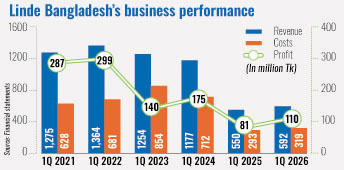
The company attributed the growth to increased revenue and lower operating costs. Revenue climbed 7.6 per cent year-on-year to Tk 592 million, supported by rising demand for industrial gases.
Operating expenses fell 18 per cent year-on-year to Tk 132 million during the quarter, largely due to the divestment of its subsidiary last year.
Linde Bangladesh sold its welding electrode business to ESAB Group for Tk 7.72 billion and distributed around Tk 6.85 billion to shareholders as cash dividends from the proceeds.
Meanwhile, the company's stock closed at Tk 640.4 per share on Wednesday on the Dhaka Stock Exchange, edging up 0.08 per cent from the previous session.
Annual performance
Linde Bangladesh's annual profit declined by more than 9 per cent to Tk 344 million in 2025, mainly due to lower sales and the absence of one-off gains.
The company declared a 100 per cent cash dividend for 2025 - the lowest since its stock market listing - reflecting the drop in earnings amid a challenging business environment.
In contrast, it had announced a record 4,500 per cent cash dividend for 2024, driven largely by one-off income from the sale of its welding business.
Linde saw robust business in 2021, particularly in the medical segment, as demand for oxygen surged during the COVID-19 pandemic. However, revenue from that segment later declined as the pandemic eased, while raw material costs rose following the Russia-Ukraine war.
babulfexpress@gmail.com
© 2026 - All Rights with The Financial Express

