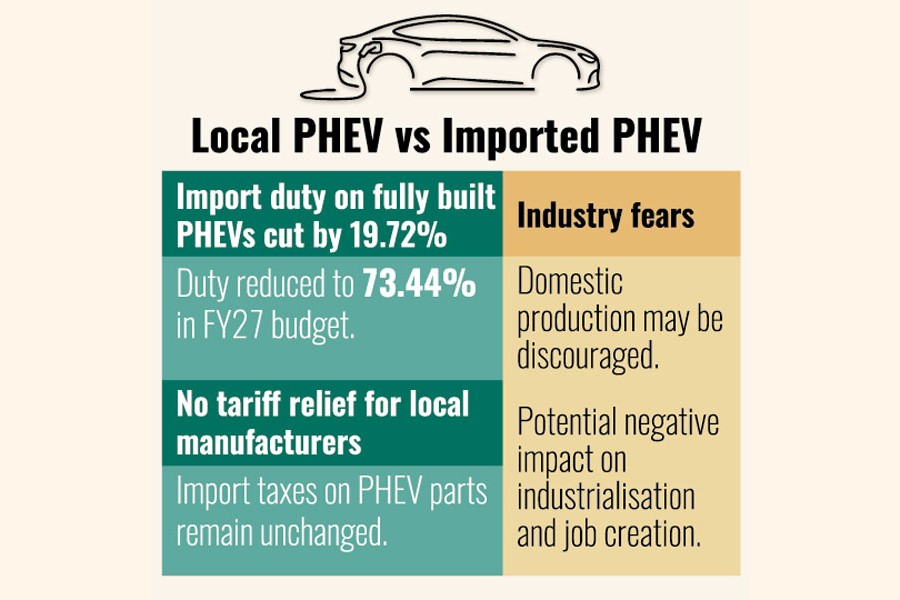
Local manufacturers of Plug-in Hybrid Electric Vehicles (PHEVs) anticipate an unfair competition with importers of such vehicles as the government has not offered any tariff benefit for them in the proposed budget for FY27.
The Bangladesh Automobile Assemblers and Manufacturers Association (BAAMA) raised the concern in a letter recently sent to the chairman of the National Board of Revenue (NBR).
In the budget for FY27, the government proposed a 19.72 per cent cut in import duty to 73.44 per cent on imports of CBU (completely built-up) plug-in hybrid electric vehicles.
However, no reduction in tariffs has been offered on imports of different parts required to manufacture or assemble PHEVs.
According to the association, they import hundreds of parts under different import codes and there are taxes levied at multiple layers.
For example, wheels and some other parts in a certain category are imported under the code HS-8708700. For the import, the applicable customs duty is 25 per cent, while the regulatory duty is 15 per cent, VAT 15 per cent, advanced income tax (AIT) 7.5 per cent and advanced tax (AT) 5 per cent.
As a result, the aggregate tariff on the goods under the said code stands at 67.5 per cent. Other imported parts of PHEVs involve more than 60 per cent tax.
Although the tax on vehicle components is 5.94 to over 10 percentage points less than the tax imposed on imported fully built PHEVs under the FY27 budget, local manufacturers fear that they would face an unfair competition which would discourage domestic production hindering new employment generation.
Aminur Rahman, head of corporate affairs of Runner Group, explained how local manufacturers would be at a disadvantage compared to importers of PHEVs.
He said manufacturers of PHEV vehicles need huge investments and the financing needs are met through bank loans. On the other hand, importers would not require any investment.
Free of financial liability, importers would be able to sell hybrid vehicles at lower prices following the reduction in import duty. But a manufacturer after huge investments made with bank credits would not be able to revise down selling prices.
"Ultimately, it will create an unfair situation discouraging the manufacturing of CBU plug-in hybrid vehicles," Mr Rahman said.
In its letter sent to the NBR chairman, the BAAMA said the use of hybrid passenger cars has been increasing very rapidly within the country.
"If incentives are offered for setting up local passenger Plug-in Hybrid Vehicle (PHEV) manufacturing industries, both domestic and foreign investors will be encouraged to establish factories, creating a favorable environment for new employment opportunities."
The association also said under the current duty structure, no matching incentives or duty benefits have been offered at any level for PHEV production, assembly, and local value addition.
"It is a matter of concern for the development of the country's automobile industry," reads the letter.
The manufacturers of CBU plug-in hybrid vehicles need policy support and tariff benefits for the sake of industrialisation and employment generation, Mr Rahman noted.
According to the BAAMA, the manufacturers are happy with budgetary supports offered to them for electric vehicle (EV) production and assembling.
The manufacturers involved in body building, welding, painting, and assembling EVs will avail themselves of reduced import tax under the proposed budget on raw materials and components.
For high value-added production (full assembly, welding, painting, bodybuilding), almost all duties and taxes are exempted with only a 3 per cent customs duty applicable to imported raw materials and components.
For lower value-added assembly operations, duties and taxes are exempted except a 15 per cent import duty on components.
mufazzal.fe@gmail.com
© 2026 - All Rights with The Financial Express

