Most listed multinational companies experienced a sharp year-on-year decline in profits in 2025, weighed down by elevated finance costs, persistent macroeconomic challenges, and political uncertainty.
Sluggish demand, driven by prolonged high inflation, alongside rising raw material costs, has complicated the business environment, market analysts say.
Economic activity has slowed following the August 2024 political changeover, with inflationary pressures squeezing demand and shrinking profitability, according to market analysts.
"The broader economic activity remained slow amid lingering macroeconomic challenges, while operating costs increased due to high input prices, hitting multinational companies' bottom lines," said Md Akramul Alam, head of research at Royal Capital.
Tight monetary and fiscal measures adopted by the Bangladesh Bank since the political changeover also dampened demand. Private sector credit growth fell to a historic low of 6.03 per cent in March, reflecting weak business confidence and tighter lending conditions.
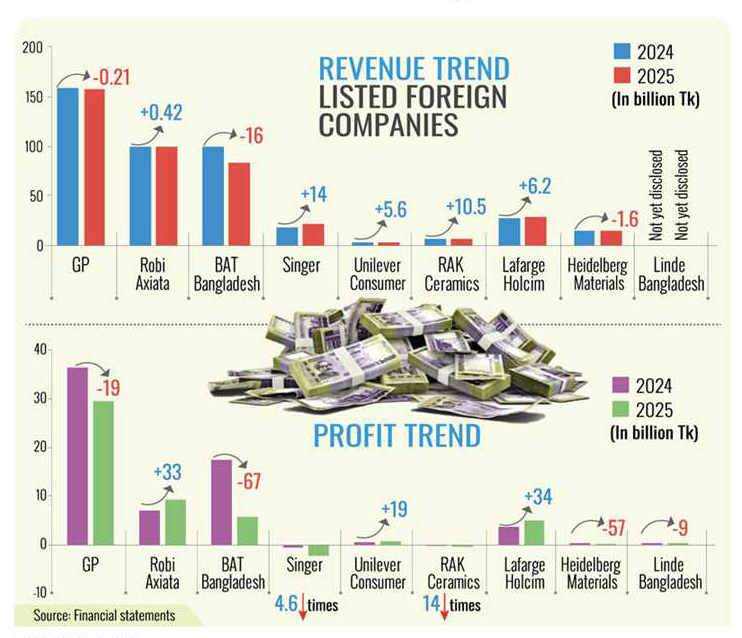
Of the 13 multinational firms listed on the stock market, nine have disclosed their 2025 financials so far. Only three posted profit growth, while four others reported declines ranging from 9 per cent to 67 per cent. Two companies remained in the red due to heavy debt burdens.
Reckitt Benckiser and Bata Shoe are yet to disclose their annual financial performance, while Marico Bangladesh and Berger Paints follow the April-March financial year.
Combined profits of the nine firms dropped 26 per cent year-on-year to Tk 48.61 billion in 2025, while total revenue fell 2.6 per cent to Tk 420 billion in the year, according to company disclosures.
Mir Ariful Islam, managing director and CEO of Sandhani Asset Management, said multinational companies had failed to achieve revenue growth at a time when consumers had little disposable income, with inflation hovering above 9 per cent.
"Consumers cut back on discretionary spending as essential goods became more expensive," he said, adding that many companies were unable to pass on rising costs due to weakened purchasing power.
As foreign firms operate in diverse sectors, the factors behind profit erosion vary significantly from one company to another.
Increased finance costs reined in the bottom-line growth of multinational companies with large debt burdens.
Singer Bangladesh, for example, reported a 4.6-fold increase in losses to Tk 2.25 billion in 2025, primarily due to a 124.7 per cent surge in finance costs linked to heavy borrowing. The company, burdened with both long-term and short-term debts, declared no dividend for the first time since listing.
BAT Bangladesh saw its profit plunge 67 per cent to Tk 5.84 billion-the lowest since listing-hit by a mid-year excise duty hike and one-off costs from a forced factory relocation. Its revenue dropped 16 per cent to Tk 83.4 billion, and it declared a historically low 30 per cent cash dividend.
"The downturn was primarily triggered by the country's first-ever interim budget announced in January 2025, outside the conventional June cycle, which imposed a substantial excise duty increase across all cigarette segments," said the company.
Meanwhile, as government spending on the Annual Development Programme was reduced, cement producers received a blow, said Mr Alam, adding that the overall construction sector has been under pressure amid high inflation.
Heidelberg Materials' profit plummeted 57 per cent, while sales dropped nearly 2 per cent year-on-year in 2025.
However, LafargeHolcim Bangladesh bucked the trend, registering a 34 per cent profit growth driven by strong sales of premium products and aggregates.
"Despite a broader slowdown in the construction industry driven by reduced public sector spending, the premium product portfolio and the aggregates business continued their growth momentum," said Md Iqbal Chowdhury, chief executive officer of the company, in a statement.
Bangladesh's top two mobile operators-Grameenphone and Robi Axiata-posted contrasting earnings in 2025, owing to diverging cost structures and financial strategies amid a wider economic slowdown.
Robi's profit surged 33 per cent, largely due to foreign exchange gains amid a stable forex market and a sharp reduction in operating expenses.
"Our operational excellence helped us improve profitability despite a challenging revenue environment," said Ziad Shatara, managing director and CEO of Robi Axiata, in a statement.
On the other hand, GP reported its lowest profit in eight years at Tk 29.6 billion, due to higher costs related to spectrum and network investments, currency depreciation, and heavy taxation.
However, GP's profit rebounded in early 2026, rising 4.4 per cent year-on-year in the first quarter to Tk 6.62 billion, aided by improved cost efficiency.
The financial year for Berger Paints and Marico Bangladesh runs from April to March. So, their nine-month data have been taken into account to assess their performance this year.
Berger Paints Bangladesh reported an 8 per cent increase in profit to Tk 2.67 billion for the April-December 2025 period, driven by higher sales and reduced foreign exchange losses.
Similarly, Marico Bangladesh posted an 8.5 per cent growth in profit to Tk 4.98 billion, with revenue rising 24 per cent, supported by strong demand for its flagship Parachute coconut oil and new value-added products.
Mr Ariful Islam of Sandhani Asset Management warned that profits could remain under pressure in the next two quarters due to the energy crisis stemming from the Middle East war.
"Macroeconomic improvement and consumer confidence are crucial for business in the coming months," said Mr Alam of Royal Capital.
babulfexpress@gmail.com
© 2026 - All Rights with The Financial Express

