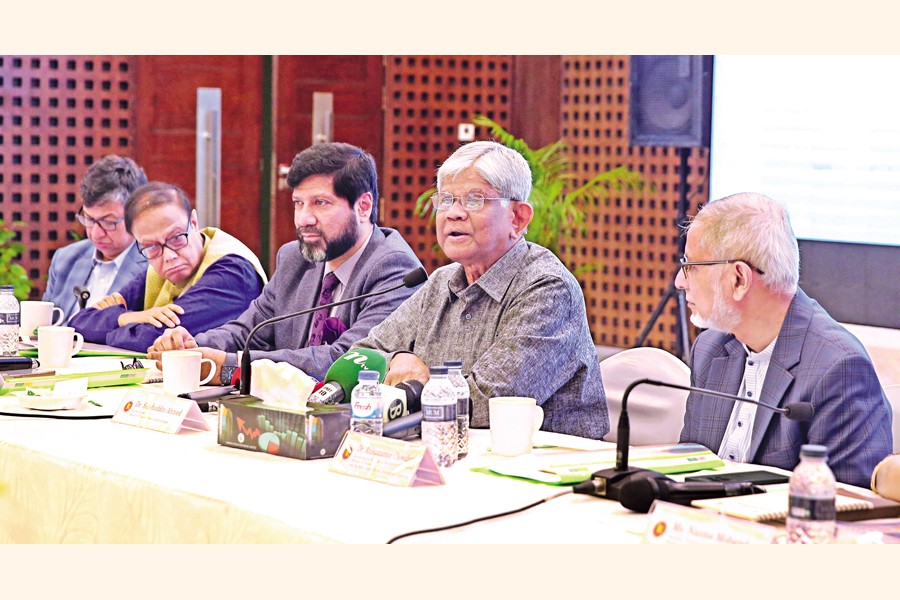
 Bangladesh Bank Governor (second from left) Dr. Ahsan H. Mansur and Finance Adviser Dr. Salehuddin Ahmed (second from right) at a seminal on Monday speak on overcoming obstacles to bond market development.
  The Bangladesh Bank and the capital market regulator have jointly prepared a comprehensive roadmap to expand the country's bond market.
They proposed setting up a dedicated department under the Ministry of Finance to oversee the securitization of existing government infrastructure and raise financing.
The regulatory authorities also suggested strengthening the Pension Regulatory Authority and making savings certificates fully tradable to generate demand for bonds by improving liquidity flow.
The information was shared on Monday at a seminar organised by the Bangladesh Securities and Exchange Commission (BSEC) and the Dhaka Stock Exchange (DSE) to discuss how to unlock the potential of the country's bond and sukuk markets.
"Bangladesh has a very different financial structure compared to the global economy," said BB Governor Dr. Ahsan H. Mansur, who spoke at the seminar as a special guest.
Bangladesh is highly dependent on bank loans. Globally, financial systems rely on bonds. The global bond market is worth $130 trillion, 130 per cent of the world's GDP, followed by $90 trillion of stock markets and $60 trillion of money markets.
Bangladesh's economy is in reverse order.
Mr. Mansur said, "We are moving away from the bank-dependent corporate structure as we see most of the problems are arising from this structure.
"Because corporations are biased towards banks, they don't want to issue bonds…. We need to create push and pull factors."
The central bank governor indicated that corporate organisations would be allowed to borrow from banks up to a certain limit, after which they would be incentivised to issue bonds.
Savings certificates and liquidity
Mr. Mansur said one of the major obstacles to developing the bond market is the lack of liquidity.
"We have a huge pool of savings certificates, none of which is linked to the market. In principle, these should be tradable. As it stands, it does not help customers. We need to make them tradable and more accessible to households," he said.
Separate department under finance ministry
The governor added, "The government can securitize the Padma Bridge or Jamuna Bridge and issue bonds. We need to work on that. Our metro rail can also be securitized."
"What we need is an operational department in the Ministry of Finance to look into this. A separate department should examine every opportunity to securitize existing government infrastructure and secure finance for new projects," he explained, adding that future development should be financed through bonds.
Funded pensions to drive demand
Dr. Mansur stressed the importance of transforming the pension system. "Currently, the pension system in Bangladesh is unfunded, but it should be funded. This fund will create demand for bonds. The Pension Regulatory Authority must ensure all pensions are funded and properly complied with," he said.
"We also need to develop the insurance sector so they can become holders of long-term bonds," he added.
Governance, taxation and public trust
The seminar's chief guest was Dr. Salehuddin Ahmed. Other special guests included Dr. Anisuzzaman Chowdhury, Special Assistant to the Chief Advisor and Chairman of the Capital Market Development Committee, and Ms. Nazma Mobarek, Secretary of the Financial Institutions Division at the Ministry of Finance.
In his remarks, Dr. Ahmed said, "In Bangladesh, people pay taxes but don't get services. Naturally, people get upset."
He described the core problem as a shortage of financing. "People assume that resources are unlimited and keep making demands. But the reality is we do not have that capacity. Our tax and non-tax revenues are very low, while private sector investment remains overly dependent on banks," he explained.
He also cautioned against populist calls for tax cuts. "If we keep reducing taxes, one day the government won't even be able to pay salaries. Everyone says 'cut taxes,' but nobody wants to pay."
Highlighting funding challenges, he said, "We want big projects, we talk about more allocation for health and education, but where is the money? Our tax-to-GDP ratio is only 7.2 per cent. In Brazil it is 26 per cent. They pay taxes and get services. Here people pay but receive nothing in return. That's why I often tell NBR officials-provide services first. If taxpayers are treated well, they'll be more willing to pay. But if you make them run around ten times and demand more fees, it won't work."
Expanding the financial sector
The adviser emphasised the urgent need to strengthen the capital market and expand Sukuk bonds to reduce excessive dependence on bank financing for both public and private projects.
"Bangladesh's financial sector relies too heavily on bank loans, and often borrowers manage to escape without repayment. This is our tragedy," he said.
He also pointed out that gratuity and pension funds remain difficult to utilise due to legal barriers and government liabilities. On the insurance sector, he described it as "chaotic" and in urgent need of reform.
"A dynamic financial sector cannot rely only on banks-it must include a strong capital market, an effective insurance sector, and specialised tax instruments," Dr. Ahmed argued.
Finally, he underscored the importance of building trust between citizens and the government. "People must feel that when they pay taxes, they receive services in return. That is the ultimate test of good governance," he said.
farhan.fardaus@gmail.com
© 2026 - All Rights with The Financial Express

