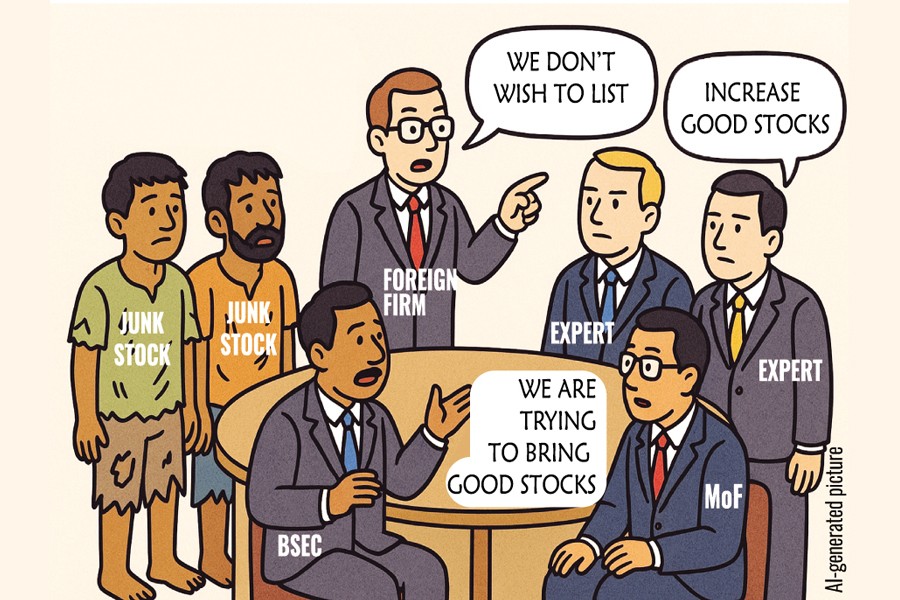
The securities regulator has moved to define 'Public Interest Entity (PIE)' to make it legally binding for all companies, including state-owned enterprises (SoEs) and multinational companies (MNCs), to go public if they meet the specified conditions.
The move comes against the backdrop of strong resistance from SoEs and foreign companies to the proposal of sharing profits with the public.
The Bangladesh Securities and Exchange Commission (BSEC) will set thresholds for financial parameters such as paid-up capital and annual revenue while determining the criteria for PIEs, said BSEC spokesperson Md. Abul Kalam.
If a company is labeled by the regulator as a PIE, it will have to issue shares to the public through an initial public offering (IPO) or raise capital through debt securities. If a company does not plan business expansion through fresh investments, it will have to enter the secondary market through direct listing.
"Companies - be it local or foreign - will have legal obligations to list if annual revenue exceeds a limit set by the regulator," said Mr. Kalam.
There are many multinational companies with paid-up capital of less than Tk 100 million but annual revenue exceeding Tk 10 billion. Legal obligations will be imposed on them through either new legislation or directives issued under an ordinance, Mr. Kalam elaborated.
Meanwhile, a decision was taken on August 10 that the securities regulator will formulate a draft ordinance/act for the listing of multinational companies, according to information from the Ministry of Finance (MoF).
The decision has already been communicated to the BSEC and the secretaries of different ministries, including the power division and the industry ministry.
After many failed attempts to bring reputed companies to the secondary market, the BSEC has now decided to adopt a firm stance by defining PIEs and compelling them to offload shares. The regulator feels encouraged particularly after Chief Adviser Prof. Muhammad Yunus instructed authorities to strengthen the equity market with quality scrips.
Excuses of SoEs, foreign companies for not listing
Discussions about listing SoEs and MNCs have been ongoing for nearly two decades, as policymakers and market stakeholders have long stressed the need for quality scrips to deepen the equity market.
The lack of significant government action in the past has been widely blamed for the failure to bring such companies to the market.
Following the change of the government on August 5 last year, expectations grew that the situation would improve and that some of the targeted companies would offload shares. The interim government, led by Prof. Muhammad Yunus, also expressed optimism over the listing of profitable SoEs.
At a meeting with representatives of the market watchdog and the finance ministry on May 11, Chief Adviser Prof. Yunus instructed that government-held stakes in companies be offloaded to the public.
However, more than three and a half months have passed since then, but no visible progress has been achieved.
The offloading of shares by SoEs has been stuck in bureaucratic tangles. Company representatives say they would place the matter before their boards and that board members would make the final decision.
On the other hand, foreign companies claim their memorandum of articles prevents them from going public, as it stipulates that shares must first be issued to existing shareholders.
The government has been particularly keen on bringing multinational firms to the capital market, such as Unilever Bangladesh, where it holds stakes.
At a meeting, Chief Adviser's special assistant Dr. Anisuzzaman Chowdhury said multinational companies had been making hefty profits year after year and there was no valid reason not to share profits with the public.
Some multinational companies operating in Bangladesh remain unlisted here, while they have been sharing profits with general investors in other countries such as India.
In this context, both the interim government and the securities regulator now believe that labeling such firms as PIEs is necessary to ensure their inclusion in the capital market.
Previously, non-listed companies were required to seek BSEC's approval to raise capital. Rules also made it mandatory for companies with paid-up capital above Tk 500 million to go public, while entities with Tk 400 million in paid-up capital had to convert into public limited companies.
However, in 2019, the BSEC relinquished that authority under pressure from powerful quarters, including senior government officials. A BSEC official said the regulator is now seeking to reclaim that authority by establishing a clear definition of PIE.
Asked about the barriers cited by company representatives, Mazeda Khatun, CEO of ICB Capital Management, said companies have multiple options for offloading shares.
"If the companies are interested in sharing profits with the public, the existing shareholders can refuse shares issued to them, which can then be subscribed by general investors," she explained.
mufazzal.fe@gmail.com
© 2026 - All Rights with The Financial Express

