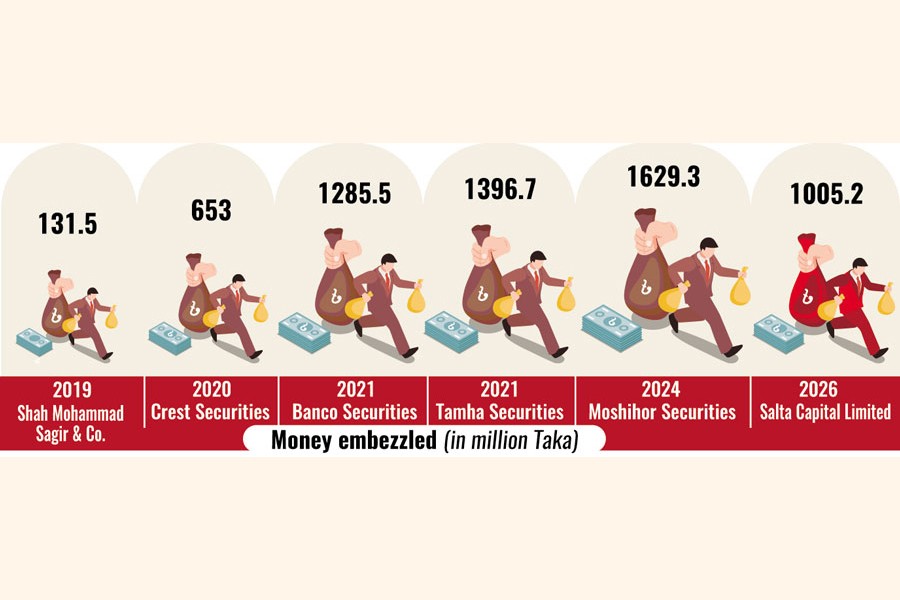
It is the same story, same mechanism; only the faces behind the scam are different and so are the victims. Regulatory action always comes late after investors have already been robbed of their assets and cash.
The securities regulator has issued directives to get bank accounts of the board of directors and senior management of Salta Capital frozen in follow-up actions as an inquiry report reconfirms embezzlement of Tk 1 billion by the broker from approximately 14,000 retail investors.
The probe report was submitted on May 11.
Salta Capital is the sixth broker that defrauded clients in about a decade, even after the market watchdog assured investors of taking measures to shield them from repetition of scams that happened earlier.
The fact that the broker had been siphoning off clients' funds first came to light during a sudden, unannounced physical inspection by the Dhaka bourse in November last year. The inspectors found a cash shortfall in the Consolidated Customer Account. The Dhaka Stock Exchange immediately informed the Bangladesh Securities and Exchange Commission (BSEC), which then immediately formed a probe committee.
Amid the latest actions taken by the commission, the Central Depository Bangladesh Limited (CDBL) was ordered to lock the personal BO accounts of Salta Capital's directors and top brass to prevent any secondary asset flight.
Although the newly-appointed BSEC chief is yet to assume office, the urgent orders have been executed and will receive retrospective approval during the upcoming commission meeting, said BSEC spokesperson Abul Kalam.
It is already too late, as the earlier incidents established the regulatory body's failure to recover embezzled funds and pay back the victims of the scams.
Mr Kalam, however, said the regulator had not waited for the final paperwork to halt the broker's operations.
"We officially froze and suspended Salta Capital's trading and Depository Participant (DP) operations on February 5 [this year]." The BSEC also suspended the license renewal of the brokerage firm, added Mr Kalam.
How did the sixth scam happen?
With this latest scam putting the regulatory bodies to shame, the aggregate claimed losses suffered by ordinary investors across six brokerage firms have officially surpassed the devastating threshold of Tk 6.0 billion.
The downfall of Salta Capital exposes a deeply troubling reality that, despite market surveillance, dishonest brokers can still operate completely invisible asset-stripping operations.
According to the probe findings, Salta Capital's management weaponized an unauthorized, duplicate version of its "back-office" software — the same mechanism used by the brokers in earlier scams.
One compliant version of the software generated clean data for submission to the regulators and the stock exchange. A parallel, duplicate version displayed entirely manipulated account balances to the broker's clients. Clients continued to see their investments and cash balances intact long after their assets had been sold or withdrawn.
To ensure the illusion remained uninterrupted, the firm altered investors' registered mobile numbers and email addresses within the Central Depository Bangladesh Limited (CDBL) database. By replacing client details with numbers controlled by the brokerage, Salta Capital effectively intercepted and diverted all automated SMS alerts and depository notifications away from the actual owners. The broker liquidated shares in investor BO accounts, pocketing Tk 728.3 million in cash. Simultaneously, they also plundered Tk 276.9 million from the Consolidated Customers' Account — an account maintained by every broker to handle clients' deposits.
What about recovery
Earlier incidents do not hold out much hope for clients of Salta Capital.
Data shows that of the Tk 5.0 billion stolen by five other brokers — Moshihor Securities, Banco Securities, Crest Securities, Tamha Securities, and Shah Mohammad Sagir & Co. — the DSE has managed to recover and refund a meagre Tk 0.53 billion over the years.
This represents a dismal 10.6 per cent recovery rate, distributed strictly on a pro-rata basis.
The masterminds behind the latest heist — Managing Director Abu Sayeed Md. Shahidullah and CEO Mohammad Rezaul Karim — turned off their mobile phones. Law enforcement agencies are currently attempting to determine their exact whereabouts and are preparing to impose travel restrictions amid fears that key individuals might have already fled the country.
Meanwhile, the DSE has ordered both bourses to verify individual claims and take steps to compensate affected clients. But market analysts are highly skeptical about a swift resolution.
"Unlike banks, we do not have a direct recovery mechanism," DSE Chairman Mominul Islam previously noted during talks with The FE on past scams. "Compensation is made through the limited Investor Protection Fund, while we attempt the long, arduous process of legally attaching the physical assets of the accused firms."
Who should be held accountable?
The recurring nature of these scams highlights a persistent regulatory vulnerability: the absence of automated, real-time remote surveillance.
While the DSE has mandated a standardized, non-editable back-office software architecture designed to reduce the probability of portfolio manipulation to zero, adoption has faced heavy resistance. A total of 34 brokerage firms have continuously flouted the directive, failing to implement the mandatory software. Whether Salta Capital was one of them could not be known immediately.
The BSEC spokesperson said future monitoring will feature automated, instant data matching between the CDBL and brokers' back-office software, allowing any inspection team to instantly extract the real financial data at any given point.
But what about the victims who have already fallen prey to the latest financial fraud by a market intermediary? Who should be held liable?
"It was the stock exchange itself that issued compliance certificates recommending the renewal of Salta Capital's license, claiming everything was pristine," said Mr Kalam, adding that the frontline regulators who fell asleep on the watch and blindly certified these fraudulent houses can no longer escape accountability.
As automated shields like real-time SMS alerts are forged, the entities that signed off on these brokers' clean records will also have to face the music.
farhan.fardaus@gmail.com
© 2026 - All Rights with The Financial Express

