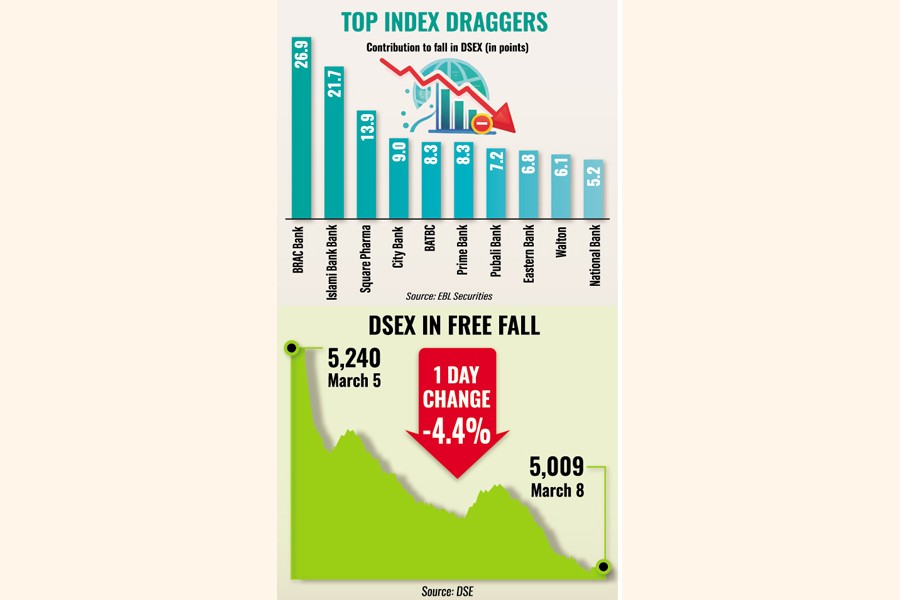
The stock index witnessed another sharp decline on Sunday, marking its highest single-day drop in six years afresh as panicked investors tried to exit the market amid the intensifying Middle East conflict.
Relentless bearish spell gripped the market right from the outset of the week's first session, which induced panic-stricken investors to dump holdings to minimise further losses in their already hampered portfolio.
The market failed to earn any breather as the session progressed with widespread price corrections across most stocks, leaving the overall market sentiment in a state of persistent uncertainty.
The benchmark index of the Dhaka Stock Exchange (DSE) finally plunged 232 points, or 4.42 per cent, to 5,008. The DSEX lost 592 points since the US-Israel launched strikes on Iran on February 28.
Sunday's index plunge is the biggest since March 9, 2020, the day when the coronavirus outbreak triggered a sharp fall.
Market analysts said investors remained wary of potential macroeconomic repercussions of the ongoing geo-political tension, particularly the risks of fuel and power supply disruptions within the country.
Md. Ashequr Rahman, managing director of Midway Securities, said there was no sign of any de-escalation of the war. And, oil prices were skyrocketing across the globe, triggering further tension.
The government of Bangladesh also has started fuel rationing for vehicles.
"That's why Sunday's sharp fall of the equity market was a complete reflection of the tension centering the war between Iran and US-Israel coalition," Rahman said.
The companies that mainly intensified the fall of the equity market were large-cap ones and majority of them were the banks that experienced appreciation over the last few months, he said.
"The market operators also felt panicked following such corrections," he added.
On 28 February 2026, Israel and the United States began joint air attacks on Iran, starting a war primarily aimed at destroying Iran's missile programme and bringing about regime change.
Then Iran initiated a blockade of the Strait of Hormuz, a critical global energy chokepoint, following US-Israeli strikes, causing a near-total halt in shipping traffic and threatening 20 per cent of the world's oil supply.
Bangladesh's energy security remains heavily dependent on Middle Eastern suppliers such as Saudi Arabia, the United Arab Emirates, and Qatar, making the country acutely vulnerable to disruptions in the Gulf.
Any disruption in fuel imports could hamper power generation and industrial output, potentially slowing overall economic activity.
While oil prices rise amid instability in the Middle East and key sea routes such as the Strait of Hormuz become insecure, Bangladesh is confronted with multiple economic stresses.
Economists and market insiders have already warned that if the conflict persists, the consequences could be immediate: longer shipping routes, higher freight costs, and ultimately rising energy prices that directly hit production costs across the economy.
Further escalation could push prices even higher in the coming days.
Bangladeshi businesses have already expressed deep concerns, saying the intensifying conflict may pose fresh challenges and drive up the cost of doing business.
Higher oil prices would directly inflate Bangladesh's import bills, placing renewed pressure on foreign exchange reserves. An increase in LNG and fuel oil prices would raise electricity generation costs, potentially affecting industrial output and export competitiveness, particularly in energy-intensive sectors.
There is also a risk of renewed inflationary pressure if transport and production costs climb in response to rising fuel prices.
On Sunday, trading activities remained low and amounted to Tk 5.32 billion, which was 16 per cent higher than previous day's turnover of Tk 4.59 billion.
Major sectors suffered losses with the banking sector witnessing 6.2 per cent correction in market capitalisation while the remaining sectors experienced between 1.3 per cent and 6.2 per cent corrections on the day.
Price declines in blue-chip stocks -- BRAC Bank, Islami Bank, Square Pharma, City Bank and BAT Bangladesh -- largely dragged the market down. They jointly accounted for a 81-point drop in the key index.
BRAC Bank alone wiped out 26.9 per cent from the benchmark DSEX index.
The blue-chip DS30 index plunged 91 points to 1,920 as all 30 blue-chip stocks experienced price erosion.
Losers outnumbered gainers on the DSE trading floor. Of the 390 issues traded, 371 saw price declines, 10 ended higher, and nine others remained unchanged.
The port city bourse, the Chittagong Stock Exchange, also went down, with its CSE All Share Price Index (CASPI) losing 420 points to 14,405 while the Selective Categories Index (CSCX) shed 255 points to 8,805.
mufazzal.fe@gmail.com
© 2026 - All Rights with The Financial Express

