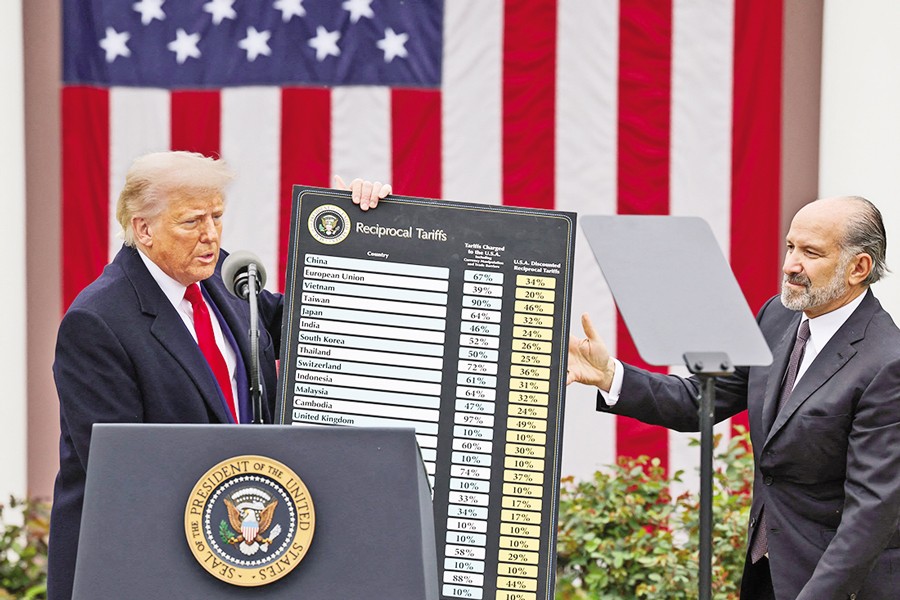
WASHINGTON, Nov 20 (Agencies): The US trade deficit fell by nearly 24 per cent in August as President Donald Trump's sweeping global tariffs pushed imports lower.
In a report delayed for more than seven weeks by the federal government shutdown, the Commerce Department said Wednesday that the the gap between what the United States buys from other countries and what it sells them fell to $59.6 billion in August, from $78.2 billion in July.
Imports of goods and services dropped 5 per cent to $340.4 billion in August from July when US companies were stocking up on foreign products before Trump finalized taxes on products from almost every country on earth. Those levies went into effect Aug. 7.
US exports blipped up 0.1 per cent in August to $280.8 billion.
Trump, charging that America's persistent trade deficits mean that other countries have taken advantage of the US, has overturned decades of US policy in favor of free trade, slapping double-digit tariffs on imports from most countries and targeting specific products, including steel, copper and autos, with their own levies.
Still, the US trade deficit is up so far in 2025, coming in at $713.6 billion through August, up 25 per cent from $571.1 billion in January-August 2024.
A drop in imports and the trade deficit is good for economic growth because foreign products are subtracted from the nation's gross domestic product. GDP is the output of a nation's goods and services.
"August's smaller trade deficit will be a tailwind for third quarter real GDP, since it means that more US expenditures were directed toward domestically-produced goods and services rather than foreign ones," Bill Adams, chief economist at Comerica Bank, wrote in a commentary. "While this release is quite dated because of the government shutdown, it contributes to evidence that the economy was growing briskly in the third quarter."
Tariffs, which Trump says will protect US industries and lure factories to America, are paid by importers who typically attempt to pass along the higher cost to their customers. Economists say Trump's tariffs are one reason US inflation remains stubbornly above the Federal Reserve's 2 per cent target.
After voters' dissatisfaction with the high cost of living led to big Democratic gains in the Nov. 4 elections, the president relented and dropped tariffs last week on beef, coffee, tea, fruit juice, cocoa, spices, bananas, oranges, tomatoes and certain fertilizers, saying they "may, in some cases" have contributed to higher prices.
His tariffs are also facing a legal challenge that has gone to the Supreme Court. In a Nov. 5, hearing, the justices sounded skeptical that the president had the authority to bypass Congress and slap unlimited tariffs on most imports simply by declaring a national emergency.
Meanwhile, US job growth likely picked up moderately in September, while the unemployment rate held steady near a four-year high of 4.3 per cent, consistent with sluggish labor market conditions that economists and policymakers have blamed on low supply and demand for workers.
Though the Labor Department's closely watched employment report on Thursday would be backward-looking, it would confirm the significant loss of momentum in the labor market this year, marked by sharp downward revisions to nonfarm payroll counts.
The report was delayed by the 43-day shutdown of the government. The longest shutdown in history has forced the Bureau of Labor Statistics, which produces the employment report, to cancel the release of October's report as no data was collected for the household survey to calculate the unemployment rate for that month.
October nonfarm payrolls will instead be combined with November's employment report now due on December 16, the BLS said. Heading into the economic data blackout, the BLS had estimated that about 911,000 fewer jobs were created in the 12 months through March than previously reported.
"The labor market is clearly slowing, the assumption is that the trend is going to continue," said Sung Won Sohn, a finance and economics professor at Loyola Marymount University. "We're going to be scratching the bottom for a while, but I don't think we are going into recession."
Nonfarm payrolls likely increased by 50,000 jobs in September, a Reuters survey showed, which would be more than double the 22,000 positions added in August. Economists argued that August's payrolls count was held back by a seasonal quirk and expected an upward revision in line with prior-year trends.
A reduction in immigration that started during the final year of former President Joe Biden's term and accelerated under President Donald Trump's administration has depleted labor supply. Economists estimate the economy now only needs to create between 30,000 and 50,000 jobs per month to keep up with growth in the working-age population, down from about 150,000 in 2024.
While the unemployment rate increased in August, it had mostly bounced between 4.1 per cent and 4.2 per cent this year.
"This strongly suggests that the sagging pace of job growth is mostly, though not entirely, reflecting the shift in labor supply and that the labor market broadly has slackened slightly but not to a substantial degree," said Stephen Stanley, chief US economist at Santander US Capital Markets.
The rising popularity of artificial intelligence is also eroding demand for labor, with most of the hit landing on entry-level positions, and locking recent college graduates out of work. Economists said AI was fueling jobless economic growth.
Others blamed the Trump administration's trade policy for creating an uncertain economic environment that had hamstrung the ability of businesses, especially small enterprises, to hire. The US Supreme Court early this month heard arguments on the legality of Trump's import duties, with justices raising doubts about his authority to impose tariffs under the 1977 International Emergency Economic Powers Act.
Despite payrolls remaining positive, some sectors and industries are shedding jobs.
"The environment is particularly detrimental to small and medium-sized enterprises; that's where we've seen most of the employment losses," said Brian Bethune, an economics professor at Boston College. "This is a highly polarized economy."
Some economists believed the September employment report could still influence the Federal Reserve's December 9-10 policy meeting, if it showed a stable or deteriorating labor market.
US central bank officials will not have November's report in hand at that meeting as the release date has been pushed to December 16 from December 5. Minutes of the Fed's October 28-29 meeting published on Wednesday showed many policymakers cautioned that lowering borrowing costs further could risk undermining the fight to quell inflation.
"The Fed is itchy about cutting further," said Martha Gimbel, executive director of the Budget Lab at Yale. "If you see a really weak report, that might move the Fed, but it would take a pretty weak report."
© 2026 - All Rights with The Financial Express

