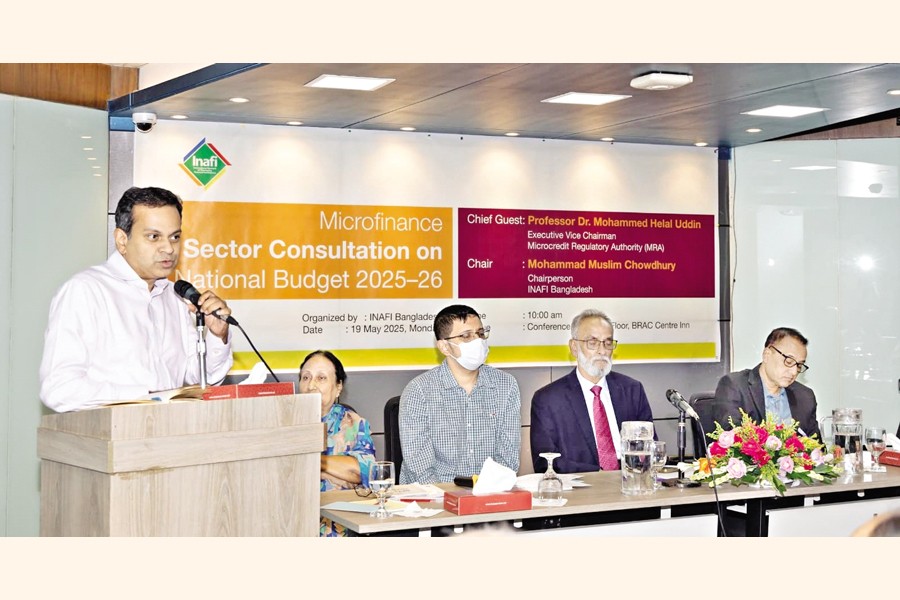
 INAFI Bangladesh organised the 'Microfinance Sector Consultations on National Budget 2025-26' at the BRAC Centre in Dhaka recently.
 Microfinance sector leaders have urged the government to introduce a range of supportive budgetary measures in National Budget 2025-26, including the establishment of a Tk 100 billion revolving Micro Loan Fund aimed at ensuring sustainable financing for the sector.
At a pre-budget dialogue, they also called for simplified tax provisions and allocation of grant funding for essential social development programmes, particularly in light of declining donor support.
They also emphasised the importance of institutionalising formal pre-budget consultations between the Ministry of Finance and microfinance institutions to ensure that policy decisions reflect on-the-ground realities and sector needs.
INAFI Bangladesh organised the 'Microfinance Sector Consultations on National Budget 2025-26' at the BRAC Centre in Dhaka recently, says a statement.
The consultation was attended by Dr. Mohammed Helal Uddin, Executive Vice Chairman (EVC) of the Microcredit Regulatory Authority (MRA), as the chief guest while Asif Saleh, Executive Director of BRAC; Md Ariful Haque Choudhury, President of ASA; and Dr Humaira Islam, Executive Director of Shakti Foundation for Disadvantaged Women; were present as guests of honour.
Mohammad Muslim Chowdhury, Chairman of INAFI and Sonali Bank PLC, chaired the event.
Emranul Huq Chowdhury, Vice Chairman of INAFI Bangladesh, delivered the keynote presentation outlining major policy and financial expectations of the sector.
He said, "The microfinance sector plays a vital role in financial inclusion and poverty alleviation. A revolving fund of at least BDT 100 billion is essential for sustaining operations, and simplified tax policies will enable us to reach more people with fewer administrative burdens."
Asif Saleh, Executive Director of BRAC, stressed the need to safeguard the social mission of MFIs.
He said, "As we move toward financial sustainability, we must not lose sight of our social obligations. The country is at a critical stage facing a poly crisis. In this space, just like during Covid-19 times, MFIs need to play a leading role in reaching the informal sector, in climate adaptation and addressing unemployment issues by creating new jobs by providing add-on linkages. The government's support -- through enabling policies and budget allocations -- can help us maintain this balance."
Dr. Mohammed Helal Uddin, Executive Vice Chairman of MRA, called on the sector to better quantify its contributions. "The microfinance sector must present its impact in measurable terms. This evidence is essential to make a stronger case for support from policy-makers and development partners," he said.
He advocated for greater access to finance for underserved communities and highlighted a practical funding strategy. "If large MFIs are allowed to mobilize savings -- similar to the model used by banks -- and use that to support smaller MFIs, the sector's current funding crisis could be significantly mitigated."
© 2026 - All Rights with The Financial Express

