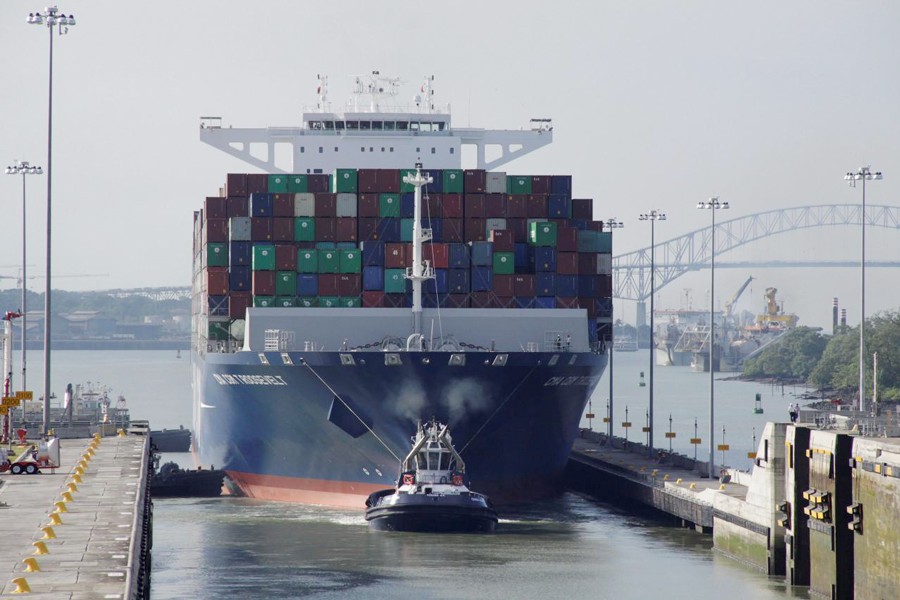
 A tugboat towing the British CMA CGM T. Roosevelt cargo vessel during its transit at the expanded canal through Cocoli Locks at the Panama Canal, on the outskirts of Panama City, Panama — Reuters
 PANAMA CITY, Sept 16 (Reuters): Fewer ships from China and the United States (US) could use the Panama Canal if trade tensions escalate between the two economic giants, but the dip could be offset by grain exports from north Brazil, the head of the organisation that operates the waterway said.
The canal, which cuts through Panama creating an essential shipping route between the Atlantic and Pacific oceans, is a major source of revenue for the central American country.
"Most cargoes passing through the Panama Canal come from or go to the United States and China," Panama Canal Authority chief Jorge Quijano told Reuters late on Thursday. "Tensions between them could ultimately have an impact on the amount of loadings using the waterway in any direction."
The administration of US President Donald Trump is readying a list of $200 billion in Chinese imports on which it plans to levy tariffs in coming days, stepping up the trade war between the world's two largest economies.
However, Quijano said he expected more bulk cargo from Brazil, the world's largest soy producer, would boost canal traffic.
Brazilian soy has traditionally been shipped across the Atlantic and Indian oceans, but farmers in top soy state Mato Grosso earlier this year signed a memorandum of understanding with the canal to look at ways to cut transport costs and increase grain volumes using the waterway via ports in the north of Brazil.
New demand for US liquefied natural gas (LNG) in countries including Japan and Mexico could also compensate for fewer vessels going to China, Quijano added, saying: "The canal has many ways to ease any impact."
The Panama Canal has not disclosed updated figures on vessel transit by volume. In its fiscal year 2017, which ended in September 2017, it handled a record 403.8 million tonnes, including 143 million tonnes in container ships and 79 million tonnes in bulk carriers.
Brazil and Argentina have already taken a greater share of the Asian grains markets, leading to lower traffic through the canal in the first few months of 2018, Quijano said. To offset that, Panama needs to convince Brazilian exporters to use the canal, Quijano said.
About 2.0 million tonnes of Brazilian soy went through the canal last year, out of annual soy exports of around 60 million tonnes, Brazilian data shows.
© 2026 - All Rights with The Financial Express

