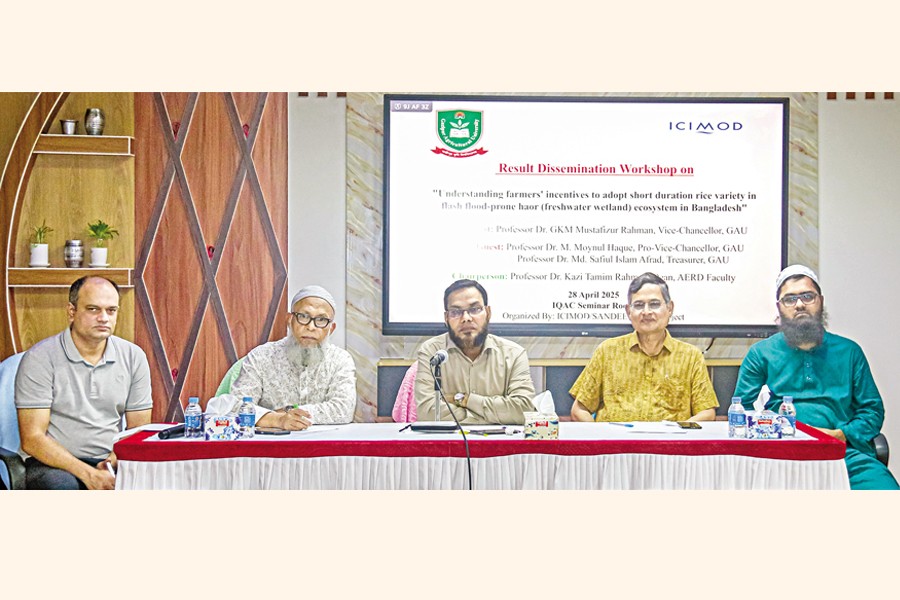
 Participants at a workshop titled 'Understanding Farmer's incentives to adopt short duration rice variety in flash flood-prone haor (freshwater wetland) ecosystem in Bangladesh' held at Gazipur Agricultural University on Monday.
 A special workshop titled 'Understanding Farmer's incentives to adopt short duration rice variety in flash flood-prone haor (freshwater wetland) ecosystem in Bangladesh' was held at Gazipur Agricultural University (GAU) on Monday.
The workshop was organised by GAU and funded by the Nepali institutions ICIMOD (International Centre for Integrated Mountain Development) and SANDEE (South Asia Network for Development and Integration), says a statement.
The primary goal of the workshop was to share research findings, highlight the advantages of short-term rice cultivation for farmers, provide farming techniques and solutions, and facilitate discussions and feedback.
The workshop was presided over by Dr. Kazi Tamim Rahman, Dean of the Faculty of Agricultural Economics and Rural Development at GAU, while Vice-Chancellor of GAU Dr GKM Mustafizur Rahman was present as the chief guest.
Pro-Vice-Chancellor Dr M Moynul Haque and Treasurer Dr Md. Safiul Islam Afrad were present as special guests.
The keynote speaker was presented by Dr. Md Sadik Rahman from Sher-e-Bangla Agricultural University, the principal investigator of the project, while the workshop was conducted by Dr. Debasish Chandra Acharjee, Professor of Agribusiness at GAU.
The workshop saw the participation of deans, directors and scientific officers from various academic faculties, the Bangladesh Rice Research Institute (BRRI), Bangladesh Agricultural Research Institute (BARI), and the National Agricultural Training Academy (NATA).
In the opening session, Dr. Sadik Rahman presented the research findings of the project conducted in the Haor region of Kishoreganj, highlighting that although short-duration Boro rice varieties cultivated in the area were beneficial for protecting farmers from sudden floods, they were not economically profitable, which discouraged farmers from adopting them.
The study showed that if the production cost per hectare could be reduced by Tk 8,000 or if the yield could be increased by 112 kg per hectare, farmers in the Haor region would benefit economically from short-duration Boro rice cultivation.
Therefore, the research emphasised the need for the development of low-cost, high-yield rice varieties suited to the region.
© 2026 - All Rights with The Financial Express

