Q1: Ms. Meulemeester, welcome to Bangladesh. Is this visit part of your regular market engagement, or are there specific business and policy priorities shaping your visit at this time? How does BAT view Bangladesh in terms of its strategic importance within the wider global portfolio?
Pascale Meulemeester: Bangladesh is one of BAT's key markets globally because of its scale, long-term potential, and demographics. We are proud of our leadership position and remain focused on being a responsible, constructive partner in the country's development journey.
As BAT approaches its 125th anniversary in 2027, our presence in Bangladesh for more than 116 years reflects the market's importance to us. It speaks of our long-term commitment to the country, our enduring partnership with the government, and our continued contribution to the economy and the livelihoods of almost 5 million people across our value chain.
My visit also comes at an important time, as discussions around the National Budget gather momentum. We believe the current ad valorem, multi-tiered, excise framework for cigarettes is broken. It requires thoughtful reform to make the tax structure more sustainable, predictable, and better aligned with the country's long-term revenue objectives.
Q2: Bangladesh is seeking to position itself as an attractive destination for foreign direct investment. How would you assess the current policy and regulatory environment for multinational investors?
Pascale: The new government has rightly placed a strong emphasis on attracting foreign direct investment, and that ambition is both timely and encouraging. As one of the longest-standing foreign investors in Bangladesh, we believe there are a few conditions that enable long-term investment to grow and deliver value. Chief among these are a stable business environment, consistent policy direction, and a clear long-term fiscal roadmap - all of which are essential to strengthening investor confidence and supporting sustainable economic growth.
But equally important is how policy is shaped in the first place. Achieving the right environment requires genuine inclusivity - transparent stakeholder dialogue between policymakers and the industry, where both sides work as partners. When that relationship functions well, policy decisions are better informed, more balanced, and ultimately more effective in delivering the outcomes the government is seeking.
Q3: You have spoken about the need to transition toward a specific tax structure. Drawing on your global experience, why do you believe that approach would be more effective for Bangladesh?
Pascale: Globally, there are only 17 countries with a tiered system, and only three of those have a multi-tiered ad valorem structure. The current system is not just unusual; it has not delivered real-term tax revenue growth for the past six or seven years. The price gap between the highest- and lowest-priced cigarettes is the widest we have seen. When nine out of ten consumers migrate to the bottom of the market, that fundamentally erodes tax revenues for the government, as well as threatening the sustainability of the legal industry.
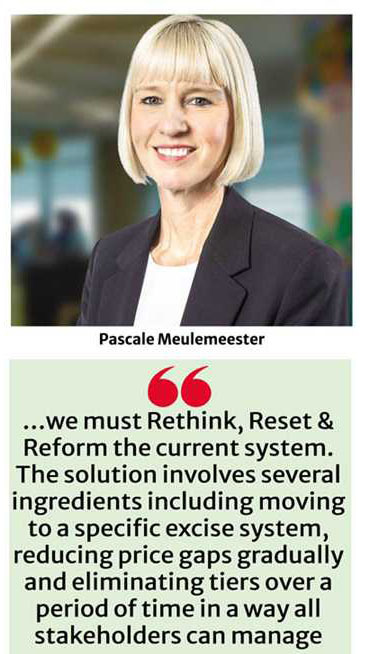
As I have said, fundamental reform is needed. In practical terms, that means we must Rethink, Reset & Reform the current system. The solution involves several ingredients including moving to a specific excise system, reducing price gaps gradually and eliminating tiers over a period of time in a way all stakeholders can manage. There should be no further increases in ad valorem excise - what remains today for manufacturers to cover costs in Bangladesh is lower than anywhere else in the world.
The suggested reforms are in line with best practices from around the world, where an increasing number of countries are adopting specific excise duties. It is what Bangladesh needs for sustainable revenue growth, what the legal industry needs for viability, and uniquely, what tobacco control groups also believe is the best approach.
Q4: Critics often argue that frequent tax hikes can unintentionally fuel illicit trade and broader market distortions. In your view, how can policymakers strike the right balance between public revenue objectives, regulatory priorities, and maintaining a stable legal market?
Pascale: Illicit trade is a complex issue, and fiscal policy is one of several factors that can influence it. When the tax component of the legal retail price rises too sharply, it can create stronger incentives for unlawful activity and deepen market distortions through noncompliance.
International experience suggests price adjustments are most effective when they are moderate, gradual, and predictable. Sudden shocks, like the one in Bangladesh back in January 2025, will disrupt consumer behaviour, erode the legal industry, and put pressure on revenue ambitions.
Effective and uniform enforcement also remains essential. Stronger production monitoring, better reconciliation between output and taxes paid, and consistent oversight from NBR across all manufacturers will help protect the integrity of the legal industry.
Q5: With the upcoming National Budget, there is considerable discussion around revenue mobilisation and the possibility of further increases in cigarette prices. How do you see such measures affecting the industry, consumers, and the government's broader revenue objectives?
Pascale: In our discussions with the Ministry of Finance and the NBR, we have consistently underscored the importance of stability. With its first budget, we ask that the new government embark on a more balanced fiscal approach - one that moves steadily beyond the limitations of the current model. We believe this budget can mark the beginning of a more considered reform journey that supports long-term revenue growth and industry sustainability.
Q6: Across your region, you have seen a wide range of taxation models. In Bangladesh's case, what are the risks of relying so heavily on tobacco tax revenues, and what broader measures should the government consider to improve the overall tax-to-GDP ratio in a more sustainable way?
Pascale: If we look at it from a practical economic perspective, Bangladesh depends on tobacco tax revenues far more than most nations do. While tobacco-related taxes contribute close to 10% of total government tax revenue, the global average is much lower, typically around 1% to 2%.
The new administration faces a pivotal choice: it may either persist in replicating the errors of its predecessor, or acknowledge that it is unreasonable to expect different outcomes from the same actions repeatedly. It is essential to recognise that continuously relying on exhausted strategies will not yield new or improved results.
If we look at international best practices, successful countries do not improve their tax-to-GDP ratio by repeatedly targeting the same industries. They do it by increasing compliance, widening the tax base, and creating a fairer, more transparent, and more balanced taxation system.
If Bangladesh moves forward with reform gradually, moderately and transparently, it can create a more stable and effective excise framework - one that supports stronger revenues, encourages foreign investment, protects the legal economy and aligns with the country's long-term ambitions. The opportunity is real, but so is the risk of inaction. What is required now is a clear commitment to modernisation and the discipline to avoid repeating the mistakes of the past.
© 2026 - All Rights with The Financial Express

