Bangladesh is yet to take full advantage of global apparel buyers' shift towards small-quantity orders, as many still prefer China for its strong competitiveness and wide range of product variety, industry insiders said.
Amid geopolitical and trade tensions, global buyers are diversifying sourcing destinations and placing smaller work orders to better prepare for and navigate shocks, they added.
With changing consumer demand patterns and fast-evolving fashion trends, buyers are increasingly placing orders in small quantities.
Bangladesh is receiving some such orders, but not in significant numbers as it mostly handles volume-based work orders.
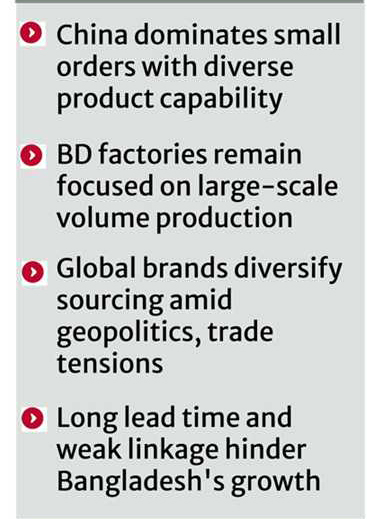
Industry insiders identified long lead time for shipments, lack of adequate backward linkage -- especially in woven garments -- and the mindset of factory owners as key reasons behind the situation.
A recent case study titled "H&M's Evolving Apparel Sourcing Base" by Dr Sheng Lu, a professor at the University of Delaware, also hinted at similar findings.
Using H&M's publicly released factory list on February 26, the study analysed the company's sourcing strategies and changes to better understand its fast fashion model and sourcing practices.
H&M sources apparel from nearly 800 factories across 23 countries, along with about 550 textile raw material suppliers in 15 countries.
Compared to its 2024 sourcing base, the company appears to have consolidated the number of factories it sources from, the study said.
The retailer maintains long-term relationships with suppliers. Of its nearly 800 contracted apparel factories, 314 (about 40 per cent) have worked with H&M for more than 10 years, and another 126 for six to 10 years. Only 261 factories (around 33 per cent) have relationships of less than three years.
At the country level, China remains H&M's largest sourcing destination, accounting for over 230 factories or 29.5 per cent as of February 2026.
H&M also sources the widest range of apparel categories from China, including woven (85 factories), jersey (56), knitwear (32) and denim (11).
"In other words, China is one of the few countries that can make almost all types of products for H&M," the study noted.
In contrast, H&M sources narrower product categories from other major suppliers, such as Türkiye for jersey, denim and knitwear; India for denim; Indonesia for underwear and swimwear; and Pakistan for denim and socks.
This finding aligns with recent studies indicating that Western fashion companies commonly regard China as highly competitive for its product variety, which is difficult for other countries to match.
The study also showed that more than 76 per cent of H&M's contracted factories in China employ fewer than 500 workers, reflecting its role in supplying variety-driven, small- to medium-sized orders.
In contrast, factories in Bangladesh, Pakistan and Indonesia are more concentrated in large-scale production, typically employing over 1,000 workers. In Bangladesh, 41 per cent of H&M's contracted factories have more than 4,000 workers, indicating a focus on high-volume production.
H&M sources from 234 factories in China, followed by 127 in Bangladesh, 115 in Türkiye, 92 in India, 57 in Vietnam and 36 in Portugal.
Talking to The Financial Express, Sheikh HM Mustafiz, managing director of Cute Dress Industry Ltd, said he handles small-quantity orders by adding value through complex work, which brings higher profit.
However, Bangladesh is yet to scale up such work due to its existing setup, lack of supply chain efficiency and limited product diversification, he noted.
He said many premium and mid-sized buyers place small orders and offer good prices, but local exporters often prefer bulk production as it is easier in terms of design and manufacturing.
Exporters said that although Bangladesh did not receive many small-quantity orders in the past, the situation is gradually changing.
In many countries, multi-skilled workers can produce entire garments -- around 200 to 300 pieces -- under a "tailor-shop" model.
In Bangladesh, however, production follows a line system, where each worker performs a specific operation. This system is efficient for bulk production but less suited to small orders.
Bangladesh also requires a long lead time -- up to four months from production to shipment -- while an additional 45 days may be needed if raw materials are imported, exporters added.
munni_fe@yahoo.com
© 2026 - All Rights with The Financial Express

