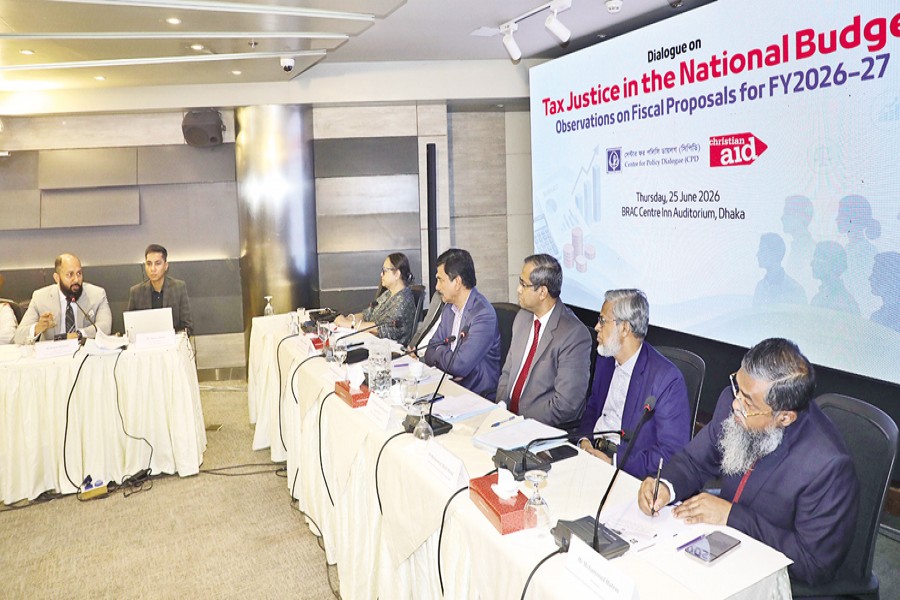
 Former DCCI president Rizwan Rahman speaks at a dialogue titled 'Tax Justice in the National Budget: Observations on Fiscal Proposals for FY2026-27' at BRAC Centre Inn in Dhaka on Thursday. FE Photo
 The Centre for Policy Dialogue (CPD) on Thursday called for institutionalising 'tax justice' by conducting a Tax Justice Impact Assessment (TJIA) for every national budget to evaluate its impact on poverty, gender equality and regional disparities.
Unveiling a set of recommendations for the FY2026-27 national budget, the private think tank also proposed indexing personal income tax thresholds and slabs to inflation annually to protect low- and middle-income earners from 'bracket creep'.
The proposals were presented at a dialogue in the city, chaired by CPD Research Director Dr Khondaker Golam Moazzem. Tamim Ahmed, a senior research associate at CPD, presented the keynote paper titled "Tax Justice in the national budget: observations on fiscal proposals for FY 2026-27." Nuzhat Jabin, country director of Christian Aid in Bangladesh, delivered the welcome address.
The discussion was attended by representatives from the business community, tax professionals and policymakers.
Presenting the report, Tamim Ahmed outlined a series of reforms aimed at making the country's tax system more equitable, transparent and efficient.
To improve wealth redistribution, CPD proposed replacing the existing wealth surcharge with a direct wealth tax.
It also recommended simplifying the Value Added Tax (VAT) system by reducing the standard VAT rate from 15 per cent to 10 per cent and consolidating the current eight-rate structure into three tiers: standard, reduced and zero-rated.
To shield low-income households from the burden of indirect taxation, the report suggested introducing a cashback or rebate mechanism on VAT paid for essential goods.
Highlighting the extent of tax evasion, the report estimated that Tk 2.26 trillion in revenue was lost in FY2022-23.
To strengthen compliance, CPD recommended criminalising repeated failure to file tax returns, making Electronic Fiscal Devices (EFDs) and e-invoicing mandatory nationwide, and enhancing transaction transparency.
The think tank also called for the withdrawal of tax concessions for fossil-fuel-based power producers to better align fiscal policy with environmental goals.
For greater fiscal transparency, CPD proposed publishing comprehensive tax expenditure reports detailing all tax exemptions, their fiscal costs and policy justifications.
To modernise tax administration, it advocated the complete digitisation of the National Board of Revenue (NBR) and the legal separation of revenue policy formulation from revenue administration to reduce political influence.
On corporate taxation, CPD suggested aligning the statutory corporate income tax rate with the
Organisation for Economic Co-operation and Development's (OECD) global minimum tax rate of 15 per cent.
It also recommended replacing blanket tax incentives for listed companies with performance-based incentives linked to investment, export growth and job creation.
Speaking at the event, former Dhaka Chamber of Commerce and Industry (DCCI) President Rizwan Rahman stressed the need to end the longstanding distrust between businesses and tax officials.
"Tax justice is difficult to ensure because political pressures often influence policy decisions, including measures such as the legalisation of undisclosed income," he said.
He noted that the middle-income group remains the main driver of the economy and should be given opportunities to move into higher income brackets.
He also criticised the imposition of additional taxes on the property sector, saying that the cost of purchasing property in Bangladesh is often higher than in many developed cities.
Tax expert Snehasish Barua suggested reinstating the 5 per cent income tax slab and reducing the effective corporate tax burden, saying businesses often pay substantially more than the statutory rate due to supplementary levies and compliance costs.
Bangladesh Knitwear Manufacturers and Exporters Association (BKMEA) President Md Hatem called for reinstating the reduced tax rate on export cash incentives and granting tax waivers for subcontracting activities to support industrial competitiveness.
Metropolitan Chamber of Commerce and Industry (MCCI) President Kamran T Rahman stressed the need to build trust between taxpayers and the authorities to broaden the tax base.
"We need to think outside the box instead of putting additional pressure on existing taxpayers," he said, adding that turnover tax should be withdrawn because it unfairly burdens loss-making enterprises.
Former NBR chairman Dr Abdul Mazid said budget consultations should continue beyond June 30 and fiscal policy discussions should remain active throughout the year.
"Policymakers must familiarise themselves with the realities faced by taxpayers and approach reforms with empathy," he said.
Income Tax Policy Member Barrister Mutasim Billah Faruqui said tax justice had been strengthened through the abolition of the minimum tax, describing it as one of the most significant reforms aimed at making the income tax system more progressive.
He said the tax administration had introduced thousands of changes to simplify business processes and compliance requirements.
"It was a challenging task for the government to meet the revenue collection target as the budget did not impose any unusual new taxes," he added.
doulotakter11@gmail.com
© 2026 - All Rights with The Financial Express

