President of Bangladesh Knitwear Manufacturers and Exporters Association (BKMEA) Mohammad Hatem said that factories are struggling to operate at full capacity due to a shortage of fuel.
"Exports have fallen in recent months, while factories are currently operating at only 50-60 per cent of their capacity.
"Right now, energy shortage is one of the biggest problems. The government says that there is no fuel shortage or crisis, but in reality, we are not getting fuel in filling stations," he said.
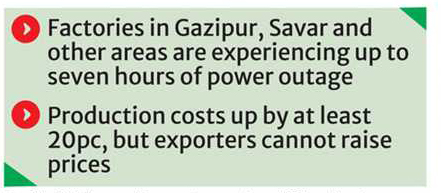
He alleged that factories are experiencing two to three hours of load-shedding on an average daily while units in Gazipur, Savar and other areas even face up to seven hours, he alleged.
Speaking at a press conference held Saturday at a city hotel, the BKMEA leader said that in many cases factories are unable to procure fuel, as filling stations are not allowed to supply fuel in containers under instructions from the Bangladesh Petroleum Corporation.
The district administration is monitoring the situation and also imposing fines where necessary, he said.
The conference was organised to announce that the four-day Bangladesh International Textile, Knitting and Garment Industry Exhibition (BTKG Expo 2026) will begin at the International Convention City Bashundhara (ICCB) in Dhaka on April 29. BKMEA and Inforchain Digital Technology Co Ltd will jointly arrange the show.
Organisers said more than 1,000 exhibitors from 30 countries will display modern textile machinery, dyes and chemicals, knitting and weaving technologies, embroidery, cutting and sewing equipment, and washing and dry-cleaning technologies at around 1800 booths.
Mr Hatem said the industry must move towards more technology-driven, efficient and sustainable production systems to remain competitive globally.
He expressed the hope that such an international exhibition would help the sector move forward.
He warned that regardless of the current business situation, failure to keep pace with modern technologies would result in Bangladesh losing its market share, with export orders shifting elsewhere.
Responding to a question, Mr Hatem said that the global economy has been going through a turbulent period due to factors like Russia-Ukraine war and other geopolitical tensions, the impact of which has also been felt in Bangladesh.
He said the exhibition aims to help the industry recover and attract international buyers by showcasing its technological capabilities.
Replying to another question, the BKMEA President said the current business situation is not favourable, and many factories have already shut down due to a lack of cooperation from the banking sector, with more at risk of closure.
He alleged that exporters are facing difficulties opening letters of credit, conducting import-export operations, and accessing credit facilities.
He noted that complexities in customs procedures, and in some cases arbitrary practices, are hindering trade.
He said overall production costs have increased by at least 20 per cent, but exporters are unable to pass on the additional costs to buyers as prices are fixed in advance.
Meanwhile, global demand has declined, leading buyers to reduce order placements.
Speaking at the event, Executive President of BKMEA Fazlee Shamim Ehsan said the global fashion industry is rapidly moving towards fast fashion, recycling, and circularity, making technological advancement essential.
The primary objective of the exhibition is to familiarise entrepreneurs in the sector with such technologies, he added.
Ehsan, who is also the convener of BTKG Expo 2026, said despite the ongoing challenges, such initiatives would encourage investment and could inspire the emergence of new entrepreneurs.
He said that although fuel cards have been introduced, adequate fuel supply is not available at all levels.
While supply has normalised in some areas, shortages persist in other places, he said.
He further said that due to the global economic slowdown, consumer spending has marked a fall in key markets, including the European Union, affecting apparel demand.
As a result, order volumes have decreased globally, not just in Bangladesh, he added.
Munni_fe@yahoo.com
© 2026 - All Rights with The Financial Express

