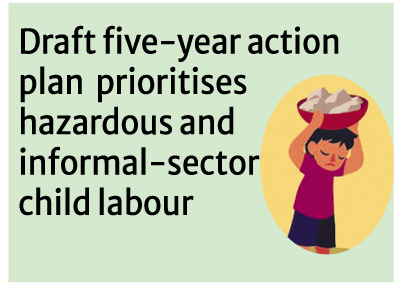
Bangladesh has drafted a new five-year National Plan of Action (NPA) resetting the target for eliminating all forms of child labour to 2030, with an initial focus on eradicating the worst forms from hazardous occupations and the informal sector, sources said.
The government had previously set targets of eliminating the worst forms of child labour by 2021 and all forms by 2025. Both deadlines were missed for reasons, most notably the Covid-19 pandemic, they said.
People involved in drafting the plan said the new NPA would be finalised by the middle of this month. It sets out five strategic objectives, including a monitoring and evaluation framework, which was absent from the previous action plan.
 The revised NPA and its updated timeframe are also considered important for achieving the global target of eliminating child labour by 2030 and for helping Bangladesh retain eligibility for zero-tariff export access to the European Union market, particularly after its graduation from the least developed country (LDC) category, they added.
When contacted, Labour Ministry Additional Secretary Abdur Rahim Khan said a validation meeting was held in the capital on Wednesday and that the NPA would be finalised by July 15 after incorporating observations made during the meeting.
He said the new NPA places greater emphasis on implementation strategies and coordination among all relevant stakeholders. Its five strategic objectives are prevention, protection, prosecution, partnership, and monitoring and evaluation.
According to the Bangladesh Bureau of Statistics (BBS) National Child Labour Survey 2022, published in 2024, around 1.78 million children are engaged in child labour across the country, of whom 1.07 million are involved in hazardous work.
The government has already declared 43 sectors hazardous for children, up from 38 in 2022, while calls are growing from various quarters to include domestic work on the list, officials said.
It has also declared eight industries -- export-oriented garments, leather goods, tanneries, ceramics, glass, silk, shrimp processing and shipbreaking -- free from child labour, they added.
The highest prevalence of both child labour (1,776,097 children) and hazardous child labour (1,068,212 children) is among those aged between 14 and 17 years, according to the draft NPA.
The industrial sector accounts for the largest share of both child labour and hazardous child labour, at 66.6 per cent and 54.7 per cent respectively, followed by the service sector (44.4 per cent and 29.9 per cent) and agriculture (38.8 per cent and 3.3 per cent).
"This calls for greater attention to addressing child labour in the industrial sector, including large informal workplaces, followed by the service and agricultural sectors," the draft says.
BBS data also show that child labour is more prevalent in rural areas, at 44 per cent, compared with 4.6 per cent in urban areas.
However, hazardous child labour is more concentrated in urban areas, accounting for 24 per cent, compared with 2.7 per cent in rural areas.
The draft therefore says greater attention is needed in rural areas to address child labour overall, while efforts to eliminate hazardous child labour should primarily focus on urban areas.
"The NPA 2026-2030 identifies hazardous child labour and child labour in the informal sector as its priority," the draft says, noting that child labour in Bangladesh is a multidimensional problem rooted in poverty, inadequate education systems, social norms, weak governance and environmental vulnerability.
Speaking to the Financial Express, Bangladesh Labour Foundation Executive Director AKM Ashraf Uddin called for aligning compulsory education with the minimum employment age of 14 by extending free and compulsory education through Class VIII to accelerate child labour eradication efforts.
ILO Bangladesh Country Director Max Tunon said: "In line with ILO Convention 138, keeping children in school remains one of the most effective ways to prevent child labour."
Emphasising the need for stronger links between child labourprogrammes and social protection for vulnerable families, he said social safety nets that support parents while ensuring children remain in school could help break the cycle of intergenerational poverty.
The draft NPA also recommends a comprehensive approach encompassing poverty alleviation, improved access to quality education, stronger law enforcement, greater public awareness and enhanced protection for disaster-affected and marginalised communities.
Without addressing these interconnected factors, child labour will continue to undermine the rights and future of children in Bangladesh, it warns.
Bangladesh Institute of Labour Studies (BILS) Executive Director Syed Sultan Uddin Ahmed said the new NPA is particularly important as the International Labour Organization (ILO) has set 2030 as the target year for eliminating all forms of child labour.
He said the initiative must be led by the government rather than the international community or civil society organisations, while stressing that private-sector industries employing large workforces should be fully involved in implementing the plan.
Munni_fe@yahoo.com
© 2026 - All Rights with The Financial Express

