Infrastructure Development Company Limited (IDCOL) has now turned its focus on promoting rooftop solar systems for both industries and public infrastructures.
In this regard, IDCOL is seeking around Tk 10 billion in credit from the central bank to finance the installation of an additional 300 megawatts of electricity for industrial rooftop solar systems, officials said.
The agency, well-known for illuminating rural areas by financing solar home systems, the largest off-grid renewable energy initiative in the world, has recently requested the fund from the Green Transformation Fund (GTF).
The GTF, operated by the central bank, has a combined size of US$200 million, €200 million, and Tk 50 billion. Banks and financial institutions can borrow from it at rates as low as 1.0 per cent, while customers receive loans at a maximum rate of 5 per cent.
IDCOL Chairman Shahriar Kader Siddiky, also secretary of Economic Relations Division, wrote in a recent letter to the Bangladesh Bank governor that the new Net Metering Guidelines 2025 aim to promote rooftop solar for industries by encouraging both capital expenditure (CAPEX) and operational expenditure (OPEX) models, as well as local manufacturing of solar equipment.
The government is trying to support the industries in reducing their operational costs by generating their own power and selling excess back to the grid. This also helps ensure a more reliable and cost-effective power source, mitigating risks associated with energy shortages, he wrote.
Mr Siddiky said the Power Division has recently requested IDCOL to undertake a large-scale initiative to implement the government's policy of delivering clean, affordable energy across Bangladesh through rooftop solar system.
"With this instruction, IDCOL is undertaking specific programmes to promote rooftop solar systems for both industries and public infrastructures," he noted.
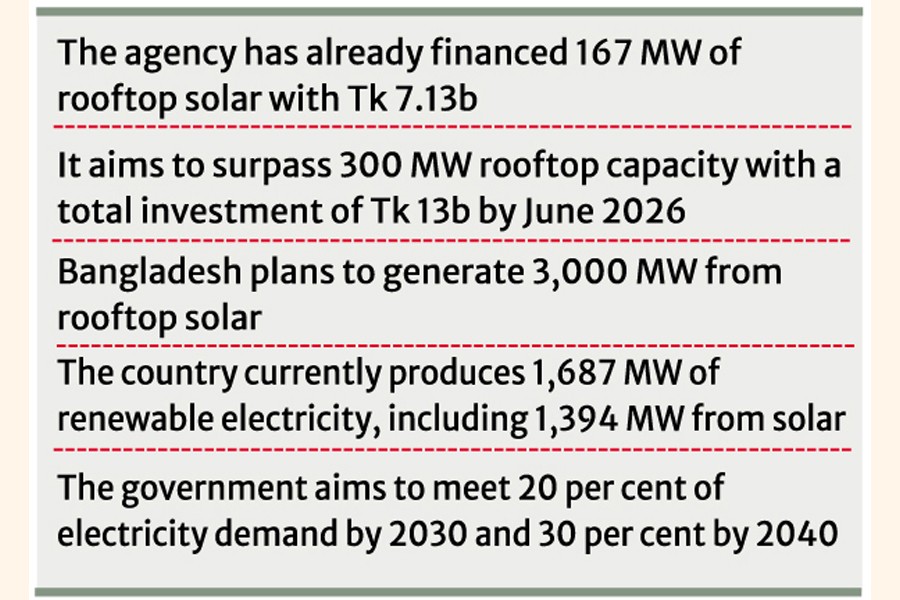
He further wrote that with concessional funding from the World Bank and kfw, IDCOL has so far distributed Tk 7.13 billion to 103 industrial units to support the installation of 167 MW of rooftop solar capacity.
By June 2026, IDCOL aims to exceed 300 MW of rooftop solar installations with a total investment of Tk 13 billion, he said, adding that the organisation has prepared a strong pipeline to install more than 300 MW with its available funds.
However, to meet the growing demands and comply with the government instructions for large-scale rooftop solar deployment, IDCOL requires concessional funds of around Tk 30 billion, with which it can facilitate installation of at least an additional 1,000 MW over the next five years.
He also wrote that to align with the government's commitment to convert conventional power to renewable power, the Power Division is putting significant emphasis on a more aggressive approach-doubling efforts with a target to install more than 3,000 MW of rooftop solar systems within the shortest possible time.
Mr Siddiky added that through initiatives taken by the ERD, IDCOL has started negotiation with the World Bank, ADB, EIB, AIIB, kfw, JICA and other prospective development partners to arrange lines of credits for implementing this urgent government initiative.
However, organising loan availability in line with current demand and portfolio requirements of development partners will require extensive discussion and time to finalise all necessary processes.
"As the renewable energy transition requires sustainable financing, we believe that the "Green Transformation Fund" could be of great source for quickly supporting at least the installation of rooftop solar systems in the industries of the country," he noted.
IDCOL officials said that the total potential rooftop solar capacity identified in the industrial sector stands at 3,621 MWp, with the textiles and garments sector alone accounting for 2,815 MWp.
The government has set a target to generate some 3,000 MW of electricity through the National Rooftop Solar Programme 2025, to be installed on the rooftops of state-owned buildings including schools, hospitals, and rail stations.
Under the Renewable Energy Policy 2025, the government aims to meet 20 per cent of the country's total electricity demand from renewable sources by 2030 and 30 per cent by 2040. Bangladesh currently generates some 1,687 MW of electricity from renewables of which 1,394 MW alone comes from solar alone.
syful-islam@outlook.com
© 2026 - All Rights with The Financial Express

