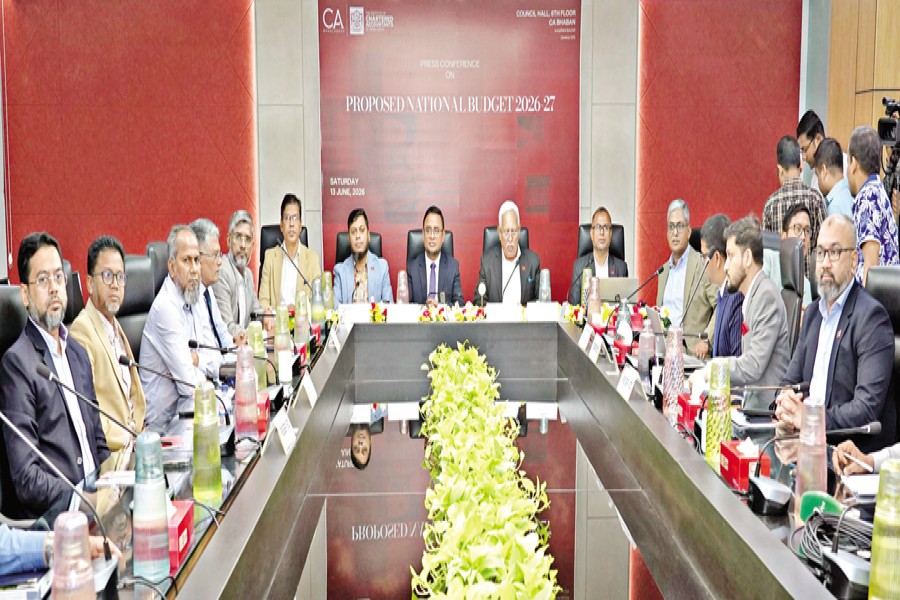
 Institute of Chartered Accountants of Bangladesh holds a press conference titled 'Chartered Accountants' Perspectives on the Proposed National Budget 2026-27' held at CA Bhaban in the capital on Saturday.
 The government's plan to borrow Tk 1120 billion from the banking system to finance the proposed FY2026-27 budget deficit may reduce the availability of credit to the private sector and adversely affect investment, the Institute of Chartered Accountants of Bangladesh (ICAB) has warned.
Speaking at a press conference titled "Chartered Accountants' Perspectives on the Proposed National Budget 2026-27" at CA Bhaban in the capital on Saturday, ICAB leaders said excessive reliance on bank borrowing could crowd out private-sector credit at a time when investment and business expansion need support.
ICAB President NKA Mobin said the proposed budget reflects the government's commitment to economic stability, revenue mobilisation, employment generation, investment growth and private-sector development.
However, he noted, achieving the ambitious revenue target of Tk 6.95 trillion would require coordinated reforms and greater efficiency in tax administration.
"The proposed budget deficit stands at Tk 2.43 trillion, of which Tk 1.12 trillion is expected to be financed through borrowing from the banking system. Such borrowing could restrict credit flows to the private sector and hinder private investment," he said.
ICAB welcomed the government's focus on tax modernisation, digital transformation, improving the ease of doing business and promoting investment-friendly policies.
It said raising the tax-to-GDP ratio while ensuring transparency and accountability in tax administration would be essential for sustaining economic growth.
The institute noted that several of its pre-budget recommendations had been incorporated into the Finance Bill. These include the abolition of the minimum tax provision, setting tax rates for the next five years, tax incentives for registered startups, strengthening the tax refund mechanism and reducing mandatory deposit requirements for tax appeals.
According to ICAB, these measures will simplify business operations and improve the overall investment climate.
The institute also welcomed the proposed VAT exemption for content creators and freelancers, changes in VAT treatment for locally manufactured products and the inclusion of free-trade-zone-related provisions in customs legislation.
However, it urged the government to reconsider some measures.
ICAB warned that the proposed 0.2 per cent advance tax on direct sales by manufacturers, importers and suppliers to retailers could add to inflationary pressures.
It also expressed concern that making the Business Identification Number (BIN) mandatory for trade licence renewals and for opening merchant accounts under mobile financial services (MFS) could create practical difficulties for small and emerging businesses.
ICAB further recommended introducing online hearings for tax assessments, appeals and alternative dispute resolution proceedings, fully digitising tax administration and strengthening oversight and audits of public expenditure.
Mobin said the Document Verification System (DVS), jointly introduced by the National Board of Revenue (NBR) and ICAB, has become an important tool for improving tax administration.
He said the system has already helped enhance transparency, curb tax evasion and boost revenue collection, and would play an even greater role in the future.
Sarker Nahidul Islam, director of Tax and Advisory Services at Rahman Rahman Huq, said the proposed reforms represent a significant step towards simplifying the tax system, improving compliance and making it easier to do business in Bangladesh.
He said restructuring the tax framework into five categories, with emphasis on reducing business costs, broadening the tax net and strengthening compliance, is particularly important as Bangladesh prepares for graduation from least developed country (LDC) status.
Among the business-friendly initiatives, he highlighted the introduction of a digital business services platform, simplified operation of foreign currency (FB) accounts and a fixed 30-day timeline for dividend processing.
He also noted that expanding VAT input credits to labour, transportation and solar power, alongside easier access to double-taxation treaty benefits, would improve tax efficiency.
Nahidul added that clearly defined record-retention requirements - 12 years for companies and six years for non-corporate entities - would strengthen documentation standards and compliance.
Snehasish Barua, partner at Snehasish Mahmud & Co, said the government's primary objective is to contain inflation.
To support that goal, the government reduced income tax, VAT and customs duties at the source and import stages ahead of the budget announcement. These measures are intended to provide some relief to consumers amid rising electricity and utility costs, he said.
Barua said implementation remains the key concern, particularly the risk of harassment by tax and VAT officials at the field level.
ICAB Vice-President Md Moniruzzaman, acting Chief Executive Officer Mostafa Kamal and other council members were also present at the press conference.
newsmanjasi@gmail.com
© 2026 - All Rights with The Financial Express

