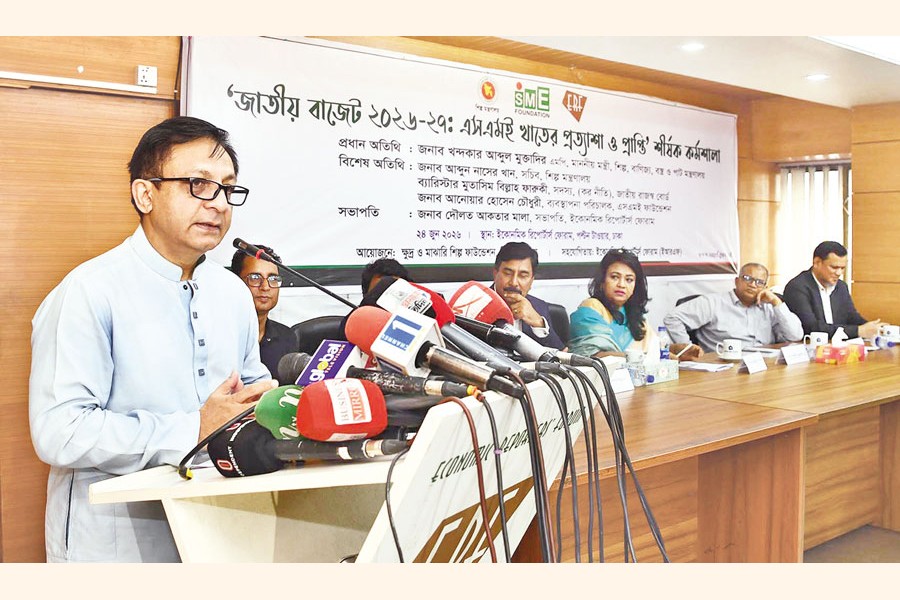
 Commerce Minister Khandakar Abdul Muktadir speaks at a seminar titled "National Budget 2026-27: Expectations and Achievements of the SME Sector", organised by the SME Foundation and the Economic Reporters' Forum in the capital's Paltan area on Wednesday.
 The government is planning to transform unviable state-owned sugar mills into industrial parks and gradually shift towards sugar beet-based production in a move to make the sugar industry economically sustainable, Commerce, Industry, and Textiles and Jute Minister Khandaker Abdul Muktadir said on Wednesday.
He said the existing sugar mills can no longer be made viable under current economic and agricultural realities.
The minister was speaking as the chief guest at a seminar titled "National Budget 2026-27: Expectations and Achievements of the SME Sector", organised by the SME Foundation and the Economic Reporters' Forum (ERF) in the capital's Paltan area.
"There are 15 sugar mills in the country, of which nine are operational and six remain closed," he said.
Mr Muqtadir noted that even the state-owned Keru& Company remained profitable primarily because of its distillery operations rather than sugar production.
"These mills were established 60 to 70 years ago. The realities of that period were very different from those of today," he observed.
Highlighting the limitations of sugarcane cultivation, the minister said a sugarcane crop takes around 14 months to mature, while the mills operate for only about three months using the harvested cane.
"Maintaining a factory operation for round the year is no longer economically feasible when it can be run for only three months," he said.
He also questioned the utilisation of dedicated agricultural lands for sugarcane cultivation for more than a year when multiple crops can now be grown on the same land annually.
As part of the government's reform plans, Mr Muqtadir said some existing sugar mills would be converted into sugar beet-based mills.
According to him, the current sugar recovery rate from sugarcane in Bangladesh is around 5.0 per cent, compared with the global average of 10 per cent. In contrast, sugar beet can yield around 15 per cent sugar, while requiring only four-and-a-half to five months to cultivate.
"This would allow farmers to grow other crops on the same land during the remaining period of the year," he said.
The minister further said industrial parks would be developed on large tracts of unused land belonging to certain sugar mills to attract new investments and generate employment.
"We are preparing for attractive packages, including energy support and other incentives, for potential investors. The objective is not necessarily to continue the old factories but to create new industries and jobs," he added.
Citing the example of state-owned fertiliser factories, Mr Muqtadir said though those plants are highly profitable, they often remain idle because of gas shortages, forcing the country to import fertiliser with spending valuable foreign exchange.
To address the issue, the government is considering establishing a dedicated gas supply network exclusively for fertiliser factories, he added.
"If successful, the factories will be able to operate throughout the year, significantly reducing the need for fertiliser imports," the minister added.
He also indicated that a similar investment-friendly approach would be pursued in the steel and engineering sectors also.
Among others, Barrister Mutasim Billah Faruqui, Member (Tax Policy) of the National Board of Revenue (NBR), and Anwar Hossain Chowdhury, Managing Director of the SME Foundation, attended the event as special guests. ERF President Doulot Akter Mala chaired the seminar, while General Secretary Abul Kashem moderated the session.
newsmanjasi@gmail.com
© 2026 - All Rights with The Financial Express

