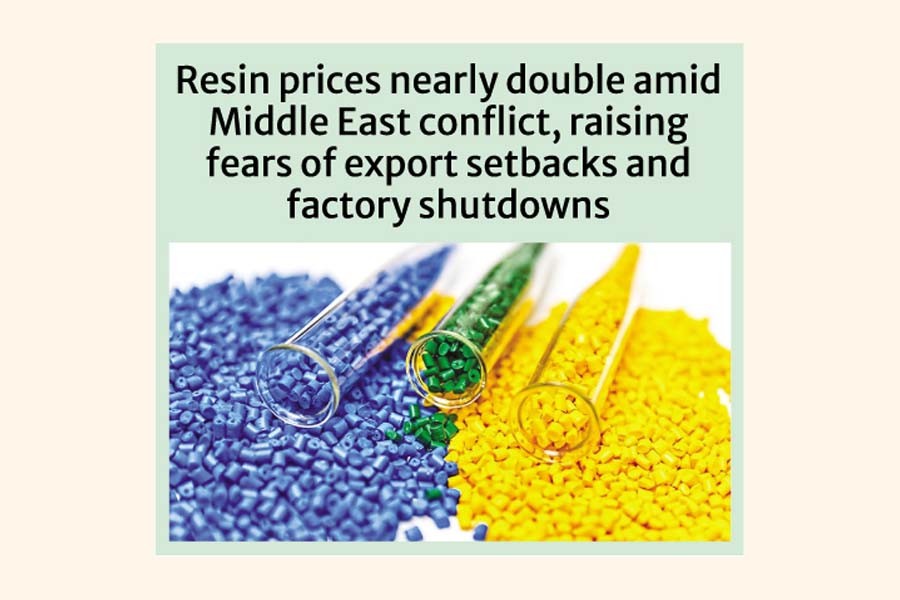
Bangladesh's plastic goods manufacturers lament huge business losses as the ongoing Middle East war -- involving Iran and the US-Israel -- has resulted in high raw material prices following global energy and petrochemical market disruptions, insiders say.
They warn that their raw material stocks, mostly resin, may last only a few weeks, fearing production cuts, higher prices, and pressure on export performance.
The price of resin, the key raw material used in the plastic industry, has gone up to $1,500-1,800 per tonne from $900-950 per tonne before the war, they say.
They attribute this to the sharp rise in crude oil prices, which have surged from about $60-70 per barrel to $115-120, markedly increasing production costs.
ASM Kamal Uddin, managing director of Luna Polymer Industry, has told The Financial Express the majority of the raw material manufacturing companies are not offering prices as factories in Qatar, Saudi Arabia, and Oman -- from where they mostly import -- shut down.
Besides, shipping costs have significantly gone up as movement has been restricted and ships are stuck at different points, he says.
His company imports about 500 tonnes of resin monthly.
Kamal says the company usually has raw material stocks for one to two months, which are going to end shortly.
Luna Polymer Industry produces special-grade plastic goods mostly used in pharmaceutical and pesticide companies, he also says.
He says they have been unable to import for the last one month, while production may shut down if raw materials are not imported at very high prices.
Besides, there are problems if buyers do not make fresh orders at increased prices. Factories could not stock up due to the absence of banking facilities, Kamal adds.
He says his factory may continue operations for one to two months, warning prolonged instabilities could trigger widespread shutdowns.
When asked, Bangladesh Plastic Goods Manufacturers and Exporters Association (BPGMEA) President Shamim Ahmed says the prices of key raw materials, mostly resin, almost doubled in a month due to global oil price volatility and geopolitical tensions.
The plastic sector, a linkage industry, is supporting around 30,000 businesses, including food processing, pharmaceuticals, garment, and consumer goods, he says.
"Without plastic packaging, many essential products cannot reach the market efficiently," he adds.
He also says despite some growth in domestic production, Bangladesh still largely depends on raw material imports.
The annual demand for plastic resin is about 1.7 million tonnes. Of this, 1.2-1.3 million tonnes are imported, while local production and recycling account for the rest, he says.
The BPGMEA leader warns that many factories are operating at breakeven or shutting down, urging required policy support to help sustain the sector, especially during the crisis.
He demands the withdrawal of import duties, which are up to 32 per cent, including tax and VAT, on raw materials.
"If the government cannot fully withdraw the duties, it should reduce them by 50 per cent to significantly ease the pressure," Shamim adds.
Industry insiders say higher prices have failed to ease the situation as suppliers cannot deliver despite these levels.
Manufacturers are prioritising limited raw materials for selected products and customers, often favouring buyers willing to accept higher prices to cope with the situation, they say.
The situation has further been complicated by difficulties in opening and adjusting letters of credit (LCs), with many suppliers unable to fulfil orders or demanding revised terms, they add.
According to BPGMEA, some 6,000 factories create direct employment for about 1.5 million workers.
The local market size is about $4.0 billion.
Munni_fe@yahoo.com
© 2026 - All Rights with The Financial Express

