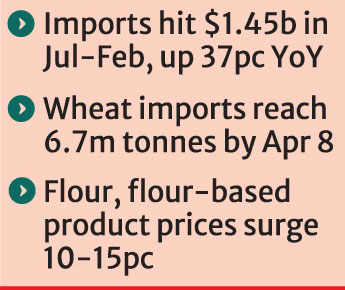
A sharp rise in wheat imports drove Bangladesh's import bill up 37 per cent to $1.45 billion in the July-February period of the current fiscal year (FY26), compared to $1.06 billion in the same period last fiscal year, Bangladesh Bank data showed.
According to Ministry of Food data, the country imported around 6.7 million tonnes of wheat as of April 8.
Most of the imports -- over 85 per cent -- were made by the private sector, the ministry said.
The government imported around 0.6 million tonnes of wheat this fiscal year for safety-net programmes.
Despite higher imports, prices of wheat flour and flour-based food items have increased by 10-15 per cent over the past three months.
 The food ministry expects total wheat imports to reach a record 7.5 million tonnes by June.
Currently, coarse flour (atta) is being sold at Tk 45-50 per kg (loose) and Tk 65-68 per kg (packet). Fine flour (maida) is priced at Tk 62-65 per kg (loose) and Tk 75-78 per kg (packet).
Prices have increased by Tk 4.0-5.0 per kg during this period.
Prices of bread, biscuits, buns, muffins, cakes and other flour-based items have also risen by 10-15 per cent.
However, these price hikes come at a time when global wheat prices remained at relatively low levels between July 2025 and February 2026.
According to tradeeconomics.com, wheat prices ranged between $220 and $240 per tonne during the period.
Value chain expert Prof Dr Rashidul Islam said global prices rose slightly in April but remained much lower than last year's levels.
He said stable supply from the Black Sea region, including Russia, Ukraine and Belarus, helped keep prices low, while exports from the United States and Canada also supported global supply.
He added that both the government and the private sector have ensured adequate supply through increased imports.
However, Consumers Association of Bangladesh (CAB) Secretary Humayun Kabir Bhuiyan said consumers are not benefiting from lower global prices and higher supply.
He noted that a 350-gram loaf of bread now sells for Tk 50, up from Tk 35-40 one and a half years ago, despite a 40-50 per cent fall in global wheat prices during the period.
He also said prices of bread and buns sold by street vendors have increased, or their size has been reduced, affecting daily wage earners.
The CAB secretary urged the government to regulate imports and the supply chain to prevent excessive profit-taking by traders.
An official of Akij Insaf Group said that although global wheat prices remain stable, fluctuations in the dollar exchange rate have pushed up local prices.
He added that the ongoing dollar shortage in the country is also contributing to higher costs.
He said local confectionery producers usually use North American wheat, which is more expensive.
However, he pointed out that current flour prices are still lower than those in 2023 and 2024.
Bangladesh consumes around 7.0-8.0 million tonnes of wheat annually but produces only about 1.0 million tonnes, with the rest met through imports.
tonmoy.wardad@gmail.com
© 2026 - All Rights with The Financial Express

