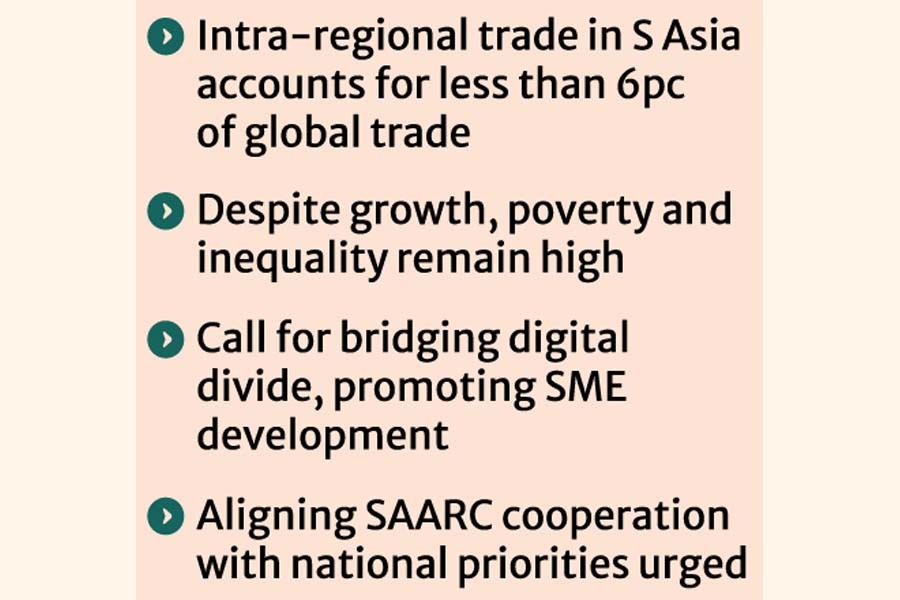
South Asia continues to be one of the least integrated regions globally, with intra-regional trade accounting for less than six percent of total trade, underscoring persistent barriers to the free flow of goods, services, and investments.
These challenges could slow economic growth and cause countries in the region to miss key development opportunities.
This observation was made by Dr. Monzur Hossain, Member (Secretary) of the General Economics Division (GED), while addressing a two-day consultative workshop on the 'SAARC Development Report 2025' that began in Dhaka on Wednesday.
"By reducing non-tariff barriers, improving logistics, and expanding cross-border transport and digital connectivity, SAARC can unlock immense potential for trade and investment," Dr. Hossain emphasised.
He further noted that despite recent economic gains, poverty and inequality persist across the region. "Bridging the digital divide and promoting SME development should therefore be collective priorities to ensure inclusive and sustainable growth," he added.
In its country presentation, Bangladesh stressed that the SAARC Development Report 2025 must align regional cooperation with national development priorities.
The presentation emphasised the need for a strong policy focus on poverty alleviation, inequality reduction, climate resilience, and digital transformation.
Bangladesh also identified key regional challenges such as persistent poverty, growing inequality, climate change impacts, energy and food insecurity, limited regional connectivity, and weak institutional coordination, compounded by significant data gaps.
Addressing the event, Prathma Uprety, Director at the SAARC Secretariat, reiterated the Secretariat's commitment to promoting deeper cooperation and regional resilience.
"Through the SAARC Development Report 2025, we aim to advance socioeconomic growth, environmental sustainability, and gender equality," she said. "Together, we can shape a stronger, more inclusive, and sustainable future for our region."
Hoe Yun Jeong, Country Director of the Asian Development Bank (ADB), underscored the importance of enhanced regional cooperation to build a resilient and sustainable South Asia.
He reaffirmed ADB's commitment to creating jobs, promoting clean energy, and protecting public health to ensure long-term stability and inclusive growth.
Dongxiang Li, Lead Regional Cooperation Specialist at ADB, emphasised the need for socioeconomic development, environmental stewardship, gender equality, and institutional strengthening to improve regional resilience.
He also reiterated ADB's support for deepening partnerships, knowledge-sharing, and capacity-building initiatives across SAARC member states.
The two-day workshop, organised by the General Economics Division of the Planning Commission, is chaired by Mr. Bidhan Baral, Joint Chief (Joint Secretary) of GED.
Delegates from Bangladesh, Bhutan, Maldives, Nepal, Pakistan, and Sri Lanka are participating in the event.
The workshop, part of an ongoing SAARC Secretariat initiative, is expected to adopt key recommendations and a timeline for finalising the SAARC Development Report 2025 today (Thursday).
jasimharoon@yahoo.com
© 2026 - All Rights with The Financial Express

