Workers in the country's ship-breaking industry are set to receive social protection under a new Employment Injury Scheme (EIS) pilot launched recently.
Earlier, in June 2022, the EIS was introduced on a pilot basis in Bangladesh's export-oriented readymade garment industry, providing lifelong payouts to injured workers and to the families of those who die at the workplace.
 Based on the success of the RMG scheme, the ship-breaking EIS has been developed. Shipbreaking is widely regarded as one of the most dangerous occupations in the world, where workers face daily risks from toxic materials, heavy machinery and falls. In most cases, workers have little or no recourse when injured or taken ill on the job.
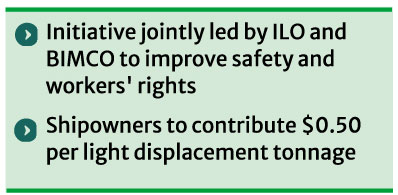
On March 12, International Labour Organization (ILO) launched the pilot EIS in collaboration with BIMCO (Baltic and International Maritime Council) to strengthen the protection and rights of workers at ship recycling yards in Bangladesh, the world's largest ship recycling nation, according to a statement.
BIMCO, founded in 1905, is the world's largest international shipping association, representing ship-owners, operators, brokers and agents.
The new EIS pilot establishes a fund providing pensions and financial support to workers and their families who are unable to work due to job-related injury or illness.
Under the scheme, ship-owners sending vessels for recycling in Bangladesh can contribute $0.50 per light displacement tonnage by signing a Letter of Intent facilitated by BIMCO.
The scheme complements the Hong Kong Convention for safe and environmentally sound ship recycling which sets global standards for the industry.
"Ship recycling is the most environmentally sound way of disposing a ship when it reaches the end of its operational life. But it is a high-risk industry, so we strongly support closing the gap until the national employment injury insurance scheme is operational in Bangladesh," David Loosley, Secretary General and CEO of BIMCO said.
"The ILO scheme offers the shipping industry a tool to strengthen the protection, safety and rights of the workers that recycle our ships," he added.
The scheme works as a social insurance where the risk is pooled and shared by the industry, according to a BIMCO statement.
By paying into the EIS, sellers of end-of-life ships can help ensure that workers and their families, in case of permanent injury or death, receive adequate and timely compensation in line with international labour standards.
Working on a voluntary basis, the EIS is a temporary protection mechanism that will support Bangladesh as it progresses from its current employer-liability system, it said.
A new system will replace the EIS and work as a national, wage-based employment injury insurance scheme, anchored in the law and administered by a national institution, it said, adding Bangladeshi authorities have committed to this transition, and the new system is expected to become mandatory in July 2027.
BIMCO called on its members to sign a letter of intent to contribute to the EIS fund.
Walton Pantland, IndustriALL's director of organising and campaigns and shipbuilding and shipbreaking, in a separate statement said, "Shipbreaking is a difficult and dangerous work. It has left a terrible toll of death, injury and occupational illnesses for the workers involved."
Those workers were often abandoned if injured or too ill to work, he said, adding just as the Hong Kong Convention makes shipbreaking safer, the EIS scheme provides social protection.
"This means that workers and their families will receive a pension if they are unable to work," he said, urging ship-owners to contribute fifty cents per ton to the EIS fund.
When asked, Zahirul Islam Rinku, former vice president of Bangladesh Ship Breakers and Recyclers Association, said they have been in discussion with IndustriALL and other related organisations over the launching of the scheme. He said initially ship owners will contribute to the scheme which ensures long-term support for workers in case of workplace injury and benefits for families in case of death.
Munni_fe@yahoo.com
© 2026 - All Rights with The Financial Express

