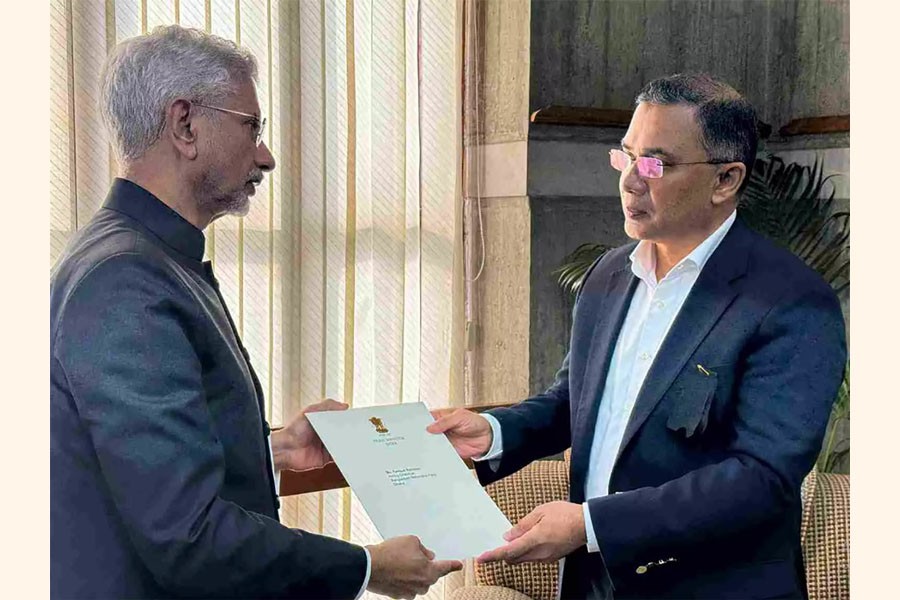
 Indian foreign minister S Jaishankar met with acting chairman of BNP Tarique Rahman in Dhaka on Wednesday and handed over a letter of condolences from Indian PM Narendra Modi during his visit to attend the funeral of Begum Khaleda Zia —Agency Photo
 The condolence letter, penned and signed by Indian Prime Minister Narendra Modi and addressed to Tarique Rahman in tribute to Khaleda Zia upon her passing, has arrived in Bangladesh at a moment in history laden with meaning. On one hand, since it is couched in terms of a formal expression of sympathy and diplomatic courtesy, it is important to recognise that this letter has been received and interpreted in a manner that goes well beyond its initial expression of condolence. In a society that is liberating itself from decades of democratic oppression, nothing-not even expressions of condolence-is taken at its literal or immediate face value.
From an overt perspective, the letter strictly maintains diplomatic nicety by being a polite recognition of personal loss and a reminiscence of past engagements between the two nations, a mention of the significant role that Khaleda Zia has historically been instrumental in being the first woman Prime Minister in a patriarchal Bangladesh, and the supreme importance placed on the India and Bangladesh relationship. However, the reality of diplomatic nicety isn't a matter of abstract contextual realities, either, or of a situation in which the content isn't interpreted within the frameworks and layers of past experience. Coming out in today and in the emerging realities in modern-day Bangladesh, the implications and interpretation of the content continue to remain filtered through the spectre of the past sixteen years in the nation's history years characterised by the regression and degradation of democracy in the country and an unbalanced and very asymmetric relationship between the two nations vis-à-vis the regime in power in the last decade or so under the hegemony and dispensation of the incumbent Sheikh Hasina regime in the nation's government and politics.
A NATION'S AGONY, THE WORLD'S OBSERVATION: The funeral ceremony of Khaleda Zia was more than just a local ritual. The funeral ceremony took place in Dhaka and was attended by delegates from India, Pakistan, and other neighbouring nations, including Nepal, Sri Lanka, and Bhutan. The significance here is that there is now more than one lens through which Bangladesh's political transition will be viewed. That is, this transition will be observed by more than one regional regime without being filtered through any regime.
THE GODI MEDIA FACTOR IN INDIA: The mistrust surrounding the Bangladesh-India relations has been fuelled not only by the latter's role but also by the influence of certain parts of what has been described as the Godi media, which are known to be aligned with the ruling party's preferred ideology. In light of the occurrence of the 36 July Revolution, these media largely stated that popular uprisings took place as a disturbance against democratic rectification, further claiming that this Interim Government was precarious, illegitimate, or controlled from elsewhere, as they questioned reform ideology, instead advocating that it is better to see a comeback of Hasina, Awami League.
THE BURDEN OF RECENT HISTORY: Public opinion in Bangladesh today is more than discontent with a collapsed regime; rather, there appears to be a level of collective accountability with external enablement. A generally accepted presumption is that one-sided bilateral understandings, energy or infrastructure schemes deemed to favour India, or simply the proliferation of the Research & Analysis Wing (RAW) within the Bangladeshi state apparatus, challenge sovereignty, Bangladeshi style. What is less important than empirical verification of these specific assertions is that, often, political perception rather than political refutation prevails.
Against this background, condolences note can well be perceived as a signal. The mention of "ideals" being continued in the form of Khaleda Zia, as well as the efforts aimed at increasing the partnership between India and Bangladesh, have led to a situation where the people are worried about the future, which may see the continuation of past imbalances of power, thus delegitimising the government in the moral sense.
ZIA & THE ASSERTION OF SOVEREIGN DIGNITY: The tradition of resisting Indian hegemony in the new Bangladesh traces the most definitive and principled roots to the foreign policy agenda defined by the leadership of Ziaur Rahman, which rested on the bedrock of an equality- and realism-defined doctrine of sovereignty and self-respect. By repudiating the alternatives of submissiveness and confrontation, Zia defined a stance of sovereignty that was not necessarily dramatic in its implementation and could thus be practiced by the country in the currency of clarity, firmness, and pragmatic waiting. This was best illustrated by the Farakka Barrage dispute. When the upstream diversion of the Ganges was a reality that threatened the very existence of the Bangladesh ecosystem and the nation's riverine economy, Zia raised voice at all levels---national, regional and international--- arguing strongly that the sharing of common rivers was a matter of right rather than favour. Likewise, with respect to the claim over the Talpatti Island, his firm assertion of the claim was to resist the dilution of the sovereignty of the nation with respect to the geographical reality of the problem.
In fact, Ziaur Rahman knew too well that bilateral asymmetry could never be made good by bilateralism. Only bilateralism itself could recreate asymmetry, and therefore, by suggesting the creation of the South Asian Association for Regional Cooperation (SAARC), Ziaur Rahman had the deep-seated ambition to incorporate the interests of Bangladesh into a larger regional order, which could ensure, through dialogue and multilateral negotiations, the reduction of imbalances of power within South Asia.
Through the expansion of diplomatic relations and incorporation of sovereignty into statecraft, Ziaur Rahman constructed a politics of grammar by which the state of Bangladesh treated the Indian state symmetrically as a peer, rather than a rim land to be overlooked. This grammar of politics has shaped Bangladesh's national politics to date. At times of national introspection, the politics of Zia served as a standard against which politics is assessed not by rhetoric, but by the ability to maintain national honour without compromising regional security.
KHALEDA & THE DEMOCRATIC RESISTANCE TO FOREIGN INTERVENTION: Khaleda Zia espoused this tradition of state-led defiance, especially in the domain of democracy. While Khaleda Zia's opposition to the hegemony of the Indian state lacked the theatrics, it showed greater longevity. She always cautioned against foreign interference in the election process in Bangladesh and obstructed the consolidation of the one-party norm in the name of greater stability when the Indians were patronising the election outcome in favour of Sheikh Hasina. Her struggle was extremely costly for her personally, with her being marginalised from politics, incarcerated, and constantly vilified, yet her status as a beacon of defiance for democracy was solidified. In popular memory, she will not only be remembered for her association with being a former prime minister but for a leader who emphasised that Bangladesh's democracy was responsible not to regional dynamics but to its people.
TARIQUE & THE POLITICS OF EXPECTATION: For the Bangladesh Nationalist Party (BNP), this moment is both an opening and a test. Tarique Rahman is being evaluated less on inherited legacy than on anticipated choices. The electorate's expectations are shaped not by diplomatic courtesies he receives, but by the red lines he refuses to cross. The message from the street is unequivocal: voters may forget political rhetoric, but they will not forgive a return to perceived subservience, opaque agreements, or silence in the face of external overreach.
DIPLOMATIC ETIQUETTE & DEMOCRATIC MEMORY: Diplomacy, however, cannot be limited to mere suspicions. The letter of condolences can be seen as an instrument of statecraft, and a random rejection will have implications for the maturity of Bangladesh's diplomacy. Khaleda Zia herself demonstrated such balance by maintaining her relationship with India while ensuring autonomy.
The varied participation of South Asian countries at her burial cements this truth. Living together respectfully as neighbours does not demand shared ideologies. Bangladesh's future is not based on isolation, but rather on rebalanced international relations, where all countries, including India, will be treated with respect, rather than reverence.
THE MESSAGE BENEATH THE MESSAGE: After all, Modi's letter says as much about Bangladesh as it does about India. It says a great deal about a society that is no longer interested in outsourcing its democratic conscience and people who have learned from experience that stability without accountability is a temporary mirage. Khaleda Zia's death has brought the nation together not in memory but in determination. Her funeral was the mirror in which South Asia today witnessed the return of Bangladesh's moral voice-and any political actor, foreign or domestic, who fails to grasp the times' implications gets left on the wrong side of history. In today's Bangladesh, sympathy is appreciated, but sovereignty and the integrity of democracy are not for negotiation.
Dr Serajul I Bhuiyan is a Professor of Journalism and Mass Communications at Savannah State University, Georgia, USA.
sibhuiyan@yahoo.com
© 2026 - All Rights with The Financial Express

