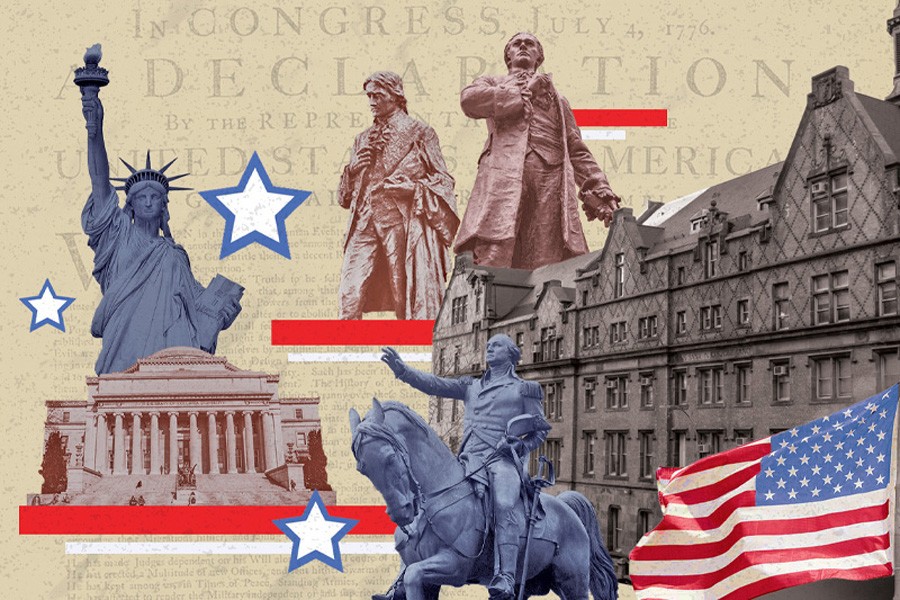
The United States marked its semiquincentennial on July 4, 2026, exactly 250 years after the adoption of the Declaration of Independence in 1776.
Before independence, Britain controlled more than 20 colonies in North America, stretching from present-day Canada to the Caribbean. Britain heavily taxed the colonies to fund wars against France and indigenous nations, while also restricting westward expansion and overturning local laws. American colonists sought independence largely because they faced taxation without political representation, strict military control, and the erosion of local self-government. After the costly French and Indian War, Britain faced enormous debt, and Parliament sought to recover those costs by imposing direct taxes on the colonies without giving them a voice or vote in London.
As the United States marks 250 years of independence, democracy stands out as one of the Revolution's most important legacies. Understood not only as a system of government but also, as Alexis de Tocqueville suggested, as a broader "social state," democracy was both a cause and a consequence of the struggle for independence. The American Revolution helped release a democratic spirit that shaped the nation and influenced the wider world, making democracy a natural starting point for assessing the legacy of America's founding.
The U.S. Constitution was built on foundational paradoxes. Its most glaring tension was the universal promise of liberty alongside the legal protection of slavery at the founding. Other structural conflicts included the struggle between states' rights and federal supremacy, and the challenge of reconciling majority rule with the protection of minority rights. The Declaration's claim that "all men are created equal" and endowed with "unalienable Rights," including "Life, Liberty and the pursuit of Happiness," was, at the time, at best an aspiration.
The Declaration has been described as one of the most influential documents ever signed, but it has also been criticised as tokenistic, compromising, and the product of committee drafting. The political economist Jeremy Bentham dismissed it as a "hodgepodge of confusion and absurdity in which the thing to be proved is all along taken for granted." Legally and constitutionally, the United States is a secular nation: it has no state religion, and the First Amendment prohibits the establishment of one. Yet President Donald Trump has worked to strengthen ties between government and religion, particularly Christianity.
Drafted chiefly by the lawyer, philosopher, and statesman Thomas Jefferson, the Declaration of Independence announced the United States as an independent nation in 1776 and rejected British colonial rule. Yet the contradictions embedded in its promises would later contribute to the Civil War and the long struggle for civil rights.
Although it was not the first declaration of its kind, it became the most famous. As American independence turns 250, the Declaration remains under global scrutiny as one of the most complex and contradictory acts of nation-building in modern history. Its ideals have still not been fully realised: nearly a century passed before Black men gained the right to vote, 144 years before women did, and 172 years before Native Americans were granted the same right.
Yet celebrations of the nation's founding are often shadowed by criticism that the founders ignored, tolerated, or upheld slavery, making the Declaration's claims about human equality and liberty difficult to accept as fully sincere. Lincoln recognised this contradiction, noting that some of the Declaration's signers, including its principal author, failed to live up to the ideals they proclaimed.
Benjamin Franklin saw the U.S. Constitution as an imperfect but necessary compromise. Although he had reservations about some of its provisions, he supported ratification, believing its success would depend on wise leadership and the vigilance of the American people. When asked outside Independence Hall what form of government the convention had created, Franklin famously replied, "A republic, if you can keep it." He understood the Constitution not as a self-sustaining mechanism, but as a fragile framework dependent on civic virtue.
The concentration of executive power, expansion of the national security state, and restrictions on civil liberties in the name of security have repeatedly eroded public trust and tested constitutional checks and balances. Yet these tensions are not merely structural flaws; they have also produced political resilience by compelling Americans to debate, reinterpret, and contest the meaning of the nation's founding principles.
The founding generation fought not only for independence, but also to secure America's place among nations. They understood that survival required engagement with the power politics of Europe. In doing so, the founding established enduring patterns in American foreign policy, some of which continue to shape how the United States understands its role in world affairs.
Born from rebellion against an overseas monarchy, the United States initially imagined itself as an anti-imperial republic. Its early political order was shaped by ideals of liberty, popular sovereignty, and self-determination. Yet this democratic vision developed alongside territorial conquest and the displacement of indigenous peoples, exposing an early conflict between America's democratic rhetoric and its imperial actions.
This contradiction became especially visible during the Spanish-American War. After the United States acquired territories such as the Philippines, Puerto Rico, and Guam, Americans fiercely debated the morality of empire. The Anti-Imperialist League argued that governing people without their consent violated the central principles of the Declaration of Independence and the U.S. Constitution.
In the 20th and 21st centuries, U.S. global dominance was often framed as a moral mission to defend and spread democracy abroad, based on the belief that international security depended on democratic expansion. Yet this mission was frequently pursued through gunboat diplomacy, economic pressure, and military intervention, creating what critics call "democratic imperialism" in modern foreign policy. Earlier patterns of westward expansion and the frontier thesis also shaped American democracy and commercial growth.
The relationship between American democracy and imperialism remains one of history's most enduring paradoxes. From its founding as an anti-colonial republic to its emergence as a global hegemon, the United States has repeatedly confronted the contradiction between self-government at home and the projection of power abroad. In the late 19th century, American expansion shifted quickly from continental growth to overseas colonialism, driven by the search for new markets and the desire to project military strength. These tensions reveal deep theoretical and structural conflicts woven into the fabric of the republic.
While emphasising the U.S. role in defending "our shared values, our liberty, and our democracy," a former British ambassador to the United States argues that America has always been "transactional" in its alliances. In this view, the United States has partnered with Britain because Britain remains a vital trade, investment, and technology partner.
Federal celebrations are being led mainly by the non-partisan America 250 Commission and the White House-established Freedom 250 initiative. However, the anniversary has also been overshadowed by disputes over whether the festivities have become too closely associated with Trump personally, rather than serving as a bipartisan national commemoration.
As part of the White House-backed Freedom 250 celebrations, billed as the biggest birthday party in American history, U.S. President Donald Trump spoke at Mount Rushmore to mark the 250th anniversary of the Declaration of Independence. Beneath the granite likenesses of George Washington, Thomas Jefferson, Abraham Lincoln, and Theodore Roosevelt, he addressed the nation at an event featuring military tributes, flyovers, and fireworks. Trump reflected on 250 years of American history, outlined his vision for the country's future, and made the July 4 celebrations central to his self-fashioned mythology.
In his 30-minute speech, Trump called the United States "the most successful, most accomplished, most exceptional nation ever to exist in human history" and said that "no country has done more good for this world."He framed patriotism as a duty to defend America's identity from "mortal threats," including what he described as a renewed communist menace. Comparing communism to the challenges of the world wars and 9/11, Trump argued that Americans must reclaim the country's identity, saying, "You do not have to be born here, but you do have to love what we have built. You must love our country."
Trump's claims of national greatness stand in sharp contrast to ongoing disputes over voting rights, ballot access, and widening economic inequality. These domestic strains point to a deeper contradiction in American democracy: while the United States has often cast itself as a defender of freedom abroad, it has struggled to protect democratic participation at home. The same tension also runs through U.S. foreign policy, where appeals to democracy have frequently been paired with coercive tools such as gunboat diplomacy, economic pressure, and military intervention. This contradiction is not confined to rhetoric. Critics often argue that overseas empire weakens democratic institutions at home.
The United States has a long, well-documented record of undermining foreign democracies through covert intervention, even while experiencing democratic backsliding at home in the 21st century. It has repeatedly interfered in other countries' political systems and, at times, helped remove democratically elected leaders to advance geopolitical or corporate interests. Iran in 1953, Guatemala in 1954, and Chile in 1973 remain among the most prominent examples, showing how the language of freedom has often coexisted with the practice of domination.
This pattern of domination has resurfaced in Trump's foreign policy doctrine, which appears to echo Oderintdummetuant-"let them hate, so long as they fear"-a phras eoften attributed to the Roman emperor Caligula. Trump seems to assume that U.S. power allows America to bypass allies and pressure other countries into compliance. Yet this coercive approach reflects a wider pattern of imperial overreach: the belief that military and economic pressure can compel obedience without lasting consequences.
Iran's war with the United States in 2026 became a revealing test of that assumption. Historians often understand America's imperial decline as a relative loss of global hegemony, marked by political instability, unsustainable debt, foreign overreach, and deep domestic polarisation. Often compared with the decline of the Roman and British empires, this process is defined by military overextension and growing internal division. Iran's resistance and retaliation during the 2026 war accelerated this decline by undermining the image of American invincibility and weakening U.S. strategic and economic leverage. Rather than forcing swift capitulation, the conflict exposed systemic vulnerabilities within the U.S. imperial project. In this sense, Iran emerged as a major catalyst of American imperial decline by revealing the limits of U.S. hard power and straining its regional alliances.
muhammad.mahmood47@gmail.com
© 2026 - All Rights with The Financial Express

