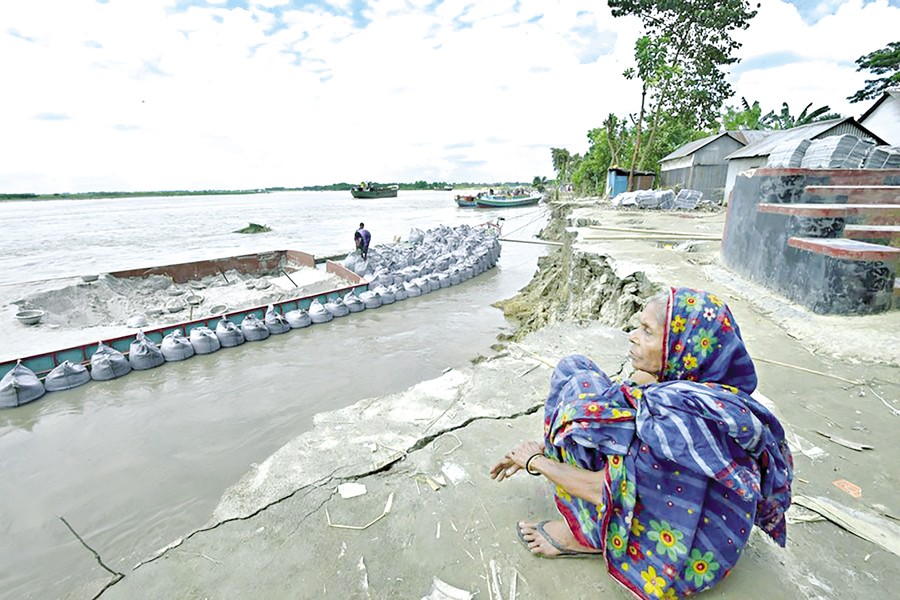
 An elderly woman sits on the eroded river bank in Munshiganj district, Bangladesh, September 19, 2022 - Xinhua Photo
 Bangladesh is often celebrated as a global leader in climate adaptation. From its cyclone preparedness programmes to community-based resilience strategies, the country has built an international reputation for confronting one of the gravest existential challenges of our time. Yet beneath this celebrated story of resilience lies another far less discussed crisis: the deepening link between climate change and gender-based violence (GBV). While the impacts of rising seas, intensifying storms, and devastating floods are widely acknowledged, what often remains invisible is how these disasters create fertile ground for the escalation of violence against women and girls.
The evidence is mounting and impossible to ignore. A recent study by the BRAC Institute of Governance and Development (BIGD, 2023) found that 78 per cent of women in climate-vulnerable districts of Bangladesh reported heightened risks of GBV during disasters. These include domestic violence, sexual harassment, exploitation, trafficking, and forced marriage. The numbers only grow more alarming when disasters strike. During Cyclone Amphan in 2020, reports of violence against women surged by 65 per cent, according to research cited by The Daily Star (2024). Floods tell a similar story, with 71 per cent of women saying they experienced greater abuse during and after such events, as documented by the United Nations in Bangladesh (UN Bangladesh, 2024). These figures are not abstract statistics—they represent real lives, communities fractured, and dignity lost in the shadow of natural calamities.
Climate-induced disasters heighten vulnerabilities at every stage. Before disasters, structural poverty and gender inequalities already place women and girls at risk. When cyclones, floods, or riverbank erosions hit, these risks multiply. Shelters, intended as safe havens, often lack basic privacy and security. Overcrowding, absence of separate facilities, and poor lighting make women targets for harassment and assault. Reports from displaced communities after Cyclone Amphan highlight how women feared using toilets at night or seeking relief materials without a male companion.
Economic distress during disasters further fuels social practices that perpetuate violence. Families struggling with food insecurity and income loss often resort to marrying off daughters early, both as a coping strategy and as a way to reduce household burdens. Studies cited by UNFPA Bangladesh (2023) indicate a rise in child and early marriages following floods and cyclones, with dowry demands even adjusted downwards to expedite such unions. In coastal districts, adolescent girls are particularly vulnerable to trafficking, as displacement fractures community networks that typically provide some degree of protection.
Domestic violence also surges during disasters. Men facing unemployment, displacement, or loss of livelihood often channel their frustration into abuse within the household. Pathfinder International (2023) documents how domestic abuse escalates during climate emergencies, compounded by the lack of accessible reproductive health services and safe water. These absences strip women not only of health security but also of autonomy and dignity. What begins as a climate disaster morphs into a cascade of personal catastrophes for women and girls.
Bangladesh has invested heavily in climate adaptation. However, its climate governance frameworks remain essentially blind to the gendered nature of disaster impacts. The two cornerstone policies—the Bangladesh Climate Change Strategy and Action Plan (BCCSAP, 2009) and the Climate Change Trust Act (2010)—make only cursory references to gender. They fail to explicitly address how disasters aggravate GBV, trafficking, or child marriage.
A 2023 review by BIGD underscores this gap, warning that existing policies do not recognise GBV in the context of climate-induced displacement as an aggravated risk requiring targeted action. As a result, disaster management plans focus on infrastructure, relief, and rehabilitation, while ignoring the psychosocial and security needs of half the population. This omission is particularly glaring given that Bangladesh has, in other policy domains, shown willingness to legislate against gender violence—the Domestic Violence Act (2010) and the Prevention of Human Trafficking Act (2012) being notable examples. Yet these frameworks have not been integrated into climate and disaster strategies.
This disconnect is not merely academic. On the ground, the absence of legal and policy recognition translates into unprepared shelters, undertrained relief workers, and a lack of monitoring systems for GBV incidents during disasters. Relief efforts distribute food and medicine, but rarely menstrual hygiene supplies or confidential reporting systems. Law enforcement officers deployed in disaster zones often lack gender training, leaving women with little recourse when violence occurs.
Statistics, though alarming, cannot fully capture the lived realities of women on the frontlines of climate change. In Satkhira, a coastal district battered repeatedly by cyclones and tidal surges, women recount stories of choosing between dignity and survival. One widow described how she avoided cyclone shelters during Amphan because of fear of harassment, opting instead to endure the storm in her fragile hut. In flood-hit Sylhet, adolescent girls speak of being pulled out of school after families lost crops, married off quickly before they became “a burden.”
Trafficking networks exploit these vulnerabilities ruthlessly. Displaced women and girls are lured with promises of work in Dhaka or abroad, only to end up in exploitative labour or sex trafficking. UN Bangladesh (2024) notes that trafficking spikes sharply after major disasters when families are displaced en masse and protective community structures break down. These are not just stories of violence but of eroded futures, stolen childhoods, and broken communities.
Bangladesh is not alone in facing this crisis. Across climate-vulnerable countries, from the Philippines to Mozambique, evidence shows that climate disasters exacerbate GBV. The International Union for Conservation of Nature (IUCN, 2022) has documented how climate-induced migration and displacement globally fuel trafficking, forced marriage, and domestic violence. Yet Bangladesh, given its prominence in climate diplomacy and adaptation, is uniquely positioned to set a precedent. By mainstreaming GBV prevention into its climate strategies, Bangladesh could model an integrated approach that balances physical resilience with social protection.
What would such an approach look like? First, revising the BCCSAP and the Climate Change Trust Act to integrate gender-based violence explicitly is imperative. These revisions should recognise GBV, trafficking, and child marriage as aggravated risks during disasters and mandate protective measures.
Second, disaster shelters must adhere to minimum standards of safety and dignity. This includes separate facilities for women, secure lighting, privacy, and confidential reporting mechanisms. Relief distribution must consist of menstrual health and reproductive services alongside food and medicine.
Third, law enforcement and disaster management personnel need gender-sensitivity training to ensure that women feel safe reporting incidents of violence. Fast-tracked prosecution of GBV cases during disasters would send a strong signal of zero tolerance.
Fourth, climate finance—both domestic and international—must allocate specific funds for addressing GBV within adaptation programmes. Too often, donor funding for climate resilience prioritises embankments, renewable energy, or infrastructure while neglecting the social dimensions of resilience. Allocating resources to psychosocial support, community monitoring, and victim assistance is not ancillary but central to resilience.
Finally, the voices of women from climate-vulnerable communities must be central to policy-making. Too often, policies are drafted in Dhaka boardrooms without consulting those who bear the brunt of climate shocks. Empowering women’s organisations, especially in coastal and riverine districts, to shape and monitor climate strategies would ensure that resilience is grounded in lived realities rather than abstract frameworks.
The silence around GBV in the context of climate change is itself a form of violence. It reflects the normalisation of women’s suffering as collateral damage in disasters. Yet resilience without justice is a hollow promise. If Bangladesh is to remain a global leader in climate adaptation, it must confront the uncomfortable truth that climate change is not gender-neutral. 78 per cent of women report increased risks of GBV during disasters; violence spikes by 65 per cent during cyclones and by 71 per cent during floods (BIGD, 2023; UN Bangladesh, 2024).
These numbers should be treated as national alarms, not footnotes. They demand urgent policy reforms, robust implementation, and a rethinking of resilience itself. Protecting embankments and rebuilding homes after cyclones may safeguard physical survival, but unless women and girls are protected from violence, exploitation, and indignity, the very meaning of resilience collapses.
Bangladesh has the opportunity—and the responsibility—to lead on this front. In doing so, it would not only protect its most vulnerable citizens but also set a global precedent for integrating gender justice into climate governance. The climate crisis is already here; whether it becomes a catalyst for a more just society or a multiplier of violence depends on the choices made today.
Dr Matiur Rahman is a researcher and development professional.
matiurrahman588@gmail.com
© 2026 - All Rights with The Financial Express

