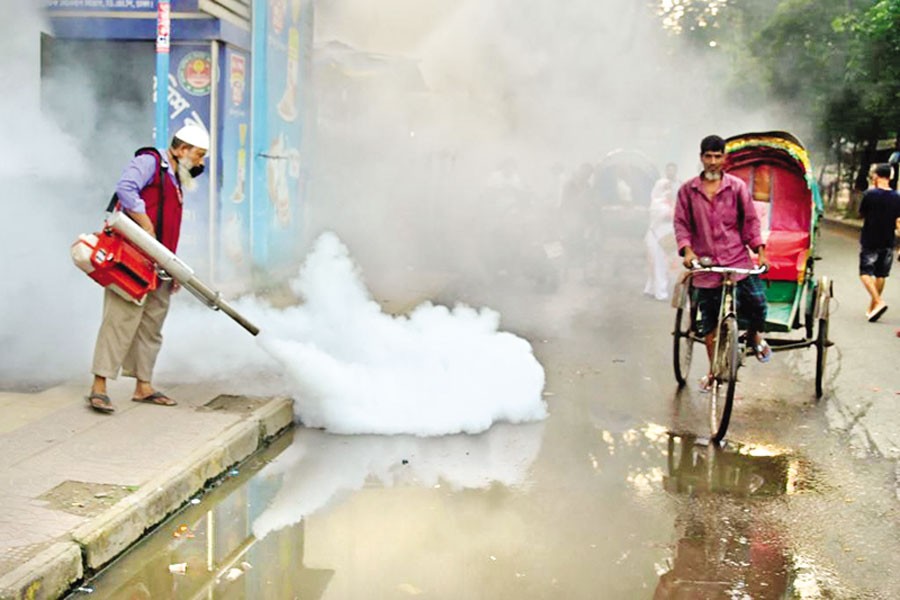
 A worker sprays anti-mosquito fog in an effort to contain the spread of dengue in Dhaka, Bangladesh, July 16, 2023 —Xinhua Photo
 Each monsoon, Bangladesh braces for floods. Yet, our most dangerous floods form in stagnant drains, discarded cups, or puddles behind slum dwellings, where the Aedes mosquito spreads dengue. In 2023, dengue killed 1,705 and infected more than 321,000-our deadliest epidemic. It should have been a turning point, but it has now become a baseline.
Dengue is not new to this country. First identified here in 1964, it has long been present, but its scale and lethality have sharply increased. In 2018, there were just over 10,000 cases; by 2023, that number had multiplied more than thirtyfold. Annual counts now swing wildly, often exceeding 100,000. More disturbing is the rise in the case-fatality ratio, from 0.16 in 2019 to 0.57 in 2024. Our people are now more likely to die from dengue than they were five years ago. This is not just a story of growing illness, but of a healthcare system outpaced by a threat it has not contained.
The geography of the disease is, in truth, a map of our own neglect. Dhaka, the densely packed heart of the nation, bears the heaviest burden-some 37,715 hospital admissions in the reference data. That is far more than any other division. This is no accident. Our capital has about 105,000 people per square mile. A third of them live in slums where sanitation is poor and standing water is abundant. The poorest cannot afford mosquito nets. Many have no room to hang one. Let no one imagine it is a disease of the poor alone. Even in affluent neighbourhoods, where homes are sealed behind fine metal mesh, the mosquito finds its way in. It breeds in the construction sites, ornamental lakes, and uncollected waste that surround prosperity. Dengue does not respect class boundaries. It exploits the failures we all share.
Chattogram, our commercial lifeline and the nation's trade gateway, tells the same story. In 2024, authorities were forced to declare seven major commercial zones as dengue 'red zones.' Nearby, the sprawling refugee settlement near Cox's Bazar is home to more than a million people. It has become a reservoir of infection, driving the division's numbers higher. Wherever we crowd people together without sanitation, drainage, or planning, the mosquito follows.
There is one lesson hidden in the data that deserves our close attention. Khulna, the third-largest city and an industrial hub, records markedly lower dengue incidence than its size suggests. The reason is instructive: rising salinity in its soil and water. Climate change near the Bay of Bengal has increased salinity, which is hostile to mosquito larvae. Nature, in other words, has done in Khulna what our municipal administrations have failed to do elsewhere. It is a reminder that the environment is destiny. Dengue thrives where our environmental management is weakest. We cannot engineer salinity into Dhaka, but we can engineer the elimination of standing water. We simply have not chosen to.
Dengue's human cost is worsened by financial ruin. There is no antiviral cure. Mild cases require rest and paracetamol; severe ones, hospitalisation, intravenous fluids, or blood transfusions. In Bangladesh, treatment costs around US$285-a possible month's income for a low-income family. Diagnostic tests alone account for much of the cost, especially at private hospitals. Our treatment remains costlier than in India or Pakistan. Dengue hits the vulnerable hardest and deepens their poverty.
None of this is a mystery to solve. The solution has been repeated by public health experts for years: eliminating stagnant water in drains, ditches, sewers, and construction sites; conducting regular, properly supervised pesticide spraying; investing in waste management;. And train the personnel and equip them. The obstacle has never been knowledge, it has been well-and accountability. The graffiti now appearing on the walls of Dhaka and Chattogram, demanding clean streets and mosquito control, is not vandalism. It is the voice of a citizenry that has run out of patience with municipal authorities who treat each outbreak as a fresh surprise rather than a foreseeable, preventable recurrence.
This must be a call not to a single ministry, but to all of us. To municipal corporations: sustained mosquito control is not a seasonal campaign launched in panic each July, but a year-round discipline. To urban planners: the unregulated construction and absent drainage that breed mosquitoes are choices. They can be unmade. To the health ministry: out-of-pocket costs that bankrupt families must be reduced through expanded public services. To climate policymakers: longer monsoons and warmer temperatures are extending the mosquito's reach. Adaptation can no longer wait. And to every citizen and housing committee: the cup of water on the balcony, the uncovered tank, the blocked gutter-these are within our own hands.
We know how to drain this flood. What we have lacked is the resolve to act before, not after, deaths are counted. The next monsoon is upon us. Let it not bring another record we mourn.
Dr. Syed Abu Hasnth is an academic and urban planner who writes on South Asian development, urban public health, and sociopolitical structures. shasnath@gmail.com.
Dr. M.G. Quibria is an economist and public policy commentator writing on trade, development, governance, and democratic change in Bangladesh and beyond. mgquibria.morgan@gmail.com
© 2026 - All Rights with The Financial Express

