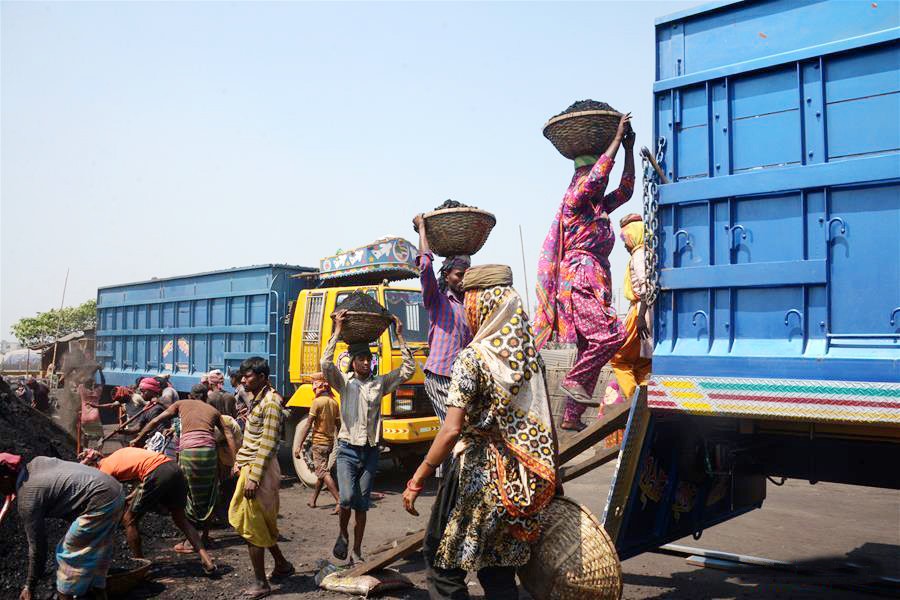
 Workers unload construction materials from a truck in Dhaka on March 8, 2019 —Xinhua File Photo
 Dubbed as a “bottomless basket” and a “test case for development”, Bangladesh has come a long way in its journey towards economic growth. Since independence in 1971, Bangladesh’s gross domestic product (GDP) has increased by about 77 times from less than US$ 6 billion to over US$ 460 billion, and its per capita GDPincreased by 30 times from less than US$ 90 to around US$ 2,700.
However, Bangladesh’s GDP growth rate has declined from around 6 per cent in FY 2023-24 to around 4 per cent in 2025 due to economic challenges. The economy is experiencing a slowdown, with growth in the industrial sector at less than 7 per cent and agricultural growth at less than 2 per cent in FY 2025.The services sector, accounting for more than one-half of GDP, registered a growth rate of less than 4 per cent in the first quarter of 2025-26, down from about 6 per cent in 2023-24.
DEVELOPMENT CHALLENGES: Notwithstanding impressive economic growth at the national level, there are several development challenges.
Macro-economic Challenges. Bangladesh’s economy currently faces significant macro-financial stresses (the banking sector faces high non-performing loans, issues with willful default culture, and weak governance), persistent and high inflation, weak tax revenue, and balance of payments (BOP) pressures.
Education. Considerable progress has been achieved in terms of numbers; however, there are major problems affecting the overall education sector. First, low pass rates and high dropout rates at different levels of schooling indicate huge system loss. Second, there is high percentage (around 40 per cent) in the ‘not in education, employment and training’ (NEET) category—higher in urban areas (58 per cent) than rural areas (42 per cent). Third, there are infrastructure deficits — insufficient classrooms and laboratory facilities. Fourth, the quality of education is poor at different levels. Fifth, the education sector has not been aligned with industry, resulting in a mismatch between skills supplied andskill demanded. Sixth, there is lack of adequate emphasis on STEM and technical and vocational education. Seventh, inadequate amounts are spent on education—only around 2 per cent of GDP compared to the UNESCO-recommended 6 per cent of GDP.
Health. Despite sharp reductions in child mortality and increase in life expectancy, there are serious problems in the health sector. First, there are human resources (HR) related issues such as staff vacancies at various levels, absenteeism, and lack of adequately trained staff. Second, there are shortages of essential services at different levels of service delivery. Third, there is a lack of effective monitoring and supervision. Fourth, there is a lack of effective coordination between Directorate General of Health Services (DGHS) and Directorate General of Family Planning (DGFP). Fifth, there is alack of effective coordination between the Ministry of Health and Family Welfare (MOHFW) and Ministry of Local Government & Cooperatives (MOLG&C), adversely affecting delivery of services in urban areas. Sixth, there is weak implementation capacity. Seventh, there is double burden of malnutrition—under-nutrition co-existing with obesity. Eighth, there is rising burden of non-communicable diseases (NCD), flu, and Nipah virus. Ninth, there is inadequate sanitation. Tenth, over the past decade, there has beenstagnant/rising fertility, and declining contraceptive prevalence rate (CPR). Eleventh,inadequate resources are spent on the health sector—only around 2 per cent of GDP compared to the WHO-recommended 4 per cent of GDP—not surprisingly therefore, there are very high out of pocket (OOP) expenses, considerably affecting the poor and the disadvantaged communities.
Employment. The labour market is male-dominated, with females accounting for only one-third of the total labour force. According to the 2024 Labour Survey, around three-fifthsof the employed population are in vulnerable employment (self-employed, plus unpaid family workers). Over four-fifths work in the informal sector, and it is higher among females (96 per cent) and in rural areas (88 per cent).
Although the relative share of agriculture to the GDP has been declining over time, the sector accounts for around two-fifths of the total employed population, followed by the services sector (38 per cent),and the industrial sector (only 17 per cent).
Between 2023 and 2024, employment declined by about 2 million at the national level, and by 1.6 million among females. There were factory closures and mass layoffs, with around 100,000 workers, mostly females. A major concern was the mismatch between the large number of graduates and limited entry-level positions.
Unemployment was 3.7 per cent, but it was higher among the relatively well educated—7 per cent among those who had completed higher secondary schooling and twice as high (about 14 per cent) among university graduates.
Youth (15-29 years) accounted for over one-third of the total labour force and the employed population.While the overall unemployment rate was 3.7 per cent, it was 9.7 per cent among those aged 15-24 years. Unemployment was especially acute among the youth, accounting for over three-quarters of the total unemployed population.
Bangladesh ended 2025 in a challenging labour market, with job losses,a significant decline in employment, anda slowdown in job creation, due to economic pressures and declining investment(from 32 per cent in 2021-22 to 29 per cent in 2024-25,and weak private investment declining from 24.5 per cent in 2021-22 to 22.4 in 2024-25).
Poverty. Poverty in Bangladesh saw a significant increase in 2024 and in 2025, with estimates from organisations like PPRC placing the overall rate at around 28 per cent, up from around 19 per cent in 2022, while extreme poverty rose to over 9 per cent.
The rise in poverty is due to three factors. First, there is high inflation (over 8 per cent in November 2025—quite high compared to neighboring countries—India, Pakistan, and. Sri Lanka). Second, there has been economic slowdown (weak investment, especially private investment; slower GDP growth; and reduced government development spending worsening employment). Third, climate disasters have been pushing millions into extreme poverty, especially among vulnerable groups (female-headed households and children). Rising chronic illnesses lead to higher household expenses and debt, thereby creating new vulnerabilities. Poverty increased in both rural and urban areas. Dhaka experienced sharper rises in extreme poverty, with therate nearly doubling from 2022 to 2024 according to some reports.Persistent inflationary pressure have pushed millions back below the poverty line. According to a recent UNDP report, over 40 million people live in extreme poverty. According to a recent UNICEF report, around 30 per cent of children live in multidimensional poverty, a much higher rate compared to adults.
Inequality. Inequality is a growing challenge, marked by widening income gaps (Gini coefficient rising from 0.458 in 2010 to 0.499 in 2022), with higher urban than rural inequality (Gini coefficients 0.54 compared to 0.45). Further, there are pronounced wealth disparity (with the top 10 per cent holding over 40 per cent of income, while the bottom 10 per cent only around 1 per cent); and deep-rooted social disparities in gender, education, health, and female-male access to job opportunities.This stems from afocus on growth over equitable distributionand uneven access to resources, resulting inuneven development.
Food Insecurity. Although total food grain production has nearly doubled in 25 years, Bangladesh imports considerable amounts of wheat and some rice, with a forecast of about 10 million tonnes of total cereal imports in 2025/26 to meet rising demand.
According to the Household Income and Expenditure Survey (HIES) 2022, around 21 per cent of the population experienced moderate or severe food insecurity nationally—higher in rural areas (22%) than in urban areas (18 per cent). High inflation, economic pressure, and climate shocks brought about food insecurity. It is more acute among female-headed households, with about two-thirds of them suffering from hunger.
Urbanisation. The urban population increased from less than 3 million in 1960 to around 70 million in 2023. It is projected to be over halfof the total population by 2050. The urban population is predominantly concentrated in Dhaka, followed by Chattogram. Search for better employment opportunities, better education, and improved living conditions led to rapid urbanisation. While boosting GDP, this rapid growth in urbanisation has led to severe challenges, including huge growth and expansion of slums;overcrowded and unhygienic living conditions; environmental degradation; and infrastructure deficit—insufficient housing, waterlogging, waste management issues, and traffic congestion, particularly in Dhaka. Rapid urbanisation has exacerbated poverty and income disparity.
Time for Urgent Action: Given the above development challenges facing Bangladesh, there is clearly need for urgent action. The newly elected government must give topmost priority to creating enabling environment in the country. That will, first, include, among others, ensuring good governance in all sectors. Second, there is the need torestore macroeconomic stability, bring financial discipline, and reduce inflation to the desired level. Third, the needed reforms in both the education and health sectors shouldbe brought about, including the much-awaited increase in public spending. Fourth, there is the need to re-build the fragile economy byincreasing overall investment (including private investment). Fifth, creation of adequate number of decent jobs in both the manufacturing and services sectors should receive high priority. Sixth, reduction in poverty and inequalities, and ensuring social protection for the disadvantaged communities should receive due consideration. Seventh, increasing food grain production andreducing food insecurity should receive adequate consideration. Finally, there is need to check unplanned urbanisation.
Barkat-e-Khuda, PhD is Former Professor and Chairman, Department of Economics, University of Dhaka, he also held senior positions in international organizations, including ICDDR, B.
barkatek@yahoo.com
© 2026 - All Rights with The Financial Express

